
Alpha Compute Corp Faces Capital Intensity and Going Concern Challenges in AI Compute Infrastructure
Recent quarterly disclosures highlight Alpha Compute’s operational struggles amid a capital-intensive AI compute and digital asset business.
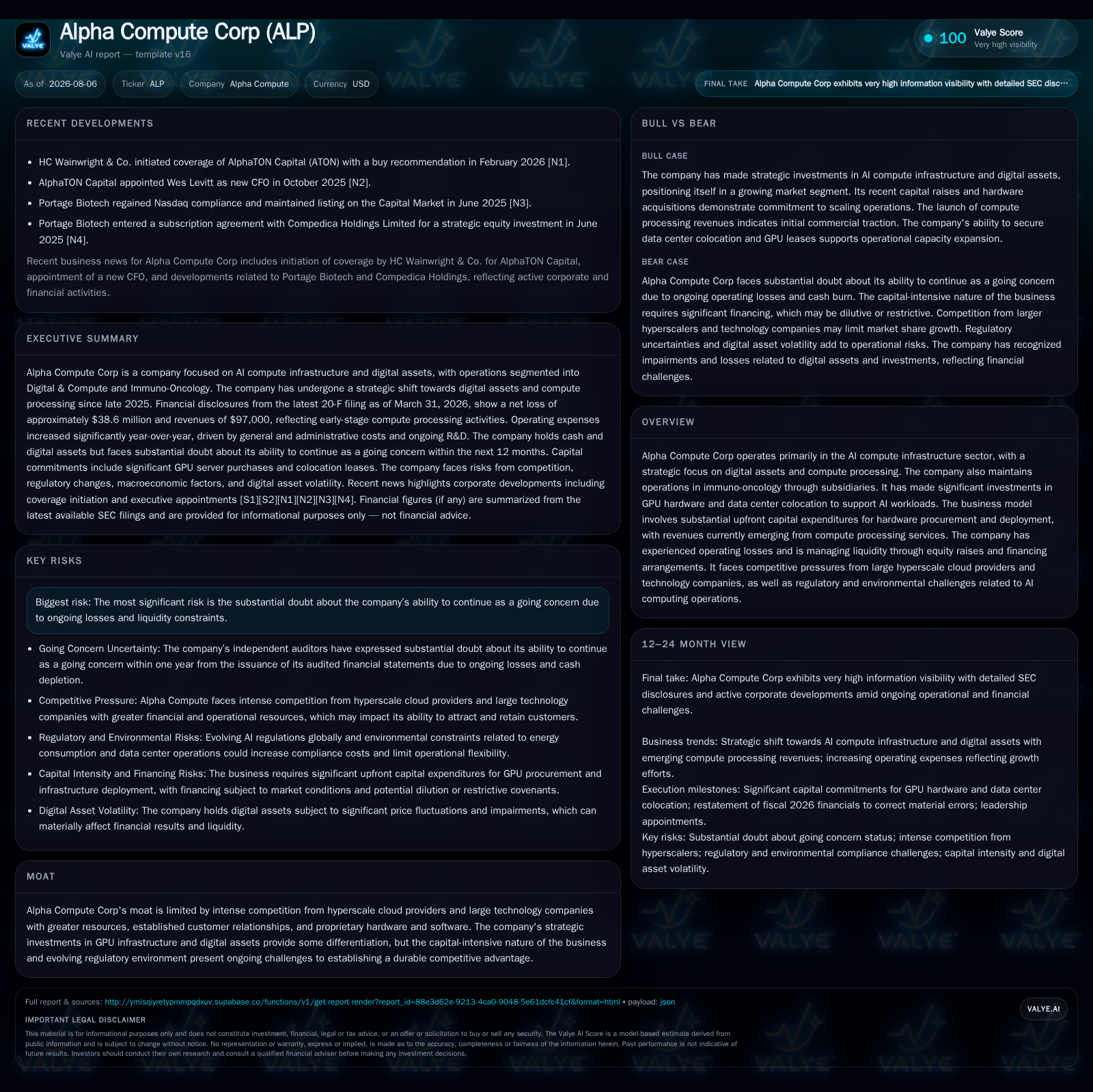
Alpha Compute Corp operates in the highly competitive AI compute infrastructure sector with a strategic focus on GPU hardware deployment and digital asset treasury management. Its latest quarterly filings reveal administrative restatements without impact on core operating losses, underscoring continued financial strain. The company’s business model depends heavily on upfront capital expenditures to build AI computing capacity, but ongoing operating losses and liquidity challenges raise substantial doubt about its ability to continue as a going concern. Competitive pressure from hyperscale cloud providers and regulatory uncertainties further constrain its growth prospects.
Latest Quarterly Update Highlights Operational Stability Amid Restatements
Alpha Compute Corp’s most recent Form 6-K filing dated August 6, 2026 discloses that the Audit Committee identified administrative errors in the audited consolidated financial statements for the fiscal year ended March 31, 2026. These errors mandated restatement of certain amounts and disclosures in the 2026 Annual Report filed on July 16, 2026 [S2]. Importantly, the restatement does not affect the core financial totals such as total revenue, costs and expenses, operating loss or net loss, nor does it alter cash flows or equity balances. This implies that while procedural accounting adjustments were necessary, the company's fundamental operating performance metrics remain unchanged and reflect ongoing challenges [S2].
The prior quarterly filing on July 28 provided an investor presentation aiming at ensuring equal investor access to updated strategic information but did not highlight new operational milestones [S3]. Therefore, the August update essentially confirms previously reported financial results with corrections that remove ambiguity about historical reporting accuracy.
Business Model Centered on Capital-Intensive AI Compute Infrastructure and Digital Assets
Alpha Compute primarily functions as an infrastructure provider in the burgeoning AI compute space. Its model involves acquiring and deploying large-scale GPU acceleration hardware within data center colocation facilities to support computationally demanding AI workloads. This requires heavy capital expenditures (CapEx) upfront to procure advanced GPUs and build out supporting data center capacity optimized for power usage effectiveness (PUE) [S1],.
Parallel to this compute infrastructure focus, Alpha also maintains a significant digital asset treasury managed as part of its financial strategy—holding blockchain-based assets whose valuation fluctuates with volatile cryptocurrency markets [S1],. Revenues currently emerging stem from compute processing services where customers pay for access or usage of computing capacity tailored for AI applications.
This dual focus creates revenue opportunities but also introduces complexity: revenues depend not only on compute customer demand but also on digital asset market conditions that influence earnings volatility. The monetization mechanics suggest usage-based or subscription-style billing for compute services combined with gains or losses recorded from digital asset portfolio revaluations.
Industry Structure and Competitive Positioning Limit Moat Durability
The AI compute infrastructure sector is dominated by hyperscale cloud providers such as AWS, Microsoft Azure, and Google Cloud that command industry-leading scale, proprietary hardware-software integration capabilities, long-term enterprise contracts, and extensive global data center networks. These factors erect high barriers to entry for smaller players like Alpha Compute who lack comparable resource access and end-customer reach.
Alpha’s somewhat differentiated approach includes targeted investments in GPU clusters supporting specialized workloads alongside maintaining a digital asset treasury. However, this strategy still faces formidable competition that compresses potential pricing power and raises customer acquisition challenges while necessitating sustained high CapEx deployments.
Without significant scale or locked-in long-duration contracts visible in disclosures, Alpha appears exposed to competitive pressures typical of capital-intensive startup-stage infrastructure providers attempting to build market share against dominant hyperscalers.
Growth Drivers Rooted in Rising AI Workload Demand
Several structural growth drivers underpin Alpha's sector. First is the soaring demand for high-performance computing spurred by increasing adoption of complex AI models requiring massive GPU acceleration resources. Growth of generative AI applications further boosts compute intensity per user.
Second is the expansion of data center colocation services supporting distributed hybrid cloud models preferred by enterprises balancing on-premise security with cloud scalability.
Thirdly, advancing GPU technology cycles create recurring upgrade needs necessitating continuous CapEx investment but also offering avenues for differentiated performance offerings when newer architectures are deployed.
Finally, rising interest in blockchain technologies underpins demand for regulated digital asset management services integrated with compute capabilities.
Executing on these drivers demands that Alpha efficiently scale its hardware deployment rate while maintaining high compute capacity utilization—all crucial KPIs though the company has yet to disclose granular metrics like customer contract length or renewal rates which would better confirm traction.
Risks Reflect Severe Liquidity Constraints and Execution Challenges
Alpha faces prominent risks around liquidity given its extended history of operating losses with no path yet evident toward profitable operations [S1]. Its dependence on equity raises and occasional debt issuance highlights vulnerability if capital markets tighten or investor appetite fades. The audit firm’s going concern qualification warns explicitly about solvency doubts due to persistent cash burn and funding requirements [S1].
Operationally, the rapid obsolescence risk inherent in GPU hardware forces frequent reinvestment cycles amid volatile product lifecycles. Supply chain disruptions for semiconductors add uncertainty to planned deployments.
Regulatory headwinds form another risk vector. Increasing scrutiny over energy consumption from intensive computing operations imposes potential costs or restrictions in major jurisdictions. Likewise, regulatory volatility concerning digital asset custody and trading could impact the valuation sensitivity of its treasury holdings.
The competitive landscape remains daunting—hyperscale cloud providers continue leveraging vast resources and comprehensive ecosystems—with limited indications Alpha has established defensible switching costs or exclusive client relationships thus far.
What To Watch Next: Execution Milestones And Demand Signals
Future updates should be monitored for:
- Disclosure of updated KPIs such as compute capacity utilization rate improvements reflecting efficiency gains;
- Evidence of increased revenue per compute unit signaling enhanced pricing power or premium service adoption;
- Announcements regarding new long-term customer contracts or partnerships that may stabilize cash flow predictability;
- Progress towards measurable cost control lowering operating expense ratios relative to revenue growth;
- Capital expenditure run rate consistency aligned with committed hardware deployment plans;
- Updates on digital asset portfolio valuation trends evidencing reduced earnings volatility;
- Regulatory developments impacting operational compliance costs or asset management policies;
- Any changes in liquidity status including successful capital raises alleviating near-term going concern doubts [S1],[S2].
These factors combined will clarify whether Alpha Compute can transition its current investment phase into scalable operations amidst competitive pressures.
Integrating Immuno-Oncology Subsidiaries Adds Complexity But Limited Near-Term Impact
Alpha's ownership stakes in immuno-oncology subsidiaries represent diversification outside its core AI compute operations. However, these biotech investments appear immaterial for near-term revenues or cash flow compared to the primary capital-intensive infrastructure business [S1]. Impairment losses recorded indicate limited commercial progress so far within these units.
Thus while noteworthy from a corporate structure viewpoint, this segment presently contributes marginally to the overall operational profile nor offsets risks inherent in scaling AI compute services.
Financial Profile Discussion
The absence of anticipated near-term profitability combined with liquidity challenges renders operational continuity uncertain absent successful execution of capital raising plans or material commercial breakthroughs. Monitoring funding adequacy alongside operating ramp milestones remains paramount for assessing financial viability over coming quarters.
Disclaimer: This analysis is based solely on public filings provided by Alpha Compute Corp as of August 2026. It does not constitute investment advice or an endorsement of company prospects but aims to frame operational developments within industry context using verified data sources.
Disclaimer: This is research-only, informational analysis and not investment advice. It may include AI-generated interpretation and general industry context. Always verify important details using primary sources.

Comments