
CION Investment Corp Advances Capital Strategy with New Unsecured Notes Amid Middle-Market Credit Focus
CION Investment Corp’s recent debt issuance aligns with its portfolio concentration in middle-market credit and regulatory-driven capital management.
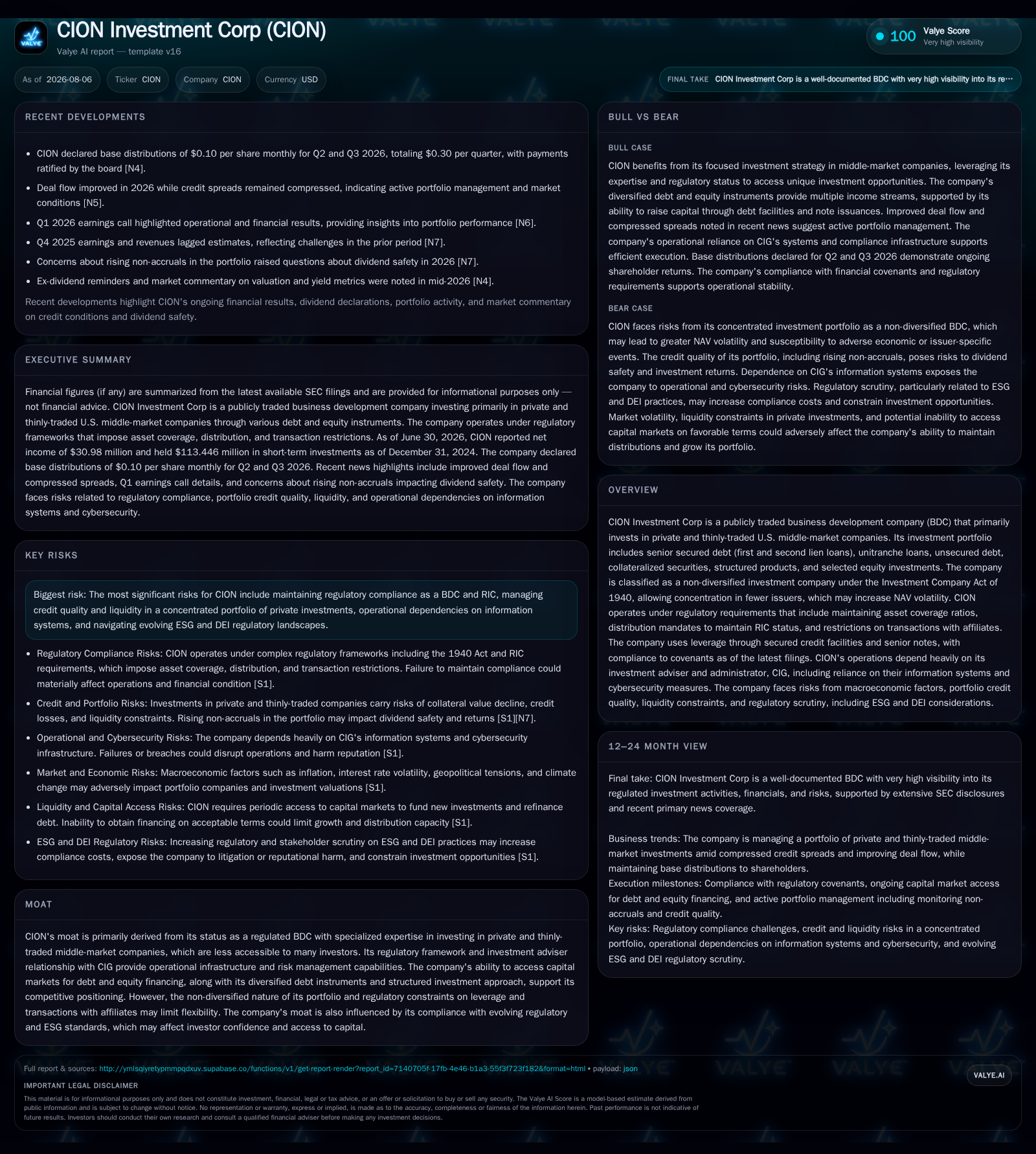
In its latest quarterly filing, CION Investment Corp detailed its ongoing capital management strategy, highlighted by the July 2026 issuance of $30 million in senior unsecured notes with fixed interest rates. Operating as a non-diversified business development company (BDC), CION specializes in private and thinly-traded middle-market debt instruments and strategically leverages debt to enhance returns within regulatory constraints. While the portfolio’s composition and concentrated nature heighten NAV volatility risks, CION’s access to capital markets and adherence to BDC-specific asset coverage ratios underpin operational continuity. Key risks include regulatory compliance, credit quality maintenance, and liquidity amid a complex investment environment. Monitoring asset coverage ratios, non-accruals, and leverage trends will be critical to assessing the firm’s execution of its growth and risk mitigation objectives.
Recent Operating Update: Capital Strategy Execution through Debt Issuance
CION Investment Corp’s most recent filing on August 6, 2026, underscores a deliberate capital management strategy highlighted by the issuance of senior unsecured notes totaling $30 million on July 15, 2026 [S3]. These notes comprise $2 million due 2029 at a fixed rate of 7.50% and $28 million due 2031 at an 8.00% coupon, with interest payable quarterly starting October 15, 2026 [S3]. The firm retains an option for partial early redemption without premium after June 2029 (for the 2029 Notes) and July 2027 (for the 2031 Notes). This transaction exemplifies CION's intent to optimize its balance sheet by increasing unsecured borrowings while aiming to repay certain existing indebtedness to reduce overall leverage [S3].
Business Model: Specialized Middle-Market Credit Investing in a Regulated Framework
As a publicly traded Business Development Company (BDC), CION channels primarily debt capital into U.S. private and thinly-traded middle-market companies [S1]. The firm selectively invests across various credit instruments including senior secured first and second lien loans, unitranche financing—which combines senior and subordinated tranches blended into one instrument—unsecured debt like mezzanine loans or subordinated bonds, collateralized securities such as CLOs and structured products, plus opportunistic equity stakes [S1][S14].
Revenue generation is chiefly driven by interest income on these debt instruments enhanced by leverage sourced from secured credit facilities and senior note issuances. CION distributes most of its taxable income as dividends to maintain regulated investment company (RIC) tax status under Subchapter M of the Internal Revenue Code [S1]. The business model involves deploying capital obtained via public equity offerings or debt issuances into illiquid private loans where traditional bank lending is limited.
However, the firm's classification as a non-diversified investment entity permits substantial concentration within fewer issuers—a practice that can augment returns but also magnifies net asset value (NAV) volatility as single borrowers' credit events disproportionately impact valuations [S1]. This necessitates robust portfolio monitoring and risk mitigation supported by CIG's investment adviser infrastructure that manages underwriting rigor, compliance with SEC regulations including those related to affiliate transactions under the Investment Company Act of 1940, and oversight of evolving ESG policy adherence [S1].
Industry Structure and Competitive Position
BDCs like CION occupy a niche intermediary role between capital markets investors seeking yield and middle-market companies underserved by mainstream bank lending due to size or trading liquidity constraints. Within this space, notable peers include Trinity Capital (TRIN), WhiteHorse Finance (WHF), and specialty finance firms such as SLR Investment (SLRC), all of which operate under similar regulatory frameworks but may differ on portfolio diversification policies or credit segments served.
CION's competitive moat stems from its expertise in structuring complex unitranche loans and managing credit-risk concentrations effectively within regulatory confines. Yet increased competition from other private credit funds offering alternative structures demands disciplined underwriting standards. Moreover, limitations on leverage—capped at a maximum ratio aligned with the reduced asset coverage requirement effective since December 2021—impose strategic tradeoffs between risk-taking capacity and distribution yield targets [S1][S18]
Additionally, regulatory scrutiny intensifies around ESG-related disclosures impacting investor confidence; CION’s compliance frameworks addressing climate-related financial risks reflect emerging market expectations that may differentiate operational resilience over time [S1][S27].
Growth Drivers: Capital Market Access Meets Private Credit Demand
The primary growth vector for CION derives from sustained demand for private credit solutions among middle-market borrowers seeking flexible financing beyond traditional bank shelves—an environment fostered by regulatory tightening on banks post-financial crisis. Favorable spreads persist between borrowing costs (~7.5%-8% on recent notes) versus yields achievable on middle-market loans that often incorporate covenants enhancing downside protections.
CION’s ability to tap both equity markets through share offerings (albeit constrained by selling price floors tied to NAV per share per the Investment Company Act) and debt markets via fixed income issuance enhances funding stability for new originations or refinancing transactions [S1][S3]. Innovation in structured products like unitranche financing additionally promotes differentiated pricing power.
Improvements in portfolio credit quality through rigorous underwriting further support growth potential by lowering non-accrual loan ratios—a key sector KPI—enabling sustainable distribution payout ratios consistent with RIC mandates while preserving NAV per share. Complementary operational enhancements via its investment adviser relationship also bolster efficiency in sourcing proprietary deal flow critical among middle-market lenders.
Risks, Watchpoints, and Constraints
CION faces several intrinsic challenges reflective of BDCs’ complex operating landscape. Regulatory compliance risk is paramount; failure to maintain asset coverage thresholds or preserve qualifying assets could jeopardize BDC status causing restrictive regulatory consequences that degrade flexibility and shareholder distributions [S1][S2]. Portfolio concentration risks amplify sensitivity to idiosyncratic borrower defaults or sector downturns exacerbating NAV swings especially given illiquid nature of underlying assets [S16][S25].
Credit risk persists with middle-market companies generally exhibiting less predictable cash flows compared to larger corporates; economic cycles could increase defaults elevating non-accrual ratios detectable through discrete reporting metrics. Interest rate fluctuations influence net investment income margins since rising funding costs may erode spread when variable-rate liabilities are weighted; however fixed-coupon notes issued mitigate near-term volatility albeit exposing reinvestment risk at maturity periods [S6][S3]. Lastly, evolving ESG regulations impose additional compliance costs alongside potential reputational effects impacting investor appeal over longer horizons [S27].
What To Watch Next
Investors should monitor subsequent filings for updated asset coverage ratios post-new note issuance reflecting potential deleveraging progress per management commentary on repayment strategies [S2][S3]. Key markers include net investment income trends vis-à-vis interest expense changes indicating margin preservation; shifts in non-accrual loan percentages signaling credit deterioration; changes in NAV per share capturing realized gains/losses from portfolio revaluations; dividend sustainability indicated through payouts relative to earnings; plus any amendments to financial covenants affecting leverage limits.
Further clarity on ESG policy implementation outcomes alongside possible capital market activity announcements such as follow-on equity raises or debt tender offers would also provide signals regarding balance sheet flexibility management aligned with growth aspirations.
Financial Profile Discussion
As of June 30, 2026, total debt outstanding stood at approximately $1.175 billion—all captured as net debt due to limited cash balances—reflecting stable use of leverage relative to prior periods [F1]. The recent senior note issuance adds unsecured long-duration liabilities supporting refinancing objectives aimed at reducing more expensive secured borrowings or maturing instruments while preserving an efficient cost-of-capital profile aligned with mid-to-high single-digit coupon rates prevailing across comparable BDC debt issuances [S3][F1].
In summary, CION maintains a disciplined approach balancing regulated leverage usage against growth investments chiefly focused on delivering consistent net investment income distributions while navigating portfolio concentration risks inherent in its focused middle-market private credit strategy.
This analysis relies strictly on publicly disclosed SEC filings up to August 6, 2026. It does not constitute investment advice or research views but aims to provide an informed perspective grounded in current operating realities.
Disclaimer: This is research-only, informational analysis and not investment advice. It may include AI-generated interpretation and general industry context. Always verify important details using primary sources.

Comments