
Cheniere Energy Strengthens LNG Capacity Amid Strategic Growth and Contract Flexibility
Q2 2026 filings reveal Cheniere’s disciplined liquefaction expansion and a balanced contract portfolio that supports cash flow stability amid LNG market volatility.
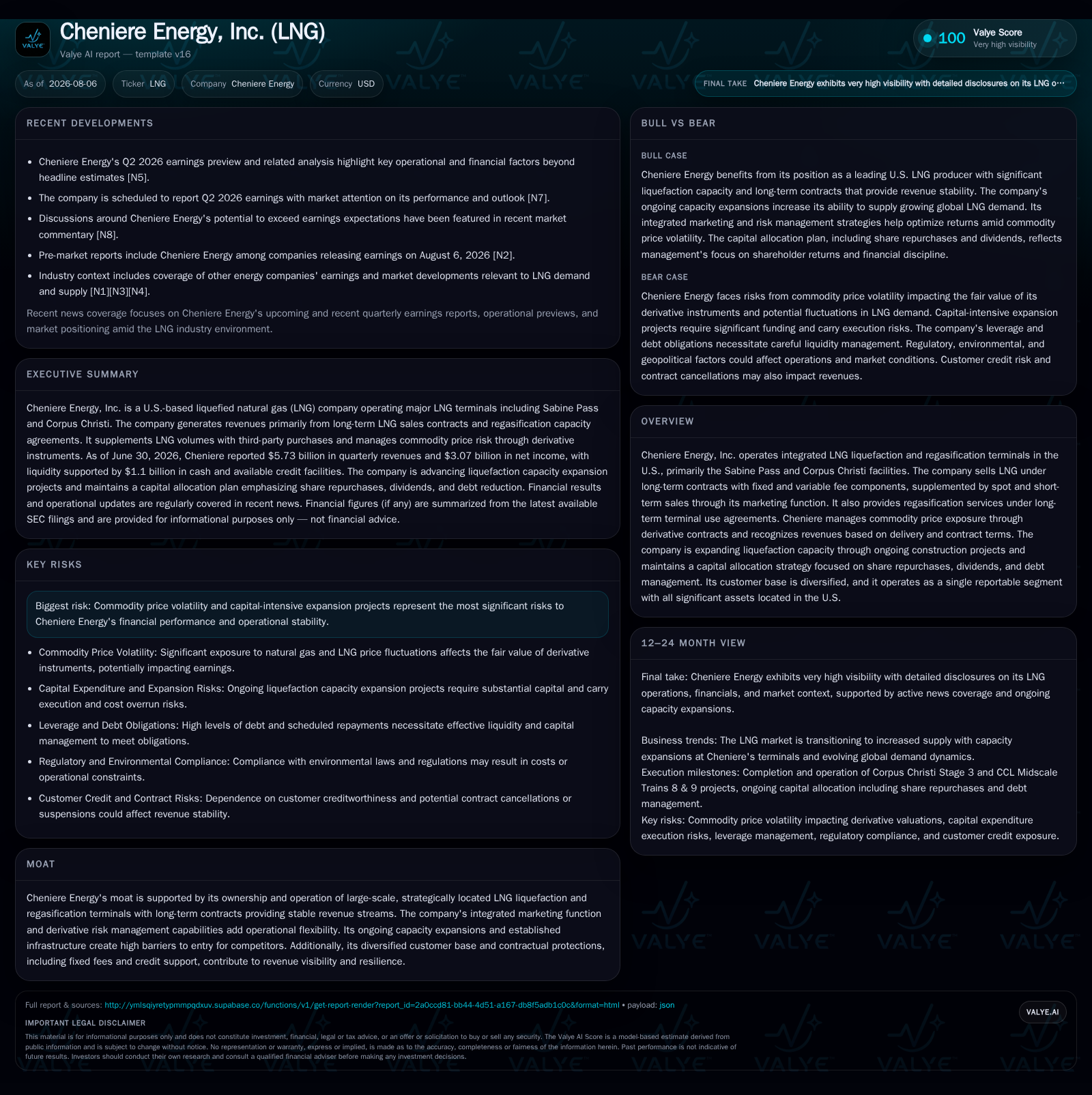
Cheniere Energy's latest quarter confirms continued progress on its liquefaction capacity buildout, bolstered by a diversified customer base and contracts combining fixed fees with variable exposure. The company’s integrated marketing and hedging practices help mitigate price volatility risks and capture margin opportunities from spot sales. Although capital-intensive expansions sustain substantial debt levels, Cheniere maintains operational resilience through contractual protections and ongoing regulatory compliance efforts.
Quarterly Operating Developments: Capacity Growth Meets Stable Contractual Revenue Streams
In its Q2 2026 filing dated August 6, Cheniere Energy reported continued operational momentum as liquefaction terminal utilization advanced due to both existing operations and incremental output from under-construction expansion projects at Sabine Pass (SPL) and Corpus Christi (CCL) [S2]. The company's integrated ownership of large-scale liquefaction assets cements steady revenue generation, supported by its stable contract portfolio. Notably, the filings indicate solid execution progress without material operational disruptions, reinforcing confidence in expanding capacity relevance during broad LNG demand growth [S3]. This steady performance consolidates cash flow visibility anchored by contracted volumes under long-term agreements.
Dissecting Cheniere’s Contract Mix: Fixed Fees Anchor Cash Flows, Variable Components Spur Upside Exposure
The company’s business model derives strength from a dual revenue stream within its long-term LNG sale contracts: a significant fixed fee component characterized by take-or-pay arrangements ensures baseline cash flows regardless of volume fluctuations, while variable fees tied to market spreads provide optional upside linked to commodity pricing conditions [S1]. This structure balances income stability with exposure to favorable market dynamics. Additionally, Cheniere secures credit support provisions enhancing contract enforceability against counterparty risk. The presence of terminal use agreements for regasification further diversifies revenue sources with similarly structured fee profiles. This blended contract approach imposes high renewal barriers for competitors given the capital intensity of infrastructure deployment combined with long-term customer commitments.
Operational Backbone: Liquefaction Utilization, Terminal Performance, and Marketing Activities
Operational KPIs such as liquefaction capacity utilization remain critical to Cheniere’s earnings quality. The recent filings note strong uptime rates across both Sabine Pass and Corpus Christi terminals [S2], ensuring that processing volumes approach contracted commitments. Beyond tolling services, the company’s integrated LNG marketing function actively manages cargo dispatches including spot market sales which complement the contracted portfolio by capturing incremental margins through flexible scheduling and cargo pricing optimization [S1][S2]. This marketing capability differentiates Cheniere from pure terminal operators and aligns with industry peers such as Venture Global LNG that pursue similar integration strategies. Although not explicitly quantified in the latest filings, fleet utilization supporting shipping logistics remains an ancillary but supportive margin lever.
Integrated Risk Mitigation: Commodity Price Hedging in a Volatile Market Environment
Given LNG’s commodity price volatility driven by geopolitical tensions, supply-demand imbalances, and alternative fuel competition, Cheniere employs derivative contracts extensively to hedge natural gas feedstock costs and protect margin integrity on variable fee components [S1]. The disclosures underscore that hedging is an integral part of risk management strategies to mitigate earnings swings caused by spot price fluctuations. While derivative instruments cannot eliminate all commodity exposure—particularly in spot sales—the combination of fixed fee contracts plus hedging program significantly reduces downside earnings variability compared to unhedged marketing peers. Continued monitoring of hedge effectiveness alongside spot market conditions will be essential for assessing realized margin stability.
Growth Trajectory: Capacity Expansion Projects and Balancing Capital Allocation Priorities
The capital profile of Cheniere’s midstream LNG business reflects sustained investment in new liquefaction trains under the SPL Expansion Project and Corpus Christi Stage 3 projects along with Midscale Trains 8 & 9 developments at CCL [S1][S2]. These initiatives require substantial capex outlays well beyond existing contractual obligations—given their scale but designed leveraging shared infrastructure assets that economize incremental costs. Importantly, in January 2026 acquisition of full ownership of the Gregory Power Plant near Corpus Christi enhances operational control but adds capital need for ongoing plant investments [S1]. Cheniere targets prudent capital allocation balancing growth funding alongside dividends distribution and disciplined debt management. Management’s ability to maintain financing flexibility will be critical to sustaining expansion without compromising credit quality.
Risks Around Commodity Volatility, Capital Intensity, and Regulatory Compliance Update
Cheniere remains exposed to commodity price cycles that directly impact margins particularly on variable fee-related revenues absent hedging coverage [S1]. Project execution risk tied to multi-billion-dollar construction efforts also bears scrutiny given historical LNG project complexity across peers like Sempra or Venture Global LNG. On regulatory fronts, the company reports resolution progress regarding air emission standards compliance at Sabine Pass combustion turbines where EPA and Louisiana Department of Environmental Quality approvals have been secured following remedial testing [S1]. This compliance track record lessens financial penalties risk though ongoing monitoring remains warranted given environmental regulation tightening trends globally.
What to Monitor Next: Contract Awards, Execution Milestones, Hedge Effectiveness, and Cash Flow Trends
Looking ahead, several milestones warrant attention as indicators of operational health and strategic execution. These include announcements of new long-term contract awards extending contracted volumes or improved credit terms; timely achievement of FID (Final Investment Decision) and construction benchmarks at SPL Expansion and CCL Midscale projects; updates on commodity pricing hedge portfolios maturing through 2026-27; as well as quarterly indicators of liquefaction capacity utilization trending toward steady-state levels post-expansion [S2][S3]. Additionally, free cash flow generation amid capital spend cycles will be a key financial KPI signaling return on invested capital progress.
Financial Profile Discussion: Liquidity Position, Debt Metrics, and CapEx Investment Context
As of June 30, 2026, companyfacts shows Cheniere held approximately $1.1 billion in cash and equivalents with current assets of $4.1 billion and current liabilities of $4.7 billion, implying a current ratio near 0.87—reflective of tight near-term liquidity typical for capital-intensive midstream enterprises undergoing expansion phases [F1]. Management continues to focus on prudent liquidity management and maintaining access to financing markets to balance growth ambitions with financial resilience.
This analysis synthesizes publicly available SEC filings through Q2 2026 along with broader sector context inherent in the LNG infrastructure industry where large-scale asset investment coexists with long-duration contracts designed to underpin cash flow stability amid volatile energy price environments. Peer references include Venture Global LNG and Sempra Energy among integrated terminal operators navigating similar capacity growth curves while deploying structured contracting strategies incorporating fixed fees supplemented by market-exposed variable components. Cheniere’s balance between contract flexibility enabled by its marketing function and rigorous commodity hedge programs positions it favorably but does not eliminate risks typical in this capital- and regulation-intensive sector.
This document is intended solely for informational purposes reflecting Valye News’ analyst insights based on sourced evidence; it does not constitute investment advice or research view.
Disclaimer: This is research-only, informational analysis and not investment advice. It may include AI-generated interpretation and general industry context. Always verify important details using primary sources.

Comments