
Shore Bancshares Sustains Profitability and Liquidity Strength in Regional Banking Landscape
Q2 2026 results highlight stable earnings, solid cash reserves, and ongoing regulatory compliance for Shore Bancshares.
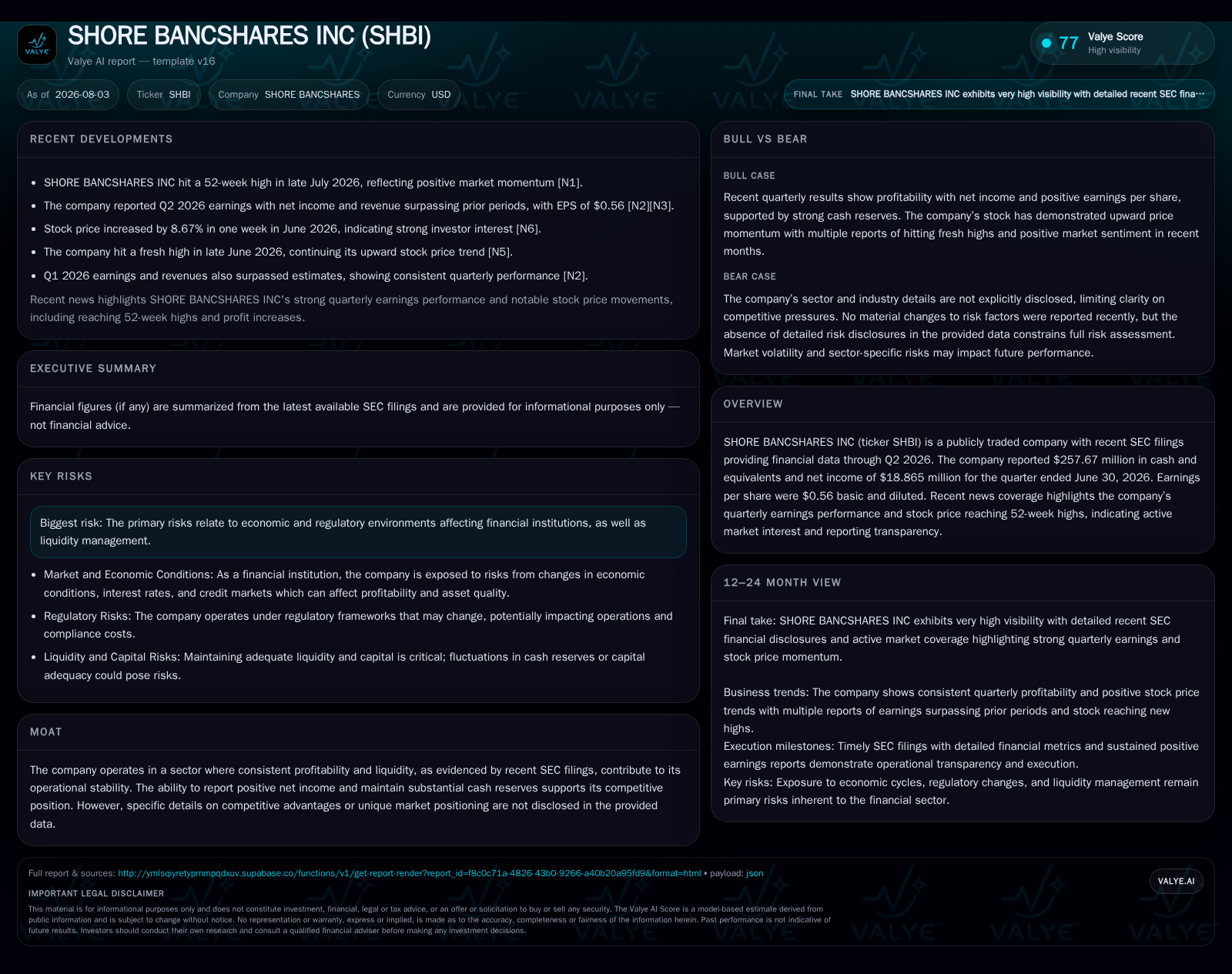
Shore Bancshares Inc. reported net income of $18.9 million with EPS of $0.56 in Q2 2026, supported by $257.7 million in cash and equivalents. The company’s sustained profitability alongside a strong liquidity position reinforces its operational stability typical of regional banks navigating interest rate and credit environments. Management changes and compliance updates reflect attention to governance amid evolving regulatory expectations. Monitoring loan growth, net interest margin trends, and capital ratios will be critical to track future performance.
Recent Operating Update
In its latest Q2 2026 filing dated August 3, Shore Bancshares Inc. reported net income of $18.865 million for the quarter ended June 30, reflecting an EPS (basic and diluted) of $0.56 [S2][F1]. This earnings performance surpassed market expectations as noted in contemporaneous coverage [N1][N2], indicating effective management of interest margins and credit components during a period often challenging for regional banks due to shifting interest rates.
Liquidity remains a key strength; the company held $257.67 million in cash and equivalents at quarter-end while maintaining total debt around $89.15 million [F1]. This resulted in a net debt position substantially negative by approximately $168.5 million, underscoring ample liquidity buffers that support lending capacity and operational resilience.
Corporate governance updates included the July resignation of Mr. Louis P. Jenkins Jr. from the Audit Committee following Nasdaq rules non-compliance related to legal expense payments made during his committee tenure [S26]. This proactive step ensured continued adherence to listing standards without material impact on operations or financial reporting trustworthiness.
Leadership continuity also advanced through the appointment of B. Scot Ebron as President of Shore United Bank, N.A., the bank’s wholly owned subsidiary [S27]. Ebron brings experience from prior industry roles consistent with the company’s community banking focus, suggesting strategic emphasis on local market penetration and operational execution.
Business Model Analysis
Shore Bancshares operates as a regional bank holding company primarily serving Maryland communities through Shore United Bank, N.A., offering consumer and commercial deposit products along with loan services including commercial real estate, consumer loans, and small business credit facilities [S1]. Revenue generation hinges on net interest income derived from interest rate spreads between loans issued to individuals/businesses and funding costs tied mainly to retail deposits complemented by wholesale borrowings.
Non-interest income streams encompass fees for account services, transaction processing, and ancillary financial products common among midsize community banks. Margins are sensitive to deposit beta — the rate at which deposit costs adjust relative to benchmark rates — as well as loan growth quality and provisioning for credit losses.
The business structure emphasizes efficient asset-liability management under regulatory oversight that mandates capital adequacy measured by tier 1 ratios and tangible common equity levels to safeguard solvency against credit or market disruptions.
Industry Structure and Competitive Position
Within the regional banking industry framework, Shore Bancshares operates among peers that share similar scale, geographic footprint, and customer concentration focused on community banking services [S1]. Its competitive positioning reflects moderate scale relative to larger national banks but benefits from local customer relationships fostering deposit stability.
Compared with peer groups in the Mid-Atlantic region, critical benchmarking points would include net interest margin dynamics under current rising rate environments, efficiency ratio trends reflecting cost discipline versus revenue generation, loan-to-deposit ratios pointing to capital deployment effectiveness, and non-performing asset ratios indicating credit quality maintenance.
The company’s ability to balance loan portfolio growth against prudent credit underwriting sustains its status within this competitive ecosystem where fintech entrants pose emerging challenges but have yet to significantly disrupt core deposit-lending relationships in Shore’s served markets.
Growth Drivers
Key growth avenues for Shore Bancshares involve expanding their loan book through targeted commercial lending segments that cater to local business development alongside steady consumer credit demand fueled by housing market activity within Maryland regions [S1]. Expanding core deposits remains imperative as it directly influences low-cost funding availability critical for net interest margin optimization.
Interest rate movements—while presenting margin compression risks—offer potential earn-back opportunities when thoughtfully managed given the asset sensitivity profile common among regional banks. Enhancing fee-based service offerings via digital platforms can augment non-interest income streams and improve customer retention metrics.
Leadership appointments signal a commitment to advancing operational efficiencies with a view toward sustainable growth anchored in community engagement rather than opportunistic geographic expansion or M&A activity at this stage.
Risks and Watchpoints
The risk landscape remains largely unchanged from prior disclosures; chief concerns include fluctuating interest rates affecting core net interest margin levels especially if deposit beta accelerates funding costs beyond repricing capabilities on assets [S2][S21]. Credit risk persists as a watchpoint due to potential economic downturns impacting borrower repayment capacity; however, no material deterioration was reported recently.
Regulatory compliance continues as a key focus area evidenced by governance adjustments ensuring Nasdaq audit standards adherence [S26]. Liquidity risk is mitigated presently by strong cash positions, though sustained monitoring is essential amid potential shifts in deposit behavior or wholesale funding markets.
Additionally, developments around regulatory landscape adjustments or competitive pressures from both traditional banks and fintech lenders targeting community banking clients could inform strategic adaptation needs.
Financial Profile Discussion
As of June 30, 2026, Shore Bancshares held $257.67 million in cash and equivalents against total debt estimated at $89.15 million resulting in a net cash-rich position important for absorbing funding shocks or supporting swift lending opportunities [F1]
This liquidity cushion combined with positive earnings yields suggests a conservative leverage posture typical within community bank models prioritizing balance sheet strength over aggressive expansion leverage.
No material changes were disclosed about risk factors or capital structure during Q2 2026 implying consistent regulatory compliance status maintained through this period [S2][S21]. The absence of notable debt refinancings or covenant pressures further supports operational stability as management balances growth ambitions with prudent capital stewardship.
This analysis is based solely on recently available SEC filings and associated publicly reported data without reliance on speculative assumptions or forward-looking statements not contained therein.
Disclaimer: This is research-only, informational analysis and not investment advice. It may include AI-generated interpretation and general industry context. Always verify important details using primary sources.

Comments