
Alexandria Real Estate Equities Leverages Innovation Cluster Dynamics Amid Growth Pipeline Challenges
Q2 2026 results highlight Alexandria’s operational resilience founded on tenant specialization and a sizable development portfolio, while signaling execution risks from ongoing litigation and macroeconomic impact.
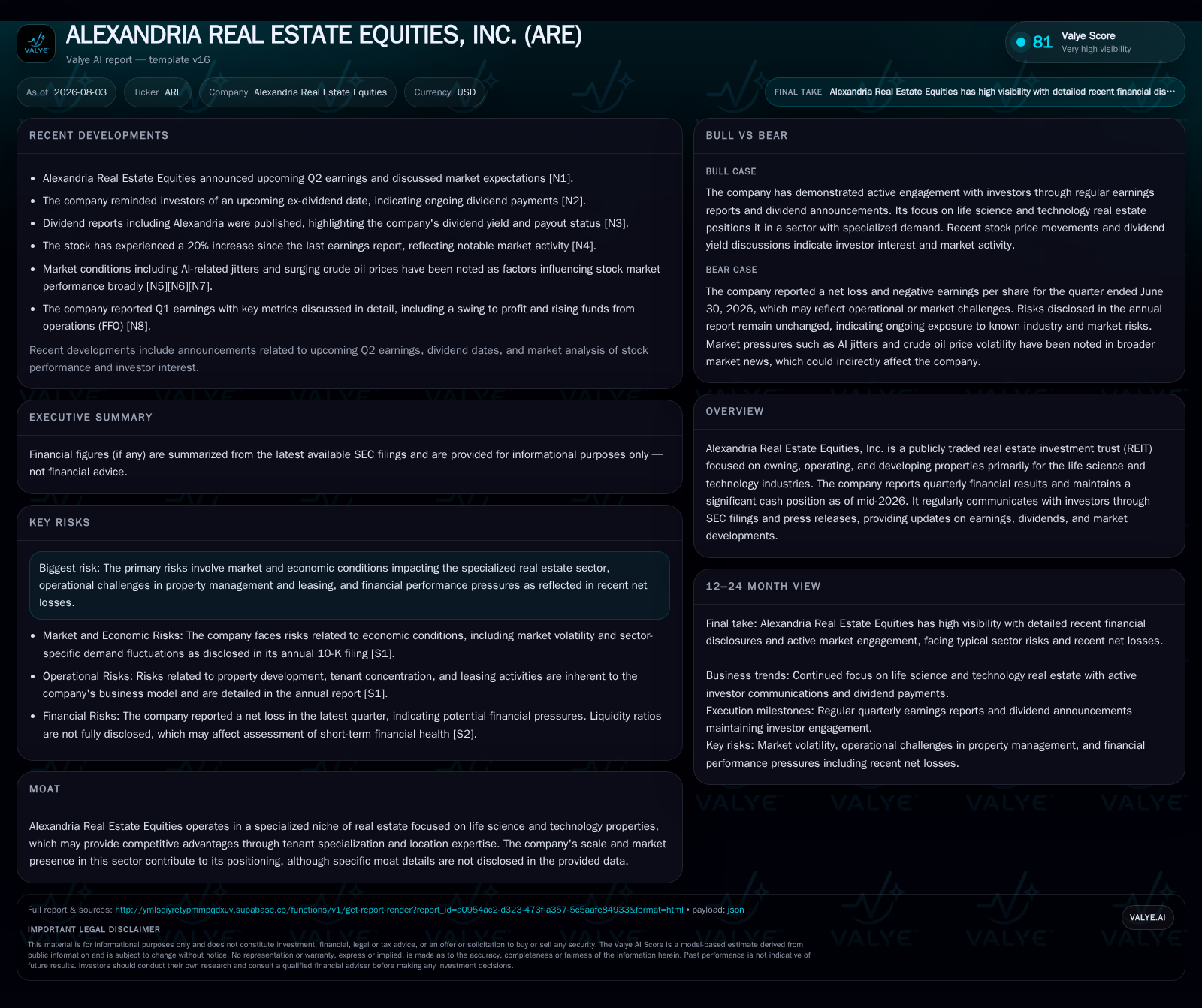
Alexandria Real Estate Equities’ second quarter 2026 filings confirm steady occupancy near 91% in its highly specialized life science property portfolio, sustaining rental revenue despite broader economic headwinds. The company’s sizeable development pipeline of approximately 3.5 million rentable square feet under construction underscores its growth strategy centered on innovation campuses but faces timing uncertainty due to legal disputes affecting a key New York City parcel. Tenant credit quality and long lease terms support revenue stability, although net operating income dipped modestly reflecting market pressures. Ongoing refinancing efforts aim to optimize capital costs amid interest rate volatility, with cash reserves nearing $470 million providing liquidity buffer. Key watchpoints include leasing momentum, development milestones, and risk management around tenant concentration and permit delays.
Q2 2026 Results Affirm Stability in Alexandria’s Niche Portfolio
through Q2 2026 corroborating operational stability during external headwinds [S2][S3]. The company's net income remains negative at around -$1.43 billion year-to-date through end-2025 driven by non-cash charges such as depreciation inherent in real estate accounting rather than cash flow deterioration [F1]. This underscores the importance of focusing on NOI and FFO rather than GAAP net income when assessing Alexandria's fundamental operating health.
Specialized Tenant Base Sustains Occupancy and Lease Terms
The cornerstone of Alexandria's operational model is leasing high-quality Class A/A+ commercial laboratory and office space tailored specifically to life science and technology companies clustered within innovation hubs or Megacampus ecosystems. These clusters promote tenant collaboration, recruitment efficiencies, and innovation synergies which translate into high tenant retention rates and long weighted-average lease expiration terms as reported in annual filings [S1]. Tenant composition spans multinational pharmaceuticals, biotech firms, digital health enterprises, academic research institutions, government agencies, medical device manufacturers, and select venture capital partners strategically invested in tenant growth trajectories. Approximately half of the rental revenue is backed by investment-grade or publicly traded tenants with solid credit profiles which dampens vacancy risk given longer lease durations with fewer renewals required annually relative to general commercial REITs [S1]. Lease term length diversity provides some cushioning against concentrated rollover risk while maintaining attractive pricing power supported by limited specialized supply.
Development Pipeline Extends Competitive Moat during Execution Risks
The company is actively engaged in developing approximately 3.5 million rentable square feet under construction as of late 2025–early 2026—a significant addition representing nearly 10% of current operating square footage—which is targeted primarily at expanding existing Megacampus ecosystems or establishing new state-of-the-art facilities meeting evolving tenant specifications for lab space density and collaboration [S1][S3]. This developmental focus is critical to sustaining growth given constrained availability of Class A/A+ lab properties nationwide arising from stringent zoning requirements, high build complexity, and limited candidate land parcels in premier clusters.
However, one key parcel adjacent to the New York City East River Science Park campus (the Option Parcel) currently faces delays tied to ongoing litigation against city economic development authorities over disputed floodwall obligations creating material uncertainty regarding construction start dates [S1]. The $178 million invested pre-development costs underscore the strategic value Alexandria assigns to this expansion but also flag execution risk that could depress near-term cash flow upside from this project until resolution. Overall capital expenditure efficiency depends heavily on timely permit approvals and controlled construction costs—a common sectorwide challenge exacerbated by inflationary pressures impacting wage rates and materials pricing.
Market Dynamics: Pricing Power and Supply Constraints in Life Science Space
Alexandria operates within a niche marked by robust demand drivers tied to expanding life science sectors fueled by sustained government funding for research initiatives, private venture capital injections into biotech startups, increasing digital health innovations necessitating lab infrastructure upgrades, and pharmaceutical R&D expansions spearheaded by large multinationals [S1][N1]. Geographic concentration in hubs such as Greater Boston, San Francisco Bay Area, San Diego, Seattle, Maryland Research Triangle Park, and New York City creates competitive advantages around cluster effects but also intense competition for prime land parcels.
Specialized laboratory spaces require substantially higher capital investment per square foot compared to traditional office real estate due to complex mechanical systems (e.g., humidity control, ventilation), contamination safeguards, enhanced electrical capacity needs for instrumentation, all governed by rigorous regulatory standards for product development environments. The economic viability of tenant companies is sensitive to funding cycles particularly for early-stage ventures reliant on capital markets or grants; downturns could depress leasing demand or trigger early departures increasing vacancy volatility.
Further risk arises from legal proceedings concerning the Option Parcel in New York City which may delay unlocking significant development value pending resolution; protracted disputes could also increase carrying costs or force plan adjustments with consequent impact on expected returns [S1]. Interest rate fluctuations represent another watchpoint especially given Alexandria’s sizable debt load around $13.7 billion gross borrowing balanced against nearly $470 million cash resources as of mid-2026 providing some liquidity cushion albeit highlighting leverage sensitivity typical in REIT structures relying on funds from operations adequacy for debt servicing [F1]. Finally climate risk mitigation strategies including insurance adequacy are actively managed according to disclosures but remain an external uncertainty factor given geographic property dispersion.
Future Milestones: Leasing Volume, Development Starts, Lease Roll Management
Key operational metrics to monitor in upcoming quarters include accelerated leasing velocity especially as significant lease expirations approach which will pressure occupancy rates if renewal terms are not favorably renegotiated or replacement tenants secured swiftly [N1][S2]. Development project commencement dates beyond those constrained by litigation impacts will be critical early indicators of pipeline contribution sustainability alongside cost management metrics.
Weighted average lease expiration (WALE) tenor changes provide forward visibility into revenue durability; any material shortening could indicate renewal challenges or restructuring needs affecting near- to medium-term cash flows. Updated guidance or announcements regarding completion schedules for major campus expansions would offer insight into scaling-related NOI growth prospects.
Financial Profile Discussion: Capital Structure and Operating Cash Flow Context
Alexandria maintains a leveraged capital structure consistent with large-scale specialized REIT peers enabling access to low-cost debt capital markets while amplifying returns on equity through disciplined asset management. As of June 30, 2026 cash & equivalents were approximately $470 million supporting liquidity needs including ongoing development funding requirements [F1]. Total debt stood near $13.7 billion as measured at September-end 2025 recently supplemented by issuance of $750 million senior notes at a fixed coupon of 5.25% due in 2036 enhancing maturity profile diversification [S26][S27].
These financing activities reflect proactive liability management amid current macroeconomic conditions characterized by heightened interest rate volatility which impacts borrowing costs and refinancing windows for floating versus fixed-rate tranches.
Funds From Operations remain the preferred performance measure driving dividend coverage analysis; despite recent net losses dominated by depreciation expenses under GAAP accounting norms standard within real estate sectors where non-cash charges distort net income relevance. Monitoring AFFO (Adjusted FFO) which adjusts for recurring capex levels will further clarify underlying free cash generation supporting shareholder distributions.
This analysis reflects information available through August 3, 2026 SEC filings and supplementary disclosures without offering investment advice or forecasts about future performance.
Disclaimer: This is research-only, informational analysis and not investment advice. It may include AI-generated interpretation and general industry context. Always verify important details using primary sources.

Comments