
First Hawaiian Accelerates Growth with TriCo Merger Under Scrutiny
Q2 results highlight merger integration costs and credit quality dynamics shaping First Hawaiian’s strategic trajectory.
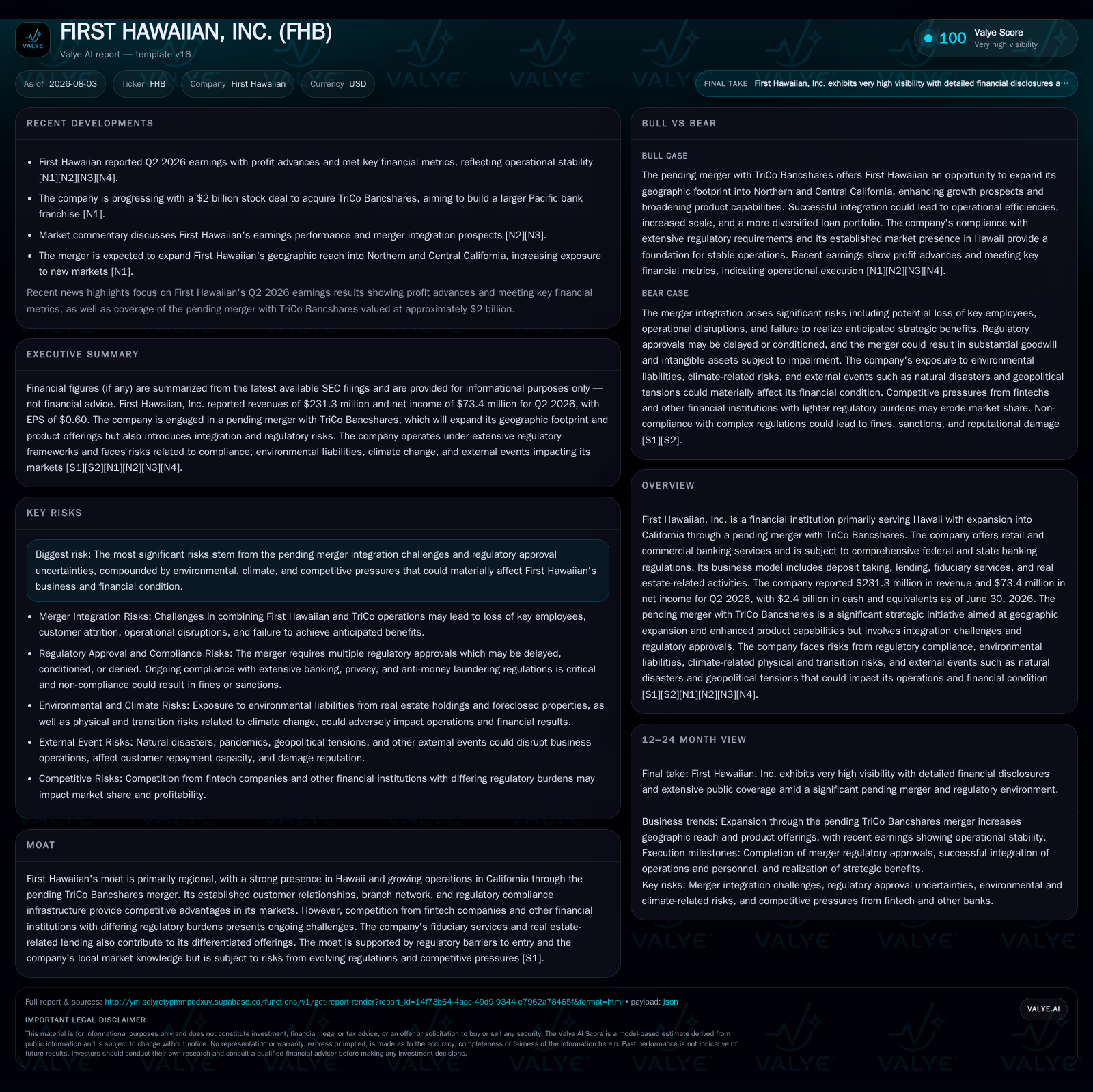
First Hawaiian reported Q2 2026 revenue of $231.3 million and net income of $73.4 million amid elevated merger-related expenses from the pending TriCo Bancshares acquisition. The transaction aims to extend the bank's footprint into California, diversifying its traditionally Hawaii-centric regional banking model, but integration risks including employee retention and IT system consolidation weigh on near-term financials. Asset quality remains a critical focus given exposure to Hawaii’s economy and real estate sector, while regulatory compliance—including anti-money laundering and environmental liabilities—continues to demand resources and attention. First Hawaiian’s competitive moat stems from its entrenched local presence and fiduciary services but faces pressures from fintech disruptors and evolving regulations.
Q2 Operating Pulse: Merger Costs and Revenue Composition Reveal Near-Term Challenges
In its latest Q2 2026 disclosure, First Hawaiian reported revenue of $231.3 million alongside net income of $73.4 million, figures that incorporate significant non-recurring expenditures related to its pending combination with TriCo Bancshares [S2][S3]. These one-time costs encompass legal fees, consulting expenses, severance, regulatory filings, and other deal-related charges that depressed margins temporarily. Management acknowledged the complexity inherent in integrating two independent operations while maintaining ongoing business continuity [N1]. The quarter's results thus serve as a transitional baseline reflecting both the strength of core operations and the immediate financial drag imposed by merger activities.
Business Model Nuances: Revenue Mix Anchored in Lending, Fiduciary Services, and Regional Reach
Geographically concentrated in Hawaii with a growing footprint extending through Guam, Saipan, and soon Northern California post-merger, First Hawaiian relies heavily on physical branches despite increasing digital banking adoption industry-wide [S1]. The branch network underpins deep client relationships enabling cross-selling opportunities critical to sustaining deposit growth amid competitive pressures.
Regional Banking Outlook: Competitive Benchmarks Highlight Scale and Service Differentiators
Within the regional banking landscape, First Hawaiian shares similarities with peer institutions like Bank of Hawaii—both focusing intensely on local markets—while TriCo Bancshares brings a foothold akin more to diversified playbooks seen at banks like Huntington Bancshares who blend regional strength with broader product suites [S1][S4]. Regulatory overhead—spanning anti-money laundering (AML), consumer privacy laws, cybersecurity mandates, environmental regulations related to property holdings—continues to impose operational cost burdens across these peers.
First Hawaiian’s moat centers on entrenched customer loyalty supported by its branch presence combined with fiduciary service offerings that are harder for new entrants or fintechs to replicate without significant capital investment or regulatory navigation [S1]. Yet evolving regulatory rules and rising competition from digital-first financial providers remain strategic challenges.
Growth Catalysts from Geographic Expansion Balanced Against Integration Risks
The transformative element currently shaping First Hawaiian's growth trajectory is its agreement to acquire TriCo Bancshares in a stock transaction valued around $2 billion [S3][N8]. This deal provides immediate scale benefits through access to California’s larger markets along with expanded product breadth resulting from complementary capabilities of the two franchises.
Nevertheless, integration risks loom large: melding distinct corporate cultures could provoke key personnel losses; consolidating IT systems poses risks of disruption affecting customer experience; inconsistent policies may impede operational synergies. Moreover, any delays or increased costs could mute anticipated merger cost savings or extension of franchise growth horizons [S2]. Such hurdles are familiar in regional bank mergers where achieving seamless unification is contingent on meticulous execution without alienating existing customer bases.
Key Risk Factors: Regulatory Compliance, Credit Quality Trends, Environmental Exposure and Fintech Competition
First Hawaiian’s risk disclosures prominently feature regulatory compliance challenges particularly concerning AML/KYC programs mandated under the USA PATRIOT Act and Bank Secrecy Act frameworks — areas fraught with potential for substantial fines or sanctions should lapses occur [S1][S4]. The company’s extensive oversight mechanisms including Board-level committees reflect heightened focus but require continual resource allocation.
Additionally, environmental liabilities tied to its branch network properties or foreclosed real estate collateral introduce episodic financial burdens due to remediation obligations under tightening state/federal environmental statutes [S4]. Finally, fintech encroachment offers a latent external threat by providing lower-cost payment solutions or alternative credit access options not burdened by traditional bank regulatory regimes which could erode deposit base or fee income over time [S8].
What Comes Next: Execution Milestones That Will Signal Success or Setbacks in Merger Synergy Realization
Investors and analysts should closely monitor regulatory approval progress for the TriCo transaction which remains subject to customary state and federal reviews—delays or conditions here could impact transaction timing or cost structure significantly [S2][S3]. Post-closing operational benchmarks such as employee retention rates will be telling indicators of internal stability amid the change. Migration status of IT platforms merging customer data and payment processing infrastructures will demonstrate progress toward synergy realization.
Credit quality metrics post-merger integration will reveal whether combined underwriting standards hold firm under expanded geographic scope. Quarterly earnings updates will likely detail any incremental restructuring charges which can pressure margin improvement timings [N1][S27]. Proxy statements forthcoming ahead of shareholder votes will provide further clarity on governance alignment enabling unified strategy deployment
Financial Profile Discussion: Capital Positioning, Profitability Metrics, And Liquidity Context
Capital adequacy ratios under Federal Reserve scrutiny remain compliant facilitating growth investments while preserving buffer against downturns or shock events common in tourism-dependent economies like Hawaii’s [F1][S2]. Overall financial positioning sustains foundational strength proving critical for weathering short-term merger disruption risks while executing long-term expansion plans.
This analysis synthesizes public filings through August 2026 including quarterly reports (10-Q), event disclosures (8-K), and annual filings (10-K) alongside market commentary to provide an informed perspective on First Hawaiian’s evolving business profile amid its transformative merger activity. This report is for informational purposes only without investment research view.
Disclaimer: This is research-only, informational analysis and not investment advice. It may include AI-generated interpretation and general industry context. Always verify important details using primary sources.

Comments