
Smurfit Westrock’s Post-Merger Scale Drives Sustainability and Integration Challenges
The combined entity leverages vertical integration and geographic diversity in paper-based packaging amid cost pressures and integration execution.
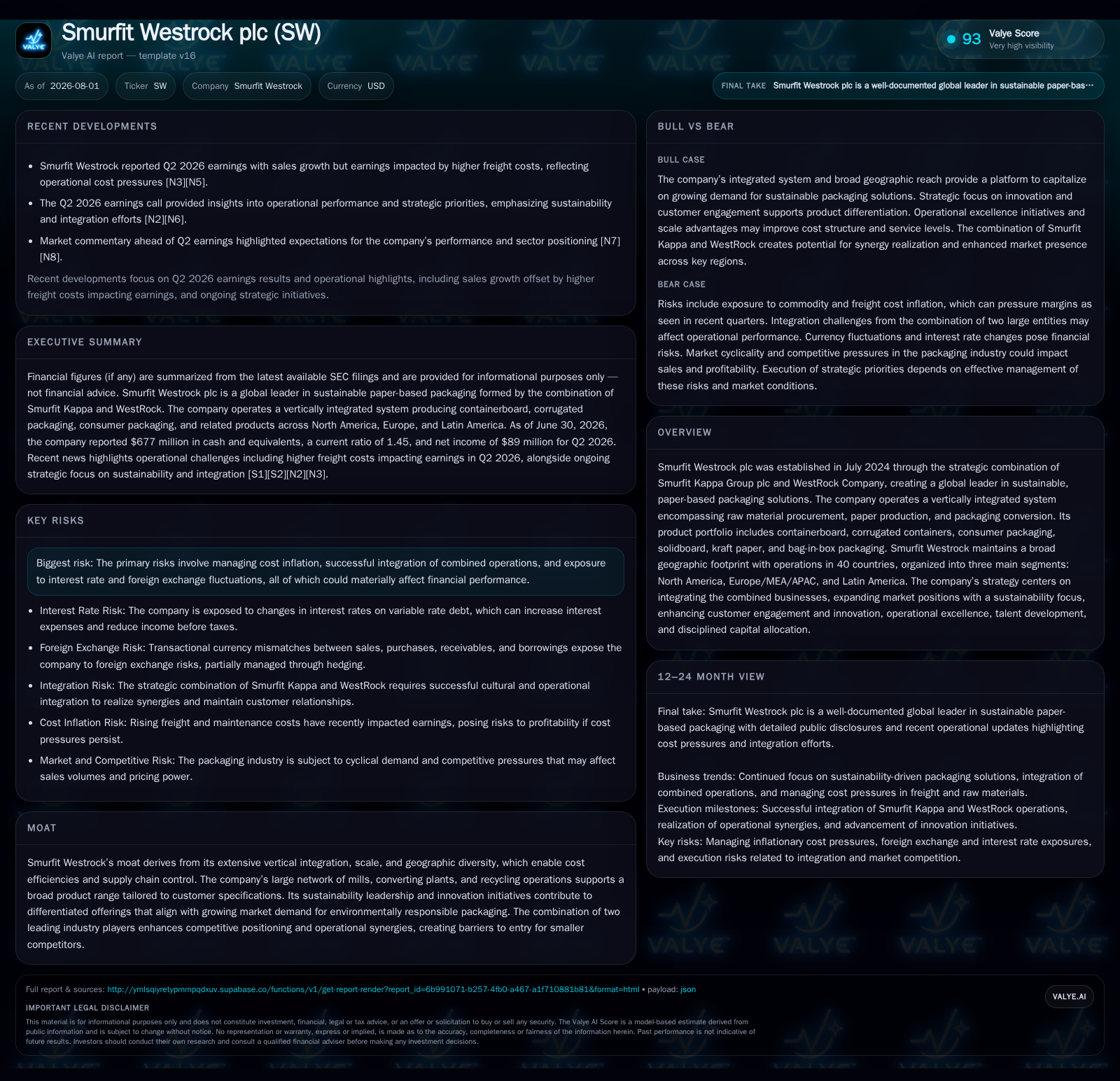
Smurfit Westrock plc, formed by merging Smurfit Kappa and WestRock in July 2024, stands as a global leader in sustainable paper-based packaging, operating a vertically integrated value chain across 40 countries. Its recent quarterly results show robust sales driven by scale and sustainability demand, though earnings were pressured by high freight costs and raw material inflation. The company’s strategy focuses on integration synergies, operational excellence, and innovation, but risks remain around cost volatility, FX exposure, and successful merger execution. Financially, leverage remains elevated post-merger, necessitating disciplined capital allocation while growth is supported by increasing demand for eco-friendly corrugated packaging across developed and emerging markets.
Recent Operating Update
Business Model Overview
Smurfit Westrock’s business model centers on delivering premium sustainable fiber-based packaging products via a highly integrated manufacturing footprint spanning raw material procurement (virgin fiber and recovered paper), milling (containerboard, kraft paper), converting (corrugated boxes, consumer packaging), recycling operations for recovered paper input maximization, and specialized packaging solutions like bag-in-box formats [S1]. It monetizes this vertically integrated chain primarily through B2B sales contracts with industrial end customers in food & beverage, e-commerce retailers, consumer products companies, among others. Revenue drivers include production volume measured in tons of containerboard and converted packaging units as well as average selling prices tied to product mix.
Vertical integration enables Smurfit Westrock to exert cost control by managing key raw materials internally — notably minimizing dependence on external pulp suppliers through self-produced virgin fiber while increasing recycled fiber content where feasible to reduce volatility [S1]. Conversion plants close to key markets enhance supply chain responsiveness. This integration supports customization capability for specific customer requirements enhancing switching costs.
The combined portfolio benefits from complementary European-centric Smurfit Kappa corrugated expertise alongside WestRock’s strong North American consumer packaging capabilities [S1]. Geographic diversification into Latin America further balances exposure against regional economic cycles.
Industry Structure and Competitive Position
The global paper-based packaging industry is characterized by a handful of large vertically integrated players—including International Paper, DS Smith plc, Packaging Corporation of America—competing with regional converters specializing in niche formats or recycled content. This oligopolistic concentration arises due to the capital-intensive nature of pulp mills and converting facilities requiring scale economies for competitive cost structures.
Smurfit Westrock has emerged as a top-tier competitor with broad mill capacity enabling flexible grade production (containerboard grades vs kraft or solidboard) matching diverse customer needs [S1]. Its extensive recycling operations secure recovered paper supplies critical given rising environmental regulations limiting virgin fiber usage. The company also invests heavily in sustainability innovations aligned with regulatory pushes globally to reduce plastic waste—a potent differentiator as customers increasingly prioritize eco-friendly suppliers.
Margins are sensitive to raw material cost swings—especially recovered paper prices which fluctuate based on supply-demand dynamics linked to secondary fiber availability—and energy costs affecting mill throughput efficiency [S1][S18]. Smurfit Westrock's geographic footprint affords some natural hedge against regional commodity shocks but exposes earnings volatility to foreign exchange impacts given that approximately 54% of sales were from outside US as of year-end 2025 [S1][S23].
Growth Drivers
Several structural growth vectors underpin Smurfit Westrock’s market opportunity:
- Increasing demand for recyclable paper-based packaging: Driven by e-commerce expansion necessitating durable corrugated shipping boxes.
- Regulatory mandates: Governments worldwide impose stricter limits on single-use plastics leading manufacturers to switch toward fiber-based alternatives.
- Innovation: Development of functional coatings or bag-in-box formats targeting premium segments supports incremental pricing power.
- Emerging markets penetration: Latin America segment growth reflects rising consumer packaged goods consumption aligned with urbanization trends.
- Operational scale: Synergies realized from combining two large-scale players improve unit economics enhancing competitiveness versus smaller converters lacking integrated supply chains.
KPIs such as mill utilization rates (targeting high operational efficiency), conversion plant throughput growth (more finished boxes produced), order backlogs signaling sustained customer demand strength, and sustainability metrics like recycled content percentages offer measurable insights into progress against these drivers.
Risks / Watchpoints / Growth Constraints
Key risks remain centered around managing ongoing inflationary pressures:
- Raw material price volatility: Fluctuations in recovered paper costs can compress margins if pricing adjustments lag input cost increases.
- Freight & logistics inflation: As evidenced in Q2 2026 results disrupting expected profitability restoration [N3].
- Foreign exchange exposure: Strengthening US dollar may negatively impact reported earnings from international operations; the company employs hedging strategies but residual risk remains substantial given multi-currency footprint [S1].
- Interest rate increases: With net debt exceeding $12.5 billion post-merger (gross debt $13.23 billion minus $0.68 billion cash at June 30), even partial variable rate borrowings create sensitivity raising interest expense obligations incrementally by millions per each 1% hike [F1][S1]. Maintaining investment-grade credit rating is thus pivotal.
- Integration risks: Realizing cost synergies between Smurfit Kappa & WestRock entails complex operational alignment across cultures & systems; delays or missteps could delay margin improvement timelines [S1].
- Regulatory compliance: Environmental laws necessitate continual capital spending for emission controls or waste treatment potentially adding uneven non-operational expenses [S7].
The company’s current ratio stood at 1.45, indicating moderate near-term liquidity coverage [F1]. The leverage remains elevated reflecting the sizable merger-related borrowing required, though supported by stable EBITDA generation documented at $1.72 billion operating income (latest full-year data) indicating capacity for sustained interest payments [F1][S2]. Debt facilities include a $4.5 billion revolving credit line extending maturity through 2030, providing funding flexibility but necessitating disciplined free cash flow generation for progressive deleveraging over the medium term [S4][S6][S9].
Capital allocation priorities appear balanced toward ongoing investment in mills and converting capabilities aligned with sustainability goals while carefully managing leverage ratios commensurate with investment-grade profiles reported previously [S1][N2]. The sizeable asset base spread mainly across North America ($14.2 billion long-lived assets) plus Europe/MEA/APAC ($5.5 billion) provides collateral depth supporting credit standing despite cyclical sectoral pressures [S23].
In sum, Smurfit Westrock's financial position reflects typical large-scale industrial consolidation characteristics: significant debt load underpinning strategic acquisition plus solid operational cash flow delivering consistent serviceability amidst inflationary input cost headwinds that will test margin resilience going forward.
This analysis synthesizes publicly available SEC filings up to Q2 2026 together with recent conference call disclosures and relevant industry context focused expressly on operational fundamentals without conjecture on future stock performance or investment decisions.
Disclaimer: This is research-only, informational analysis and not investment advice. It may include AI-generated interpretation and general industry context. Always verify important details using primary sources.

Comments