
MSA Safety Expands Industrial Safety Footprint with Autronica Deal Amid Operational Headwinds
MSA Safety's recent quarterly results underscore its acquisition-driven geographic growth and margin pressures amid supply chain challenges.
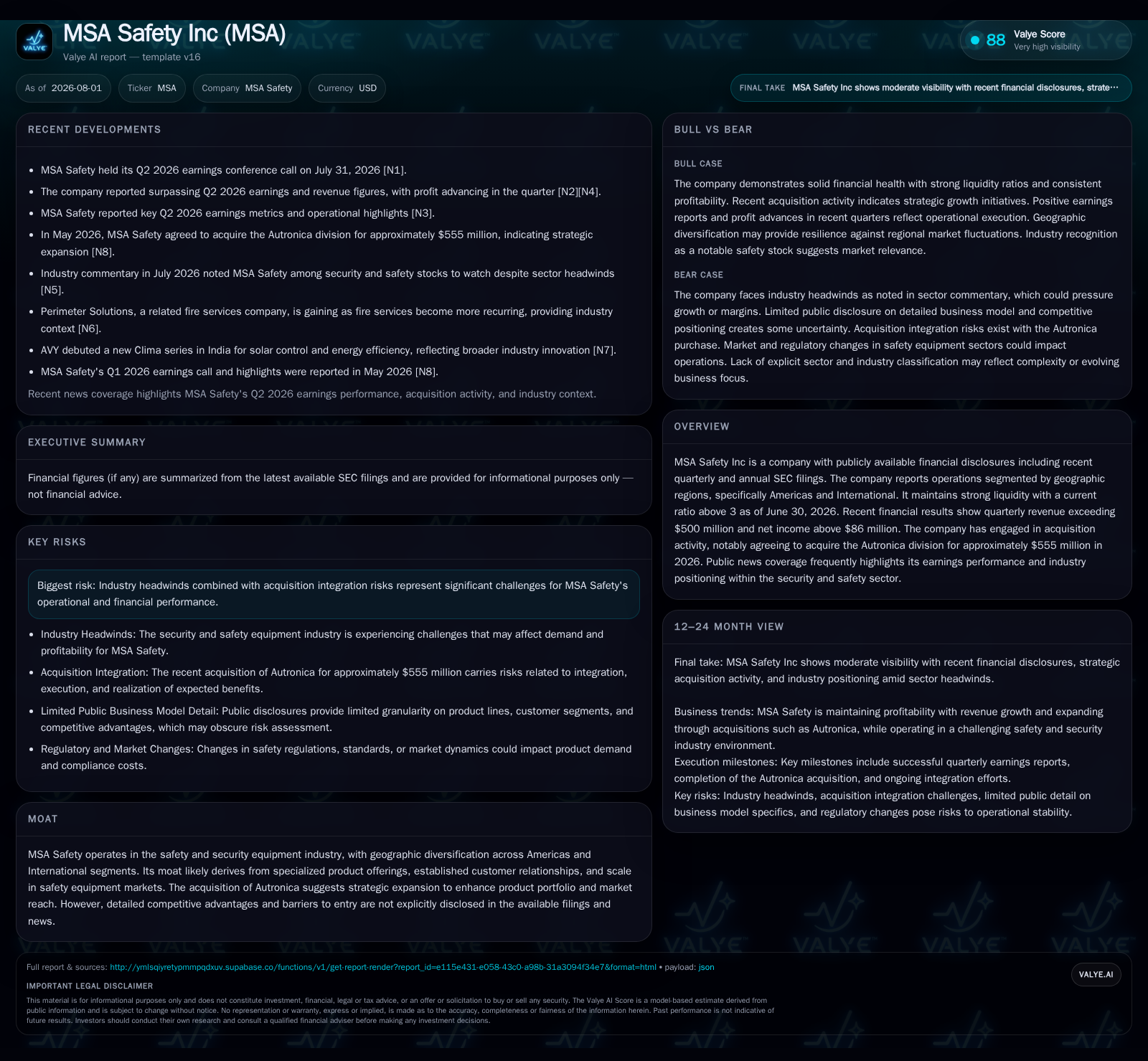
In Q2 2026, MSA Safety reported revenue exceeding $500 million and net income over $86 million, boosted by the strategic acquisition of Autronica Fire and Security. This deal significantly enhances MSA’s international segment and product portfolio but also introduces integration-related costs that pressure gross margins. The company's diversified revenue streams spanning PPE, gas detection, fire safety equipment, and growing aftermarket services align with industry trends driven by regulatory compliance and industrial expansion. Strong liquidity, including a current ratio above 3, supports flexibility despite cyclical demand risks and raw material volatility. Going forward, investors should monitor synergy realization from the Autronica acquisition and operational execution under evolving market conditions.
Q2 Operating Dynamics Reflect Acquisition-Fueled Growth with Margin Headwinds
n-related investments yet signal longer-term scale benefits.
Moreover, changes in stock compensation fair value suggest heightened retention incentives for key management amidst integration phases, implying internal acknowledgment of elevated execution risk during this period [S2]. Bridging robust revenue growth with cautious margin outlook reflects typical tradeoffs for companies aggressively expanding product scope and geographic reach under complex industrial environments.
Integrated Safety Equipment Model Driving Diverse Revenue Streams during Supply Challenges
MSA's business model centers on designing, manufacturing, and selling critical safety equipment including personal protective equipment (PPE) such as safety helmets and respirators; advanced gas detection systems deployed across hazardous work environments; and fire safety solutions tailored for industrial clients [S1]. This diverse product portfolio allows penetration into multiple end-markets including oil & gas, construction, mining, utilities, and public safety sectors where regulatory compliance forms an indispensable demand driver for safety upgrades.
The company complements hardware sales with aftermarket services encompassing maintenance contracts, training programs, software subscription renewals for monitoring systems, extended warranties, and technical support—elements that underpin recurring revenue streams while fortifying customer retention metrics critical for sustainable margin profiles [S1]. In recent filings, MSA disclosed revenue deferral policies aligned with future performance obligations arising from these service commitments indicating strategic prioritization of predictable cash flow generation despite fluctuating capital spending in core equipment sales [S2].
Supply chain complexities—notably fluctuations in copper pricing impacting sensor manufacturing—have tightened margins temporarily across the industrial hardware space. Such external cost pressures reveal the sensitivity of integrated manufacturers like MSA balancing component procurement timelines against volatile commodity markets and geopolitical uncertainties.
Geographic Segmentation Deepens with Autronica Deal Enhancing Global Reach
MSA organizes its operations into two principal reportable segments: Americas (covering North and Latin America) and International (comprising Europe, Middle East & Africa plus Asia Pacific) [S10]. Historically weighted toward the Americas segment accounting for roughly two-thirds of revenue, the acquisition of Autronica—a European-based supplier specializing in fire detection technology—augments the International segment’s footprint significantly [S16][S15].
In Q2 2026 alone, Americas contributed about $341 million of sales whereas International accounted for approximately $162 million reflecting incremental uplift as integration proceeds post-Autronica addition. This geographic diversification dilutes cyclicality tied to any single regional economy or sector capital cycle yet introduces greater operational complexity requiring sophisticated management across varying regulatory environments.
Additionally, currency translation effects factor into reported earnings volatility given geographic breadth impacting goodwill valuations—aggregated at around $726 million—with substantial allocations between segments underlining strategic focus on cross-border expansion efforts [S14][S18]
Aftermarket Services: Cementing Recurring Revenue Amid Competitive Pressure
Amid relatively commoditized product lines subject to competitive pricing dynamics among peers such as 3M Company and Honeywell International’s safety divisions, MSA increasingly leverages its aftermarket services platform to stabilize margins. Maintenance contracts involving calibration of gas detection devices or scheduled replacement parts exemplify offerings generating steady revenues less sensitive to industrial capital expenditure downturns.
By adopting deferred revenue recognition practices for such contractual arrangements in accordance with updated accounting standards adopted early in 2026 [S23], MSA signals growing reliance on these high-retention services contributing positively to cash flow resilience during variable new equipment order cycles.
This approach aligns with broader industry trends where customers prefer providers offering integrated lifecycle support rather than standalone hardware vendors—a factor potentially improving switching costs across large enterprise accounts.
Industry Context: Regulatory Compliance Costs and Raw Material Volatility
The industrial safety equipment sector contends regularly with changing occupational health & safety regulations globally mandating enhanced standards for protective gear certification, emissions monitoring fidelity via gas sensors, and fire safety system reliability. Compliance investments elevate baseline demand but also amplify R&D expense burdens necessary to maintain certification status or innovate against emerging hazards [S27].
Raw materials like copper used extensively in electronic components experience cyclical price swings intensifying input cost unpredictability—a major margin lever for companies operating asset-heavy manufacturing footprints such as MSA’s. Sustained inflationary pressures ripple through supply chains complicating inventory management strategies.
Additionally, periodic recalls or product liability issues inherent in this sector can trigger abrupt reputational risks mitigating pricing power.
Growth Drivers Anchored on Strategic Acquisitions and Innovation Pipeline
Emerging markets’ industrialization coupled with tightening global safety mandates underpin structural growth drivers supporting MSA’s long-term opportunity set. The company's proactive acquisitions—most recently Autronica—bring complementary technologies extending beyond classic PPE into integrated fire detection networks blending hardware with smart monitoring capabilities fostering cross-selling synergies [S1][S2].
Management emphasizes ongoing R&D investment aligned toward developing next-generation detection sensors and ergonomic PPE designs responding to customer demands not only for improved protection but also usability enhancements directly influencing adoption rates.
Order backlog improvements alongside steady customer retention rates serve as leading indicators confirming robust demand signals fueling expansion potential amid persistent market fragmentation.
However, fast-paced integration timelines present execution hurdles capable of slowing expected synergy capture if resource allocation challenges emerge.
Risks: Integration Complexity, Pricing Pressure, and Cyclical Demand Sensitivities
Integration costs associated with acquisitions represent a tangible near-term drag on margins illustrated by elevated expenses reported in Q2 alongside amortization of intangible assets acquired—including trade names valued at around $60 million—and goodwill reductions due to currency translations [S14][S27]. Potential disruption during consolidation phases can impede operational efficiency gains anticipated from expanded scale.
Competitive dynamics remain intensified especially versus diversified PPE suppliers like 3M that benefit from broader product ecosystems enabling embedded procurement advantage. Price competition pressures persist especially during periods of weakening industrial capital expenditures tied closely to cyclical demand patterns affecting end-user sectors such as oil & gas or construction.
Volatile raw material prices coupled with supply chain delays exacerbate margin compression risk while fluctuating foreign exchange exposures inherent in multi-national operations introduce earnings variability complicating forecasting accuracy.
What to Watch Next: Milestones in Synergy Realization and Sales Momentum Indicators
Key short-to-medium term milestones include management’s successful delivery on Autronica acquisition synergies targeted within the next fiscal quarters—specifically operational cost rationalization, cross-segment product bundling effectiveness, and expanded penetration in European markets [N1][N3][S2]. Monitoring order backlog visibility will provide clarity on underlying sales momentum ahead of macroeconomic shifts potentially influencing capital spending plans.
Additionally, management commentary during upcoming earnings calls regarding progress on supply chain stabilization initiatives paired with new product rollouts will be critical gauges validating strategic direction execution relative to competitor innovation cycles.
Financial Profile Discussion: Solid Liquidity Supports Operational Flexibility
MSA maintains a robust liquidity profile evidenced by a current ratio of approximately 3.24 as of June 30, 2026, supporting working capital requirements through volatile periods including acquisition integration phases [F1]. Cash & equivalents stood at approximately $200 million as of June 30, 2026 [F1]. Total debt reported in the latest filings includes $50 million of 5.25% Series B Senior Notes due July 1, 2028, with a principal payment of $25 million due July 1, 2027, and the remaining $25 million due July 1, 2028 [S2].
The company’s revolving credit facility is currently drawn minimally, leaving substantial undrawn capacity available for opportunistic investments or liquidity needs [S2]
Ongoing capital expenditures cluster around technology development and manufacturing enhancements necessary to sustain competitiveness but exert pressure on free cash flow conversion rates temporarily until full synergy realizations are achieved.
This analysis synthesizes latest SEC disclosures and validated financial data providing insight into MSA Safety's performance trajectory shaped by recent acquisition activities within the broader industrial safety equipment sector context. The discussion refrains from speculative guidance projections absent explicit disclosure emphasizing measurable KPIs such as segment revenues, margins impact drivers, customer retention factors, and liquidity measures framing near-term operational health.
Disclaimer: This is research-only, informational analysis and not investment advice. It may include AI-generated interpretation and general industry context. Always verify important details using primary sources.

Comments