
Myriad Genetics’ Q2 2026 Revenue Decline Highlights Reimbursement and Market Adoption Challenges
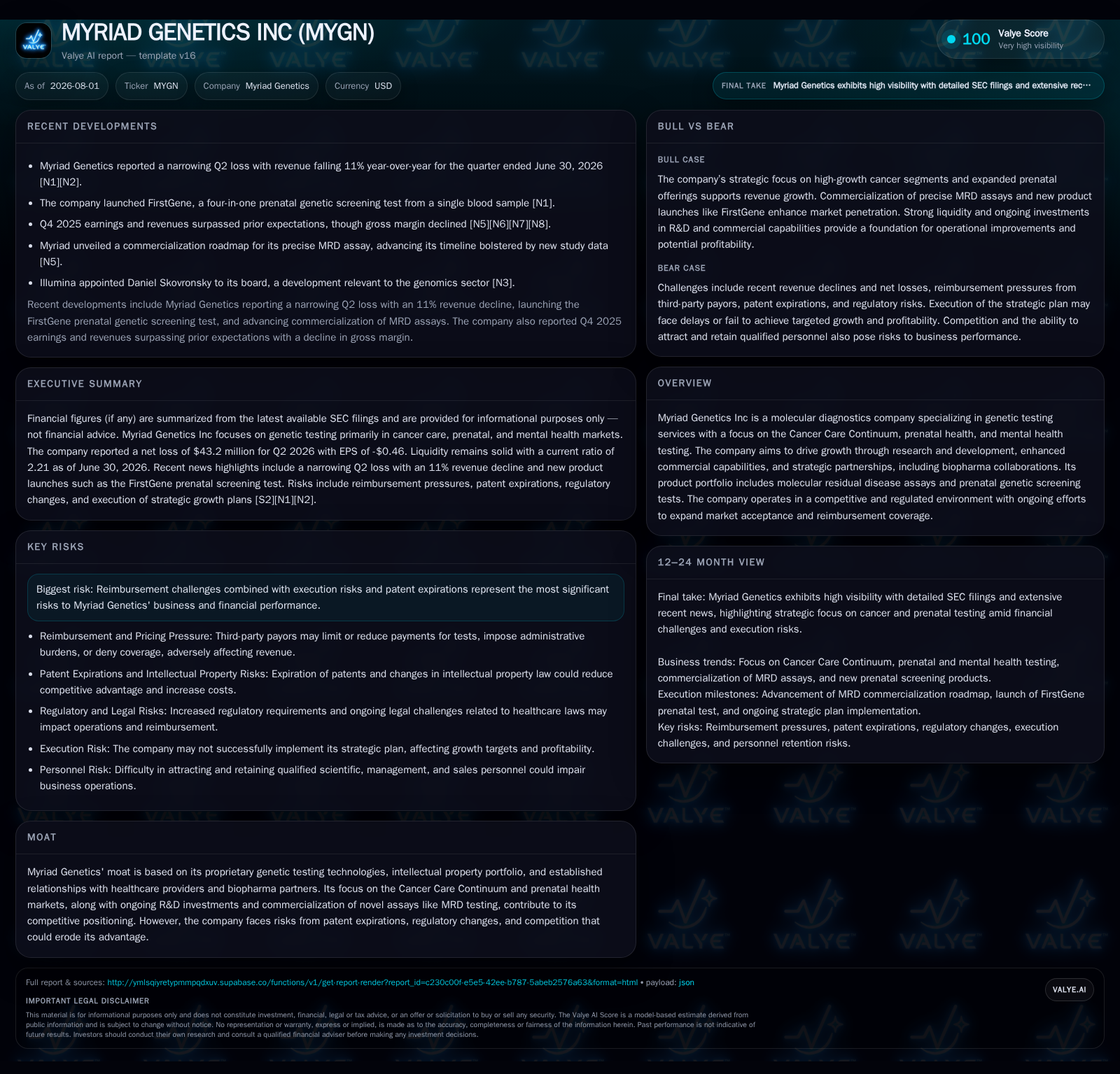
Myriad Genetics reported an 11% revenue drop in Q2 2026, reflecting ongoing reimbursement pressures and shifting test volume dynamics across its cancer, prenatal, and mental health segments.
In its latest quarterly filing ending June 30, 2026, Myriad Genetics disclosed an 11% revenue decline reflecting persistent challenges in market adoption and reimbursement for some of its key genetic tests. The company’s strategic focus remains on the Cancer Care Continuum with investments in molecular residual disease (MRD) assays and expanded prenatal offerings. However, reimbursement headwinds and competitive pressures alongside patent expiration risks continue to constrain growth. Myriad’s financial profile shows a solid liquidity position supporting ongoing R&D and commercial efforts, but near-term revenue contraction underscores risks inherent in the molecular diagnostics space.
Recent Operating Update
Myriad Genetics’ latest quarterly SEC filing for the period ended June 30, 2026 reveals a continuation of pressure on top-line growth. The company reported an approximate 11% decline in revenue compared to prior periods [S2], confirmed by contemporaneous earnings releases indicating that test volume softness combined with reimbursement challenges are principal headwinds [N1][N2]. Despite this setback, Myriad’s narrowed Q2 loss reflects cost management efforts but underscores the vulnerability to payer acceptance dynamics common across the molecular diagnostics field.
The Q2 update highlights the dual-market exposure that shapes Myriad's near-term operating profile: while some segments like prenatal testing benefit from product innovation (e.g., FirstGene four-in-one screening launched recently [N3]), other critical segments such as cancer-related assays experience slower uptake amid payer skepticism or coding hurdles. Management reiterated commitment to the Cancer Care Continuum (CCC), especially through increased emphasis on molecular residual disease (MRD) assays—a technically sophisticated category targeting minimal residual disease detection to guide oncology treatment decisions—but acknowledged that clinical adoption remains at an early-growth stage reliant on further validation and reimbursement expansion [S1][S16].
Business Model and Strategic Positioning
Myriad Genetics operates primarily by developing proprietary genetic assays deployed via its central laboratories. Its customer base primarily comprises healthcare providers—oncologists, obstetricians—and hospital systems where test ordering decisions are influenced heavily by clinical guidelines, payer coverage policies, and physician education. Revenue is generated through per-test fees reimbursed by insurance payers or government programs when coverage is secured.
The company's two main strategic pillars are: (1) driving growth within Oncology-focused testing including hereditary cancer risk assessment and MRD monitoring; (2) expanding Prenatal Health testing offerings with innovative multi-marker panels designed to increase volume through broader clinical utility. Additionally, Myriad pursues Mental Health genetic testing focused on pharmacogenomic insights.
Myriad monetizes through high-complexity assay sales whose unit economics depend on test volume growth combined with reimbursement rates. Assay development is capital intensive due to regulatory validation requirements and intellectual property licensing expenses. Commercial success depends strongly on achieving market adoption supported by coding clarity and favorable payer coverage — a structural challenge prevalent industry-wide.
The company maintains an active pipeline of laboratory-developed tests (LDTs) while navigating evolving FDA oversight landscapes—a regulatory domain still marked by uncertainty that impacts launch timing and compliance costs [S7][S24]. Biopharma partnerships enrich revenue streams by providing assay development support as companion diagnostics tied to therapeutic pipelines alongside clinical trials.
Industry Structure and Competitive Context
Positioned in the molecular diagnostics space characterized by rapid scientific innovation and evolving regulatory scrutiny, Myriad competes against established players such as Exact Sciences (cancer diagnostics), Guardant Health (liquid biopsy/MRD testing), Invitae (broader genetic testing services), Foundation Medicine (oncology profiling), and Illumina (genomics platform provider).
Competition in this space hinges on assay sensitivity/specificity, clinical validation rigor, breadth of testing portfolio, turnaround times, payer relationships influencing reimbursement coverage, intellectual property strength protecting proprietary technologies, and partnership ecosystems—for example with biopharma firms requiring companion diagnostic tools.
While Myriad enjoys entrenched clinical relationships particularly for hereditary cancer tests cultivated over decades along with owned intellectual property assets forming a moat around certain legacy products, it faces patent expirations that threaten this advantage. Moreover, competition from technology platform entrants reducing cost-per-test or offering competing MRD approaches intensifies pricing pressure.
Successful commercialization of novel assays like MRD requires overcoming physician inertia — demanding robust data supporting clinical utility as well as improving pathway access through insurance reimbursement reforms. In this respect, industry peers who scale rapidly (e.g., Guardant Health) may exert competitive pressure on price structures if they expand reimbursements faster.
Growth Drivers
Key drivers underpinning Myriad’s growth thesis include:
- Expanding personalized medicine trends fuelling demand for precision oncology testing including MRD detection geared towards guiding immunotherapy or adjuvant treatment cessation decisions.
- Launch of new prenatal screening products such as FirstGene enabling broader population access with more convenient multi-condition detection from a single maternal blood draw enhancing patient compliance.
- Increased insurance reimbursement coverage scope following updated clinical guidelines or payer policies acknowledging improved clinical outcomes associated with genetic risk stratification or residual disease monitoring.
- Strategic collaborations with biopharma companies creating co-development opportunities for companion diagnostics which can accelerate commercial acceptance through integration into therapeutic protocols.
- Investment in R&D catalyzing development of next-generation assays with higher diagnostic sensitivity or reduced turnaround times potentially improving clinician adoption rates.
Tracking KPIs such as year-over-year test volume growth within Cancer Care Continuum segments—especially MRD—and Prenatal Health volume stability alongside higher reimbursement rate achievements will provide leading signals regarding success of these growth levers.
Risks and Watchpoints
Myriad faces several structural risks that merit close monitoring:
- Reimbursement environment remains volatile; any delays or denials by insurers materially impact revenue recognition given dependence on per-test payments [S24].
- Patent expirations prompt potential erosion of hereditary cancer testing revenues where competitors may introduce cost-efficient alternatives or non-infringing tests [S4][S22].
- Regulatory uncertainty surrounding FDA’s approach to LDTs could impose additional clearance burdens raising time-to-market or incremental compliance costs affecting margins.
- Pace of physician adoption for emerging assays like MRD could lag expectations if clinical validation evidence fails to conclusively demonstrate improved patient outcomes versus standard care.
- Competitive pressures from established diagnostics companies scaling similar technologies or genomics platform entrants delivering bundled solutions may compress pricing leverage over time.
- Operational risks include ability to maintain high-quality lab standards ensuring test accuracy given complex assay workflows; any lapses could damage reputation or invite regulatory penalties.
- Dependence on key personnel skilled in genomics science and commercial execution exposes risk around talent retention amidst competitive hiring markets [S29].
What To Watch Next
Investors should track several operational milestones over upcoming quarters:
- Quarterly announcements detailing test volume fluctuations segmented between CCC oncology tests (including MRD) versus prenatal/mental health volumes will clarify market acceptance trajectories [S2][N1].
- Updates on insurance payer coverage expansions or pricing adjustments announced publicly or implied through revenue mix shifts portend improved monetization prospects.
- Regulatory developments especially any FDA guidance or legislative movement potentially revisiting LDT oversight would materially affect future assay launch cadence [S7][S24].
- Evidence publications or trial results validating clinical utility of MRD assays can substantially influence physician adoption curves.
- Progress reports on new biopharma partnerships or expansions of existing collaborations illuminating companion diagnostic pipeline depth may signal sustainable growth vectors beyond direct consumer/provider sales.
Financial Profile Discussion
As of June 30, 2026, Myriad Genetics held cash & equivalents totaling approximately $115 million against total debt near $125 million yielding a modest net debt position of about $9.8 million [F1]
Effective capital allocation balancing innovation spend against operational efficiencies will be critical given tight industry margins typical for high-complexity genetic testing businesses competing on price-sensitive reimbursements alongside substantial fixed lab overheads.
This analysis synthesizes publicly filed regulatory disclosures along with contemporaneous earnings commentary offering insight into Myriad Genetics’ evolving business model execution amid continuing reimbursement headwinds and competitive pressures characteristic within the molecular diagnostics sector. It avoids forward-looking projections not supported explicitly by disclosed evidence.
Disclaimer: This is research-only, informational analysis and not investment advice. It may include AI-generated interpretation and general industry context. Always verify important details using primary sources.

Comments