
Woodward’s Strategic Focus and Aerospace Momentum Drive Q3 Outperformance
Woodward reported strong Q3 2026 results, fuelled by aerospace segment growth and disciplined portfolio management amidst expanding industrial demand.
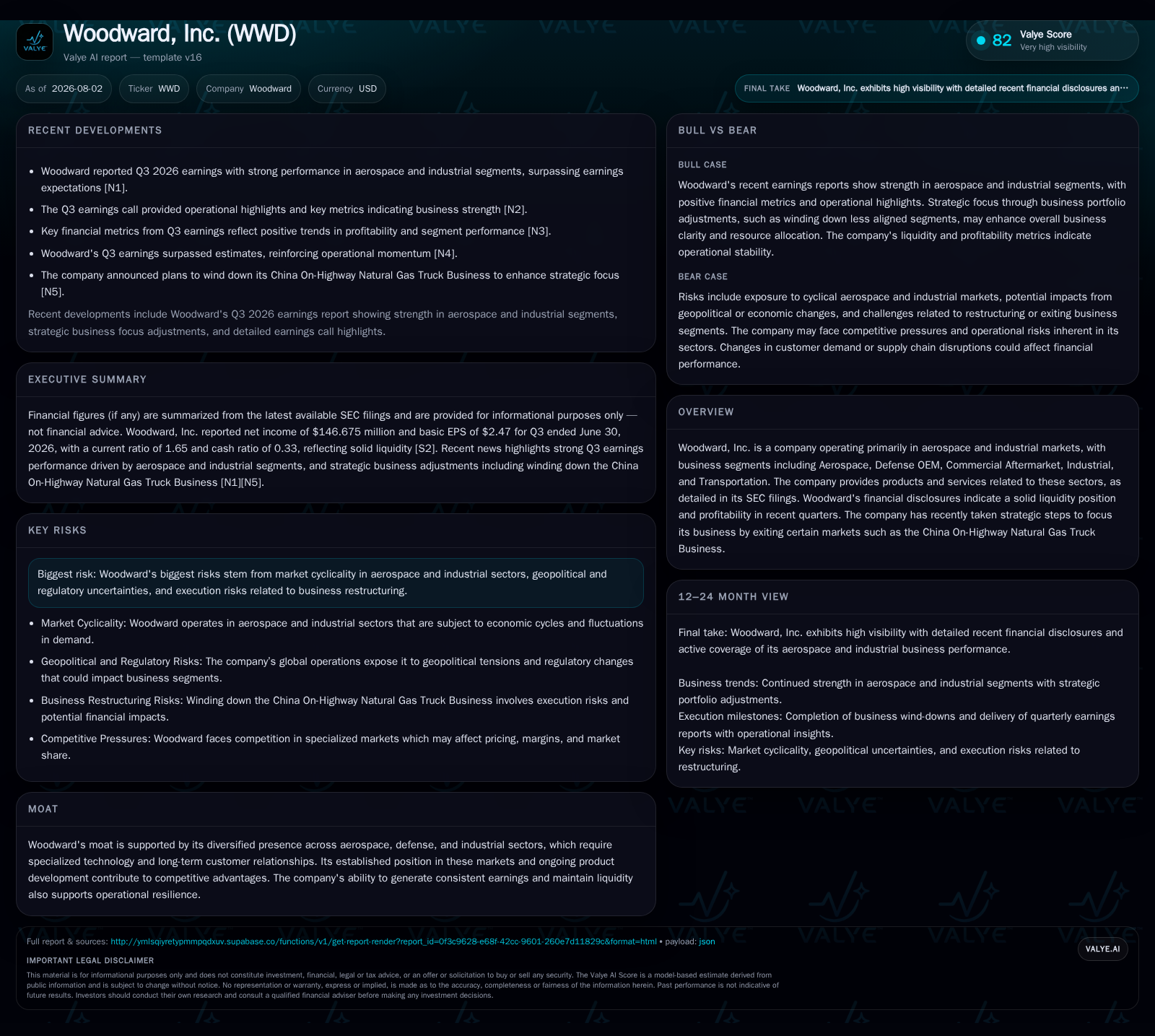
In its latest quarter, Woodward, Inc. demonstrated robust operational momentum reflecting sustained aerospace market strength and focused business portfolio adjustments. The company’s strategic exit from lower-margin sectors sharpened its industrial and aerospace segments, helping improve margins and cash flow. Woodward balances OEM contract innovation with stable aftermarket services, mitigating industry cyclicality and capitalizing on long-term aviation and defense production growth. Healthy liquidity and manageable leverage position it well for continued investment amid ongoing sector uncertainties.
Recent Quarterly Momentum Reflects Aerospace Demand Strength and Portfolio Focus
Woodward’s Q3 2026 financial disclosures reveal a solid operating performance augmented by growth in its aerospace segment alongside disciplined portfolio management moves. The company surpassed earnings expectations this quarter, propelled by sustained order intake reflective of commercial aerospace production expansion and industrial demand upticks [S2], [S3].
Critically, Woodward exited its China On-Highway Natural Gas Truck Business — a low-margin operation — allowing management to sharpen its strategic focus on core aerospace and industrial markets where technology differentiation carries higher barriers to entry [S1], [S2]. This exit aligns with the company's broader strategy to optimize capital allocation toward segments exhibiting superior long-term growth potential and margin profile.
The company reports a favorable book-to-bill ratio this quarter signaling strong backlog health relative to shipments; while exact figures are undisclosed, commentary highlights improving order momentum particularly within the Aerospace segment, aiding future revenue visibility in an industry known for cyclical volatility tied to OEM production schedules and certification cycles [N2]
How Woodward’s Diversified Business Model Balances OEM Innovation with Aftermarket Recurrence
Woodward operates primarily as a Tier 1 supplier to aerospace and defense OEMs alongside a significant presence in industrial automation and transportation control systems, splitting revenue streams between original equipment manufacturing contracts and aftermarket service sales [S1]. This blend is fundamental: OEM contracts drive growth via new platform wins or production rate increases; aftermarket revenues provide recurring income linked to installed base maintenance, upgrades, and lifecycle management.
Aftermarket services typically represent a stabilizing portion of Woodward’s revenue mix—mitigating the sharp swings in capital orders characteristic of aerospace/defense sectors. This recurring component supports margin resilience even amid production downturns or delivery delays caused by protracted certification or regulatory compliance periods intrinsic to these industries [S1], [S2].
Investment in R&D exceeding typical industry averages underscores Woodward's commitment to maintaining technological leadership essential for securing certifications that differentiate products within highly regulated markets such as commercial aviation propulsion controls or defense systems integration. These barriers deter new entrants while reinforcing customer switching costs over long asset lifecycles [S1].
Industry Dynamics Frame Woodward’s Competitive Positioning in Aerospace and Defense Manufacturing
The aerospace and defense manufacturing industry is cyclical with prolonged product development timelines stretching multiple years before revenue recognition occurs. Certification processes governed by regulators like the FAA or international counterparts delay commercialization but ensure safety and reliability standards—a double-edged sword that benefits incumbents like Woodward with established engineering know-how.
Supply chain volatility including raw material cost pressures has intermittently challenged margin stability across the sector; however, Woodward’s operational improvements, scale in multiple end-markets, and supply chain management strategies place it competitively near peers such as GE Aviation (aerospace propulsion) or Honeywell (industrial/aerospace controls). The company’s role as a trusted Tier 1 supplier with integrated control system offerings enhances pricing power relative to lower-tier component providers.
Defense contract opportunities remain subject to geopolitical factors but represent an important diversification buffer. Exposure through defense OEM aftermarket parts provides recurring sales even when new platform awards are uncertain—a factor that distinguishes Woodward from peers focused solely on commercial aviation cycles.
Investing in R&D and Product Lifecycle Management Amid Lengthy Certification Cycles
Woodward allocates a significant percentage of revenues toward research, development, and engineering activities driving innovation in control systems for both aerospace propulsion and industrial applications. Such sustained R&D outlay is needed not only to maintain pipeline competitiveness but also due to long certification cycles that extend time-to-revenue after concept development phases.
This extended horizon requires disciplined cash flow management — evident in improved operating cash conversion this quarter — as upfront R&D expenses precede contract fulfillment sometimes over years. Successful book-to-bill ratios complement this narrative by reflecting new program wins that will translate into future topline growth once certifications are secured.
Moreover, product lifecycle management capabilities enable Woodward to extract value beyond initial equipment sales via upgrade kits, spare parts provisioning, diagnostic services, and digital twin technologies enhancing installed asset efficiency—revenue levers increasingly vital as customers demand lower total-cost-of-ownership solutions.
Growth Catalysts: Commercial Aerospace Production, Defense Budget Uptick, & Industrial Automation Expansion
Key secular demand drivers underpinning Woodward’s growth thesis include the ongoing ramp-up in commercial aircraft production rates driven by recovering airline travel post-pandemic constraints along with rising defense budgets oriented toward platform modernization across North America and allied nations [S1], [N11].
Meanwhile, growth in industrial automation—particularly electrification trends within transportation systems—expands addressable markets for Woodward’s control system expertise beyond traditional aerospace/defense boundaries. This multi-pronged sector exposure provides strategic optionality amid variable macroeconomic conditions.
Increased penetration of aftermarket service contracts adds a layer of predictability to revenue streams fueled by expanding installed base sizes requiring continuous maintenance or upgrades. This aspect complements new program inflows ensuring more balanced top-line trajectories across economic cycles.
Constraints to Growth Include Market Cyclicality, Geopolitical Risks, and Execution Risks on Divestitures
Notwithstanding growth prospects, Woodward faces inherent cyclical risks tied predominantly to commercial aerospace OEM production fluctuations which can compress backlog values thereby impacting near-term revenue visibility. Moreover, geopolitical tensions impact defense procurement unpredictability warranting cautious evaluation of contract pipelines.
Execution risk arises from ongoing restructuring activities accompanying portfolio exits; successful integration or divestiture timing is crucial to realizing anticipated financial benefits without operational disruption. Supply chain disruptions—still global challenges—add further variability influencing lead times and input costs.
Currency fluctuations pose incremental risk given global footprint while regulatory compliance with export controls restricts certain market opportunities requiring vigilant oversight.
Financial Profile Discussion: Strong Liquidity Underpins Strategic Flexibility While Managing Debt
As of June 30, 2026, Woodward maintained a healthy liquidity position featuring approximately $475 million in cash & equivalents against current liabilities nearing $1.42 billion resulting in a current ratio of about 1.65—a comfortable short-term coverage metric supporting operational agility [F1]
Total debt levels are not explicitly updated in the latest quarter filings; however, best-effort net debt estimates from prior periods approximate $232 million after adjusting for cash buffers, suggesting manageable leverage allowing capacity for selective acquisitions or capital expenditures aligned with strategic objectives [F1]
Interest expense rose moderately reflecting incremental borrowings but remains well within operating income coverage limits suggesting prudent leverage usage supporting ongoing investment priorities [S2]. Capital expenditures accelerated during the quarter notably exceeding prior periods evidencing reinvestment aimed at scaling manufacturing capabilities relevant for anticipated demand growth.
Overall financial metrics underscore a resilient profile facilitating sustained innovation funding while preserving flexibility for opportunistic portfolio enhancements or shareholder returns consistent with sector norms.
This analysis reflects information available as of the Q3 2026 reporting period including SEC filings supplemented by observed industry trends relevant for understanding Woodward's evolving business landscape. The commentary avoids speculative forward-looking assertions without explicit supporting evidence.
Disclaimer: This is research-only, informational analysis and not investment advice. It may include AI-generated interpretation and general industry context. Always verify important details using primary sources.

Comments