
Lindblad Expeditions Extends Strategic Partnership and Grows Premium Expedition Travel Amid Fleet and Financial Constraints
Lindblad Expeditions reported Q2 2026 results with revenue growth and operational progress, balanced against debt leverage and niche market risks.
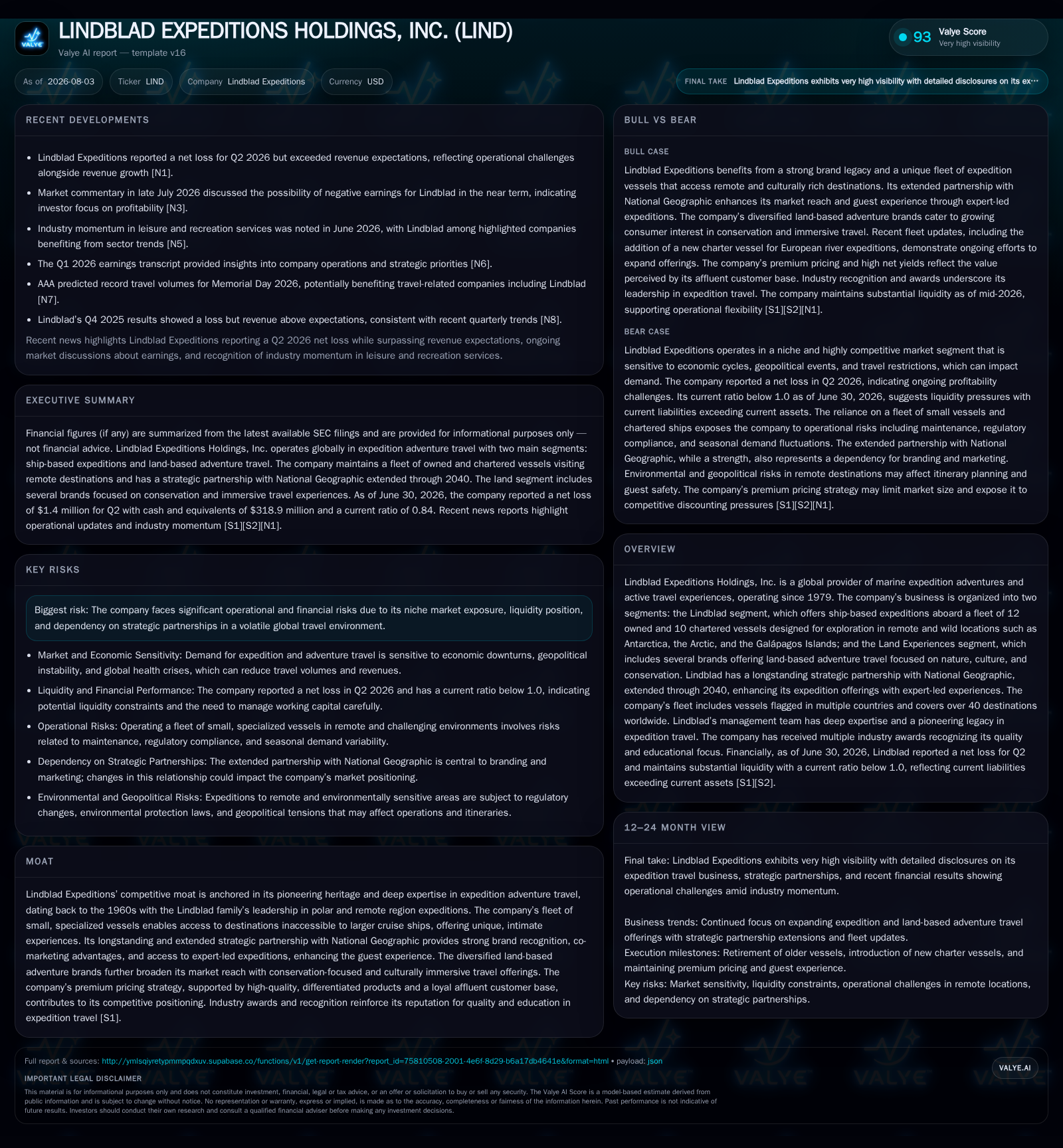
In its latest quarter ending June 30, 2026, Lindblad Expeditions Holdings, Inc. demonstrated continued growth in its expedition cruising and land-based adventure segments, supported by its unique fleet and an extended partnership with National Geographic through 2040 [S2][S3][S1]. The company remains focused on premium pricing and capitalizing on affluent travelers seeking immersive nature and conservation experiences in remote global destinations. However, Lindblad is navigating notable financial risks linked to its $675 million secured notes due 2030 and a current ratio below 1.0, indicating liquidity pressure [F1]. Operationally, fleet utilization, guest occupancy rates, and net yield per available guest night remain critical metrics for gauging performance and growth potential in this specialized cruise sector. The company’s differentiated positioning in active adventure travel provides competitive moat advantages but requires careful management of seasonality and geographic deployment constraints.
Recent Operating Update
Business Model Analysis
Lindblad operates through two primary segments: ship-based expeditions under the Lindblad segment including flagship vessels built for intimate access to fragile ecological areas like Antarctica, the Arctic, Alaska, the Galápagos Islands; and Land Experiences comprised of several boutique brands offering active adventure travel emphasizing cultural immersion and wildlife conservation efforts globally [S1]. Revenue generation centers on high-margin expedition package sales directly to consumers supplemented by ancillary streams such as pre- or post-trip extensions, optional guided excursions offered onboard or on land, onboard retail spending including photography services inspired by National Geographic branding, as well as trip insurance products. This diversified monetization approach enhances average revenue per guest night — a crucial metric measuring the effectiveness of premium pricing strategies within this niche segment.
The strategic partnership with National Geographic offers unique differentiation by lending credibility through expert-led content creation and co-branded marketing. This alliance strengthens customer acquisition capabilities by leveraging Nat Geo's loyal community of naturalists and explorers while also differentiating Lindblad’s offerings relative to mainstream larger cruise operators typically focused on mass-market itineraries [S1]. The partnership extension through 2040 reflects mutual confidence in long-term growth opportunities rather than a transient cooperative arrangement.
Industry Structure and Competitive Position
The specialty cruise and adventure travel industry is characterized by high capital intensity due to vessel ownership or long-term charters required to access niche remote locations unsuitable for conventional large cruise ships. Lindblad distinguishes itself through its fleet size balance — operating twelve owned ships supplemented by ten charters — providing flexibility in scaling capacity without overextending fixed assets unfavorable under seasonally concentrated demand patterns. Its geographic specialization into polar regions during respective seasons combined with curated itineraries ensures repeat visitation among loyal guests seeking authentic exploration experiences unavailable elsewhere.
Pricing power is enhanced versus mainstream cruise lines because customers pay premiums for exclusivity, educational enrichment through field experts onboard (including photographers/scientists), sustainable travel alignment resonant with evolving consumer preferences toward conservation tourism, plus immersive active adventures rather than passive sightseeing [S1]. Ancillary revenues confer additional margin expansion potential as these include bespoke trip add-ons often booked at higher per capita rates.
Peers operating within this specialty space include companies like Seabourn Cruise Line’s Expedition division or Ponant Cruises; however Lindblad leans more heavily into its smaller-ship profile coupled with strong brand equity from National Geographic. Its land-based adventure brands further diversify its product suite beyond sea-only offerings addressing consumer trends towards multi-modal experiences covering cycling tours (DuVine), safaris (Thomson Group), and nature-focused exploration (Natural Habitat) which create cross-selling synergies enhancing customer lifetime value.
Growth Drivers
The underlying market driver remains growth in affluent adventure travelers advocating experiential tourism emphasizing sustainability; this demographic exhibits higher disposable income elasticity even amid broader economic cyclicality given the discretionary nature of trips priced at premium levels. Expansion into underpenetrated geographies such as parts of Europe’s remote coastal regions or incremental voyages within South America also arise as avenues for volume gains.
Lindblad continues innovating itinerary design towards increasing lengths of expedition stays where feasible without overextending operational efficiency—directly improving net yield per available guest night (a key KPI reflecting combined price-levels and occupancy performance). Further growth emerges from bolstering ancillary revenue paths encompassing trip extensions before or after main cruises plus enhanced onboard activity offerings fostering higher spend per passenger.
Strategic partnerships beyond National Geographic may develop over time providing branded access into scientific research trends or conservation programs enhancing authenticity for discerning consumers. Meanwhile demographic trends supporting an aging yet active global population inclined towards experiential learning fortify long-term demand assumptions.
Risks and Constraints
Significant risks relate chiefly to the company’s relatively high leverage situation from a $675 million senior secured note issuance last year that refinanced previous notes but imposes ongoing interest obligations at a fixed rate of 7% through maturity in 2030 [F1][S6]. Current liquidity indicators—$319 million cash against $675 million total debt with net debt exceeding $350 million—render financial flexibility somewhat constrained amidst ongoing capital expenditures typical of maintaining expedition-optimized vessels equipped with cutting-edge exploration tools [F1]. A current ratio under one (0.84) elevates short-term working capital risks if operating cash flow tightens unexpectedly [F1].
Operational risks encompass weather-related itinerary disruptions inherent in remote polar regions that may reduce vessel utilization temporarily affecting yield metrics. The complex regulatory landscape governing environmental protection regimes globally could increase compliance costs or restrict sailing windows impacting scheduled journeys [S8][S9]. Moreover geopolitical tensions potentially curtail access to some destinations.
Demand-side vulnerability derives from exposure to macroeconomic cycles influencing discretionary travel budgets among older affluent cohorts alongside shifting pandemic or crisis-induced travel behaviors.
Dependency on the National Geographic relationship remains paramount; any weakening would materially affect brand-driven demand unless replaced by another equally recognizable partner.
What To Watch Next
Market watchers should focus on quarterly data points illuminating improvements or deterioration in fleet utilization rates during peak seasons alongside occupancy rate trends indicating sustained demand health versus cancellations or discount-driven repositioning.
Tracking ancillary revenue progression provides insight into effectiveness of up-sell efforts crucial for profitability enhancement beyond base fares. Additionally monitoring management commentaries regarding itinerary expansions into emerging geographic regions will reveal strategic pacing approaches balancing capacity utilization against organizational risk appetite.
On the financial front, developments around refinancing alternatives (if any), covenant compliance status concerning indebtedness instruments or adjustments to capital expenditure plans responding to liquidity cues will be critical mileposts for assessing financial stability going forward.
Financial Profile Discussion
Lindblad’s balance sheet at Q2 end reflects $318.9 million cash against $675 million in senior secured notes totaling net debt near $356 million highlighting significant leverage typical of capital-intensive specialty cruise operators investing heavily to maintain advanced expedition fleets [F1]. The current ratio sits below unity at approximately 0.84 signaling relatively tight short-term liquidity cushions given that current liabilities exceed readily liquid assets though expected operating cash flows and credit facilities provide fallback comfort [F1]. Interest expense from fixed-rate notes constitutes a material cash outflow reducing free cash flow available for reinvestment or deleveraging efforts.[S6] Capital expenditures remain substantial to sustain ships’ specialized equipment essential for safe itineraries into challenging environments.[S1] Cash flow from operations has improved materially compared with prior years due to higher deposit inflows from future bookings alongside better operational efficiency realized post-pandemic recovery cycles.[S10]
Overall liquidity strategy involves balancing maintenance of fleet competitiveness while preserving covenant compliance requiring prudent capex timing plus effective working capital management [S4][S7]
Conclusion
Lindblad Expeditions maintains a distinctive position within specialty expedition cruising complemented by complementary land-based adventure brands targeting an affluent clientele seeking unique immersive experiences aligned with conservation values. Recent quarterly revenue gains affirm persistent demand strength supported by extensive vessel deployment across multiple hemispheres underpinned by high net yield pricing models fortified through the long-term National Geographic partnership.
Nonetheless heightened financial leverage alongside operational intricacies inherent to specialized small-ship cruising present clear constraints necessitating vigilant risk management concerning liquidity resilience, seasonality impacts, geopolitical uncertainties, and evolving regulatory demands whereably preserving enterprise value creation prospects amid growing global appetite for sustainable exploratory travel.
This report is prepared solely for informational purposes without offering investment advice or research views regarding securities of Lindblad Expeditions Holdings, Inc.
Disclaimer: This is research-only, informational analysis and not investment advice. It may include AI-generated interpretation and general industry context. Always verify important details using primary sources.

Comments