
Climb Bio Advances Clinical Pipeline in Immune-Mediated Diseases with Robust Financial Runway
Climb Bio strengthens its development programs for budoprutug and CLYM116 while maintaining a solid cash position to fund operations through 2028.
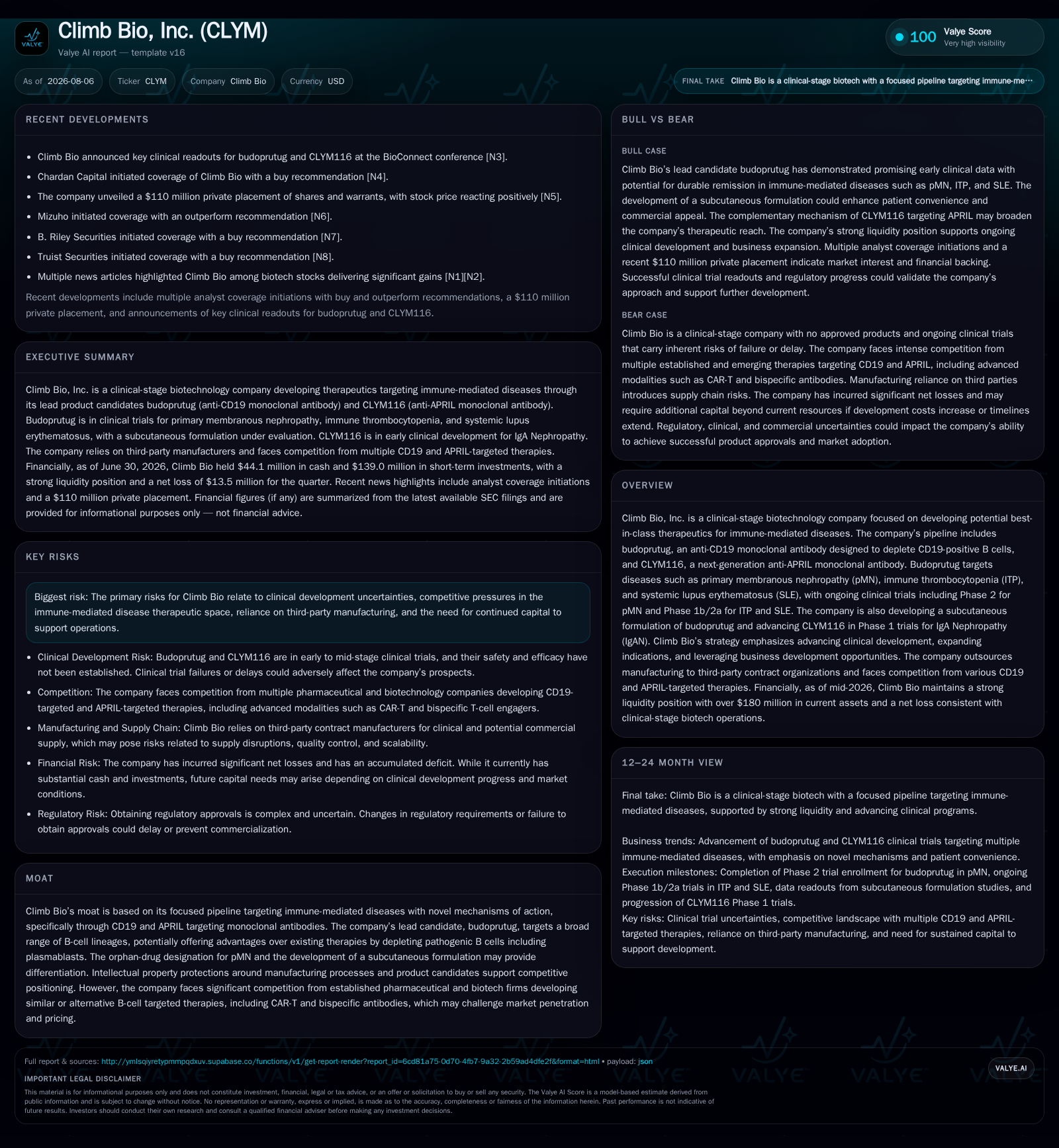
In its latest quarterly update, Climb Bio, Inc. reported continued progress in clinical-stage development of novel monoclonal antibodies targeting immune-mediated diseases. The lead asset budoprutug is advancing multiple Phase 2 and early-phase trials, supported by orphan drug designation and a strategic focus on subcutaneous formulation development. Alongside CLYM116’s Phase 1 study for IgA nephropathy, the company is expanding its pipeline breadth against a backdrop of significant competition in B-cell targeted therapies. Climb Bio’s financial profile is strong with over $44 million in cash and equivalents and a current ratio exceeding 30, supporting cash runway into 2028 despite ongoing R&D expenses.
Recent Operating Update
Climb Bio’s most recent quarterly filing dated August 6, 2026 confirms steady advancement of its clinical pipeline primarily anchored by budoprutug and CLYM116 [S2]. Budoprutug remains in pivotal Phase 2 trials for primary membranous nephropathy (pMN) — a rare autoimmune kidney disease — while parallel Phase 1b/2a studies continue for immune thrombocytopenia (ITP) and systemic lupus erythematosus (SLE). These indications all hinge on targeting pathogenic B cells via anti-CD19 monoclonal antibody mechanisms. Concurrently, CLYM116 is advancing through Phase 1 development focused on IgA nephropathy (IgAN) [S3].
Notably, Climb Bio disclosed ongoing work on developing a subcutaneous (SC) formulation of budoprutug designed to improve patient convenience and compliance compared to intravenous dosing paradigms prevalent among competitors [S1]. This addresses a key industry trend where biologic drug delivery innovations can provide differentiation beyond molecular efficacy alone.
Business Model
As a clinical-stage biotech firm specializing in immune-mediated diseases, Climb Bio’s business model centers on discovering or acquiring biologic candidates exhibiting clear mechanistic rationale against unmet medical needs. Revenue opportunities arise upon successful clinical trial milestones, regulatory approvals, licensing agreements, or eventual commercialization [S1]. Monetization currently depends largely on capital raises since no approved products or associated sales revenues exist
Budoprutug targets CD19—a transmembrane protein expressed broadly on B-cell lineages including plasmablasts implicated in autoantibody production—offering a broader depletion scope than CD20-targeted therapies like rituximab that have limitations in plasmablast targeting. This potentially translates into more durable autoimmune disease remission if clinical hypotheses validate [S1]. Therapeutic focus includes rare conditions like pMN granted orphan drug designation enabling regulatory exclusivity benefits.
CLYM116 inhibits APRIL (A Proliferation-Inducing Ligand), implicated in pathogenesis of IgAN where aberrant immunoglobulin A deposition causes renal damage. Climb Bio acquired licenses for CLYM116 rights outside Greater China through collaboration with Beijing Mabworks Biotech Co., Ltd., exemplifying strategic geographic royalty segmentation common in biotech licensing structures [S1].
Contract Development and Manufacturing Organizations (CDMOs) deliver active pharmaceutical ingredient supply chain services to Climb Bio’s pipeline candidates—a standard outsourcing approach reducing fixed capital barriers but increasing dependency risk on external capacity availability and quality controls [S1]
Industry Structure and Competitive Position
Climb Bio operates within the highly specialized immunology biotech subsector focused on immune-mediated diseases such as pMN, ITP, SLE, and IgAN—fields marked by complex pathophysiology and significant unmet need but also intense R&D competition. Established pharmaceuticals offer standard-of-care treatments but often lack durable efficacy or have substantial safety trade-offs.
Competing therapeutic modalities against which Climb Bio positions include other monoclonal antibodies targeting B-cell markers beyond CD19 (e.g., anti-CD20 agents), emerging bispecific antibodies aiming to engage immune checkpoints or dual antigens, as well as cell therapies like CAR-T specifically engineered to eradicate pathological B cells. Clinical success hinges not only on efficacy but tolerability profiles and administration convenience; here the planned SC formulation could add company product differentiation [S1].
Orphan drug designations provide meaningful market protections granting extended exclusivity durations plus potential expedited regulatory pathways enhancing go-to-market timing relative to peers lacking such status.
Intellectual property underpins competitive moat encompassing licensed patents from collaborations (CRH for budoprutug and Mabworks for CLYM116), proprietary manufacturing processes, and technology platforms securing freedom-to-operate [S1].
Growth Drivers
Climb Bio’s growth catalyst roadmap integrates several vectors:
- Clinical Trial Progress: Positive safety and efficacy data from Phase 2 pMN trial would validate budoprutug’s therapeutic hypothesis supporting label expansion efforts; similarly encouraging interim results from ITP/SLE cohorts could unlock further development investment.
- Regulatory Milestones: Orphan drug designation-associated incentives including fee waivers or accelerated review processes streamline progression towards potential FDA or EMA approvals enhancing market entry prospects.
- Indication Expansion: Leveraging the underlying CD19 mechanism across multiple immune-mediated disorders enhances potential patient population size; ongoing exploration of broader autoimmune disease applicability preserves optionality.
- Formulation Innovation: Development of subcutaneous administration options aligns with medical trends favoring outpatient-friendly treatments improving adherence—this technical advancement could also yield pricing premium opportunities.
- Strategic Partnerships: Licensing deals or co-development agreements may provide non-dilutive funding sources along with broader commercial reach particularly outside North America while enhancing pipeline diversification.
- Intellectual Property Fortification: Augmenting patents around product compositions or manufacturing confers transactional leverage during M&A or partnership discussions while deterring generic erosion.
Risks and Watchpoints
Despite promising developments, several risk factors warrant attention:
- Clinical Development Uncertainty: As a pre-commercial entity reliant on early clinical-readout dependent assets without approved therapies yet, any failure or delay in trials could materially impact valuation and viability [S4].
- Competitive Dynamics: Intense innovation cycles in immunotherapies—especially from larger biotech/pharma players investing heavily in CAR-Ts or bispecific antibodies—may erode market share potential unless differentiation is clinically validated.
- Manufacturing Dependencies: Outsourcing critical supply chain functions subjects Climb Bio to vendor reliability risks including capacity bottlenecks or quality control issues adversely affecting trial timelines [S1].
- Regulatory Challenges: Evolving pharmaceutical legislation both within the U.S. FDA framework as well as EU regulatory environment creates unpredictability around approval criteria coupled with pricing/reimbursement variability globally [S1].
- Capital Needs: Although operating cash flow suffices into 2028 based on present plans, unexpected cost overruns or clinical setbacks could trigger accelerated fundraise requirements potentially dilutive to shareholders.
- Intellectual Property Litigation: The biotech field’s litigious nature presents ongoing threats that any disputes over patent validity or infringement could divert resources away from R&D execution.
- Pricing Pressure: Global payer health systems increasingly emphasize cost-effectiveness posing risks to achieving commercially viable price points after approval especially amid price ceiling implementations internationally [S4].
What to Watch Next
Key upcoming milestones offering visibility into execution include:
- Interim readouts from ongoing Phase 2 pMN trials assessing safety/tolerability endpoints alongside preliminary efficacy signals.
- Data announcements from Phase 1b/2a ITP and SLE programs evaluating pharmacodynamics impact on B cell populations.
- Progression outcomes regarding the subcutaneous budoprutug formulation’s pharmacokinetics/pharmacodynamics profiles informing future registration trial designs.
- CLYM116 initial human dosing results providing insights into APRIL-targeted immunomodulation viability in IgAN.
- Regulatory interactions elucidating acceptances of data packages conducive to accelerated approvals leveraging orphan designations.
- Announcement of licensing collaborations or strategic partnerships aimed at accelerating commercial infrastructure developments abroad.
- Updates related to manufacturing scale-up partnerships ensuring supply continuity ahead of potential phase transitions.
Monitoring operating spend relative to cash burn rates will also inform sustainability discussions alongside external capital market receptivity influencing fundraise timing if required [F1]
Financial Profile Discussion
At Q2 ended June 30, 2026, Climb Bio reported cash & equivalents totaling approximately $44.1 million yielding an exceptionally healthy current ratio near 31:1 due to minimal short-term liabilities (~$5.9 million) versus robust current assets ($186.6 million total), reflecting prepaid R&D investments alongside financial securities [F1]. This liquidity cushion undergirds operational continuity supporting costly multi-indication clinical programs without immediate financing pressure despite cumulative net losses exceeding $289 million historically since inception [S1].
Operating expenses remain dominated by research and development costs attributable to patient recruitment activities, nonclinical studies negotiated contracts with CROs/CDMOs, personnel-related expenditures including stock-based compensation increases aligned with headcount growth efforts for scientific talent acquisition to manage expanding trials [S5][S11]. General and administrative expenses have trended upward consistent with corporate scaling activities including legal/IP management fees—a natural progression for firms transitioning towards late-stage clinical development phases requiring enhanced governance frameworks and commercial planning capabilities [S11].
Interest income adds modest offsetting revenue derived from treasury management of invested funds despite prevailing low-yield environments impacting realized returns marginally downward versus prior periods [S11]. Foreign currency exposure is immaterial currently but will remain monitored as international expansion initiatives progress especially across European trial sites introducing FX volatility considerations [S11].
While no product revenues exist yet reflecting the early-stage nature of the pipeline assets under global development programs funded predominantly through equity capital raises including private placements notably conducted post Tenet Medicines acquisition closed mid-2024 consolidating the candidate portfolio—the company's strategy emphasizes prudent capital deployment aiming for milestone-driven progress unlocking higher-value inflection points before seeking additional financing events which inherently carry dilution risks counterbalanced by pipeline robustness stakeholders expect [S17][S18]
In sum, Climb Bio sustains an adequate financial position suited to support its near-to-mid-term strategic agenda anchored by progressing multi-indication clinical assets poised at key decision thresholds where positive data could transform valuation prospects within a competitive immunotherapy landscape shaped by technological innovation cycles and regulatory scrutiny nuances uncommon elsewhere across therapeutics sectors.
Disclaimer: This is research-only, informational analysis and not investment advice. It may include AI-generated interpretation and general industry context. Always verify important details using primary sources.

Comments