
ON Semiconductor’s Manufacturing Realignment and Merger Plan Shape Market Position in Power and Sensing Semiconductors
Recent quarterly results underscore ON Semiconductor’s strategic focus on capacity optimization, margin expansion, and acquisition-driven portfolio growth amid evolving automotive and AI data center demand.
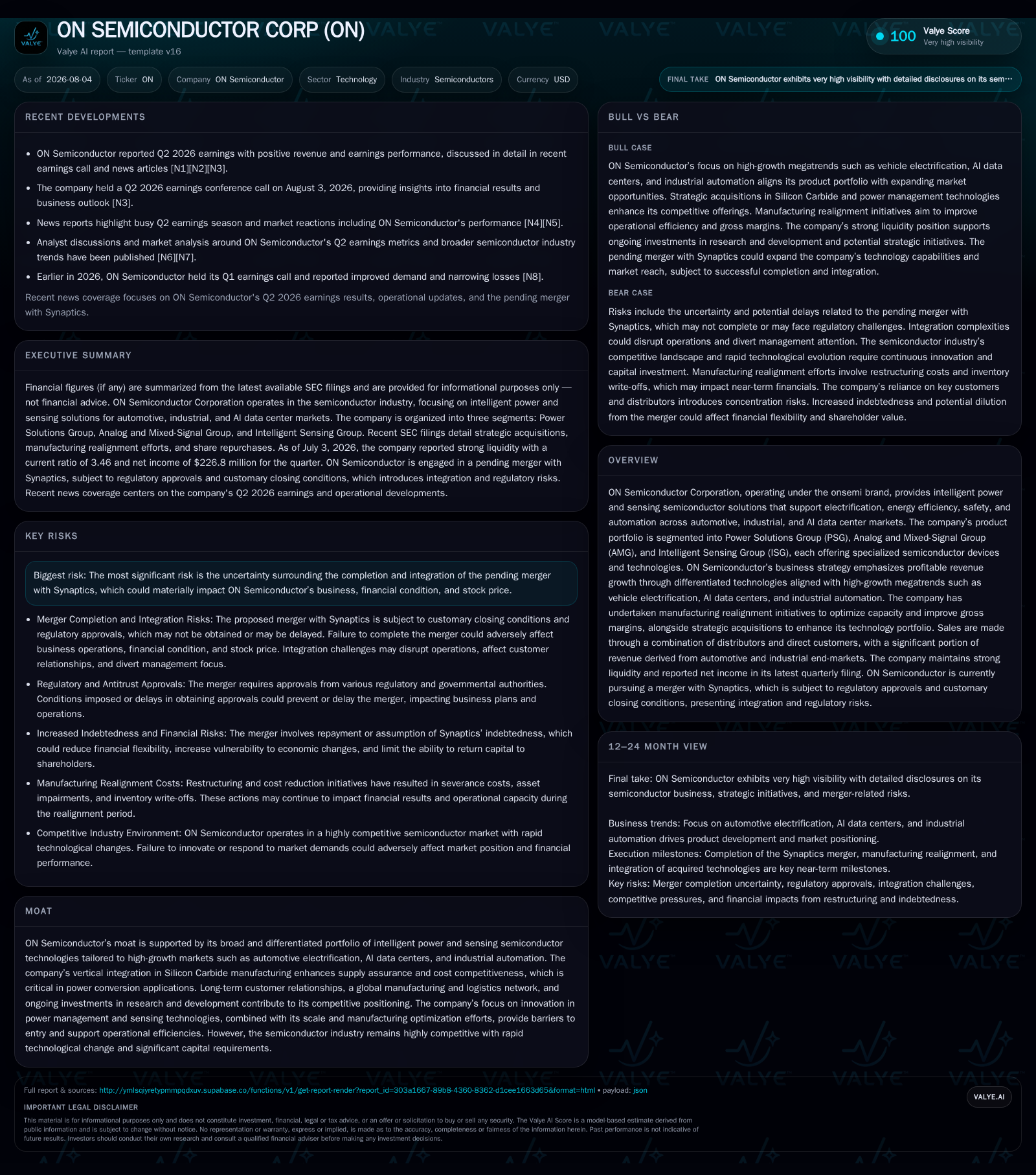
ON Semiconductor’s latest quarterly filing reveals ongoing operational adjustments including manufacturing realignment to enhance gross margins and better align capacity with long-term demand. The company’s intelligent power and sensing semiconductor solutions remain anchored in high-growth markets such as automotive electrification, industrial automation, and AI data centers. The announced mid-2027 merger with Synaptics introduces a notable execution risk that could materially impact the business. ON Semiconductor’s large scale, Silicon Carbide vertical integration, and R&D investment provide a moat against competition, although cyclical demand patterns and integration challenges pose watchpoints.
Recent Operating Update
In the second quarter ending July 3, 2026, ON Semiconductor (onsemi) reported financial results that reinforced its ongoing manufacturing realignment strategy aimed at aligning capacity with forecasted long-term demand while expanding gross margins [S2][S3]. This manufacturing approach involves optimizing wafer fabrication resource allocation within its internal facilities and strategically sourcing components to support differentiated semiconductor products. Notably, these efforts follow significant restructuring initiatives initiated in early 2025 that resulted in terminating approximately 2,400 employees and incurring nearly $667 million in severance, impairment charges, and exit costs [S1]. These past charges underscore a deliberate shift from legacy manufacturing footprints toward a leaner configuration supporting high-growth megatrends.
The Q2 earnings release confirmed revenue trends sustained by strong demand in automotive electrification segments alongside growth within AI data centers — two areas where semiconductors tailored for power efficiency and sensing excel [S3]. ON Semiconductor emphasized its commitment to profitable growth driven by innovative Silicon Carbide (SiC) power devices that enhance energy efficiency for electric vehicle drivetrains and fast charging systems. Furthermore, continued investment in intelligent sensing technologies supports advanced safety features such as ADAS (Advanced Driver Assistance Systems) for automotive markets and enables smarter automation in industrial applications.
Concurrently, on June 25, 2026, ON Semiconductor publicly announced an agreement to merge with Synaptics Inc., a move designed to broaden its technology footprint into human interface solutions complementary to its existing portfolio [S2]. This transaction is pending regulatory review and stockholder approval, with expected closure targeted around mid-2027 but subject to possible delays or termination if conditions are unmet. The company explicitly acknowledges this merger introduces execution risks that may materially impact operating performance or stock valuation during the transition period.
Business Model Nuances
ON Semiconductor operates along the semiconductor value chain primarily as an integrated device manufacturer (IDM) producing specialized analog/mixed-signal ICs, power semiconductors including SiC devices, and intelligent sensors sold mainly to OEMs in automotive, industrial equipment makers, and cloud/data center infrastructure providers [S1]. The company’s revenue generation relies largely on product sales through dual routes: approximately 54% via distributors who provide inventory fulfillment services under agreements allowing returns or exchanges within certain time frames; the remaining ~46% representing direct sales to large multinational OEM customers with longer contractual relationships [S21]. This channel mix ensures some mitigated inventory risks but also exposes the company to typical semiconductor industry cyclicality.
The three reportable segments — Power Solutions Group (PSG), Analog and Mixed-Signal Group (AMG), and Intelligent Sensing Group (ISG) — represent focused product domains addressing distinct yet overlapping market needs [S1]. PSG leads in silicon carbide wafer fabrication vertically integrated internally which secures supply assurance against foundry dependencies—a competitive lever especially critical given the increasing prevalence of SiC in electric vehicles due to higher efficiency over traditional silicon devices. AMG develops general-purpose analog semiconductors targeting power management broadly applicable across industrial machines and consumer electronics. ISG concentrates on sensing modules that enable automation safety systems and robotics.
Revenue drivers stem from the average selling price improvements tied to newer-generation SiC devices coupled with volume growth fueled by accelerating electric vehicle adoption globally plus expanding AI data center energy consumption demands [S1]. Onsemi monetizes not only by selling discrete components but also through integrated circuit modules tailored for optimized power delivery that reduce system complexity for OEMs—thereby commanding premium pricing versus commodity chips
Industry Structure & Competitive Positioning
The semiconductor industry remains capital-intensive and innovation-driven with intense competition among fabs like Infineon Technologies specializing in automotive power devices; fabless companies such as Broadcom focusing on analog/mixed-signal chipset solutions; foundries providing wafer production services; alongside players advancing AI-specific processors like NVIDIA targeting cloud markets. Within this landscape, ON Semiconductor’s differentiation arises from its vertically integrated Silicon Carbide capabilities coupled with a broadened sensing portfolio addressing multiple high-growth end markets simultaneously.
Its recent acquisitions—including IP rights for Vcore power technologies enhancing DC-DC converter efficiencies—and divestitures signal continuous portfolio pruning aligned with customer megatrends rather than chasing low-growth commoditized applications [S23]. This positions onsemi closer competitively to peers like Texas Instruments who balance analog device leadership with significant R&D investment underpinning technology differentiation.
Operational scale enables economies in wafer fab utilization supporting better gross margin profiles despite periodic cyclical softness typical in automotive electronics purchasing patterns. Moreover, rigorous supply chain management amid global semiconductor shortages has been vital to maintaining delivery reliability—a key customer switching cost barrier given costly qualification processes of new suppliers.
Growth Drivers
Key structural growth drivers include rising worldwide electric vehicle penetration necessitating more efficient SiC-based power modules enabling lighter vehicle weight and extended range [S1]. Simultaneously, rapid AI workload expansions multiply energy consumption of data centers where ON Semiconductor’s comprehensive high-efficiency power conversion solutions address growing demand for thermal management reduction.
Industrial automation deploying robotics equipped with advanced sensing fuels ISG segment prospects by increasing electronic content per unit of equipment overseen. The company also benefits indirectly from government decarbonization incentives supporting clean energy infrastructure investments demanding sophisticated power semiconductors.
The pending Synaptics merger aims to add complementary touch controller technologies augmenting end-to-end sensor-to-power conversion capabilities—which could unlock cross-selling opportunities while broadening the total addressable market beyond current exposure [S2].
Risks & Watchpoints
Execution risk surrounding the Synaptics transaction remains significant given regulatory scrutiny—including antitrust reviews—and required voting approvals. Failure or delay could impact share price performance given investor expectations embedded in current stock valuations [S2]. Additionally, integration challenges post-merger could strain resources or distract from core innovation initiatives.
Market cyclicality inherent to semiconductor demand tied especially to automotive OEM production schedules could induce volatile quarterly sales patterns influencing capacity utilization rates adversely if orders fluctuate sharply—a common risk across peers. Furthermore, pricing pressure persists amidst competition from emerging analog IC suppliers exploiting lower-cost outsourcing models.
Capital intensity constraints require continuous reinvestment into advanced fabrication facilities; misalignment between capital expenditures relative to shifting end-market demand forecasts could impair forward-looking profitability. Finally, supply chain disruptions or raw material cost volatility remain persistent threats requiring vigilant management.
What to Watch Next
Upcoming milestones include regulatory clearance progress on the Synaptics deal alongside any updated management commentary on integration plans that would clarify synergies or potential cost savings timelines expected around the mid-2027 transaction close [S2]. Monitoring gross margin trajectory will reveal whether ongoing manufacturing realignment efforts continue translating into improved profitability as planned.
R&D spending trends relative to revenue—a key innovation metric—will indicate sustained emphasis on technological leadership particularly within SiC wafers critical for EV powertrain adoption. Order backlog visibility from large automotive OEMs ahead of model production ramp-ups will serve as a barometer for near-term demand strength.
Financially, changes in net leverage post-merger alongside free cash flow conversion metrics will be scrutinized by stakeholders given elevated debt levels roughly totaling $4.5 billion offset against substantial cash reserves of $3.5 billion as of the latest quarter end [F1], balanced by a strong current ratio of 3.46 showcasing liquidity resilience.
Financial Profile Discussion
As of July 3, 2026 quarter-end, ON Semiconductor maintains cash and equivalents totaling approximately $3.51 billion against total debt near $4.5 billion resulting in modest net debt near $990 million—indicating manageable leverage when factoring operational cash flows supported by scale efficiencies [F1]. The company holds current assets worth about $7.28 billion relative to current liabilities near $2.10 billion delivering a robust current ratio of 3.46 supporting short-term liquidity needs under normal business cycles [F1].
This financial flexibility is crucial given ongoing share repurchase programs approved through 2028 totaling up to $6 billion cumulatively aimed at cautious capital return while preserving balance sheet strength amid growth investments [S4][S19]. Additionally, debt facility covenants impose consolidated net leverage caps awaiting potential recalibration post-Synaptics acquisition completion which itself includes incremental indebtedness considerations disclosed recently [S28].
The company expects capital expenditures around 5% of revenues consistent with prior years’ levels reflecting moderate reinvestment pacing suitable for manufacturing realignments without aggressive expansion potentially straining free cash flow generation [S19]. Operational cash flow metrics remain key monitors as they underpin debt servicing capability and fund discretionary activities including M&A playbook support.
This analysis aims solely to provide an informed overview based on recent public disclosures without extending into investment research views or price forecasts.
Disclaimer: This is research-only, informational analysis and not investment advice. It may include AI-generated interpretation and general industry context. Always verify important details using primary sources.

Comments