
Tarsus Pharmaceuticals Expands Ophthalmology Franchise with XDEMVY Commercial Traction and Pipeline Diversification
Recent quarterly results highlight growing sales of FDA-approved XDEMVY and strategic acquisitions enhancing Tarsus' pipeline amid ongoing operating losses.
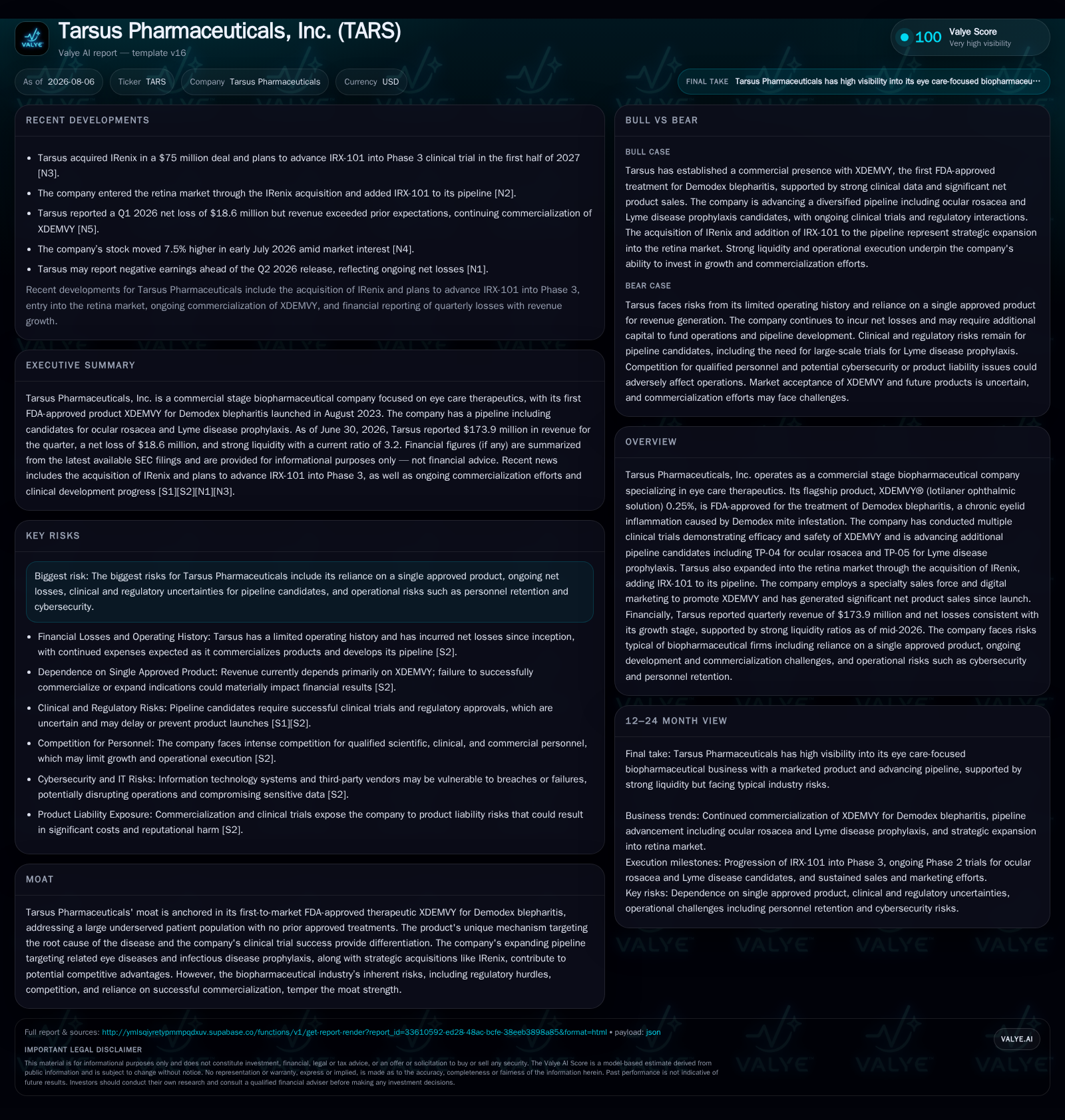
Tarsus Pharmaceuticals, a commercial-stage biopharmaceutical company focused on eye care, reported strong net product sales for its first-to-market FDA-approved therapy XDEMVY in Q2 2026. The company is expanding its pipeline through internal development of novel treatments in ocular and infectious diseases as well as acquisitions like IRenix and Alkeus to broaden therapeutic reach. Despite continued net losses resulting from substantial R&D and SG&A investments, Tarsus demonstrates solid liquidity and access to capital, positioning it for sustained commercialization efforts. Challenges remain in diversifying revenue beyond the single approved product and managing regulatory, reimbursement, and competition risks.
Recent Operating Update
Tarsus Pharmaceuticals reported its quarterly results for Q2 2026 underscoring significant progress in commercializing XDEMVY® (lotilaner ophthalmic solution) 0.25%, the first FDA-approved treatment specifically targeting Demodex blepharitis [S2]. Since its U.S. approval in July 2023 and launch in August 2023, the company has generated tangible net product sales contributing to total quarterly revenue of $173.9 million as confirmed by market commentary [N1] and filings [S2]. Despite running operating losses of $18.6 million for the quarter, this compares favorably to prior-year losses illustrating improving operational leverage as sales build.
The commercialization strategy centers on employing a specialty sales force skilled in ophthalmic therapeutics combined with digital direct-to-consumer marketing campaigns to cultivate awareness among eye care professionals and patients. Awareness surveys indicated unaided recognition of Demodex blepharitis has risen approximately from 2% initially to around 25% following these efforts [S1]. With an estimated addressable U.S. patient population of 25 million sufferers—approximately nine million actively seeking treatment or associated therapies—the market opportunity remains sizable [S1].
Business Model Analysis
Tarsus operates as a mid-to-late stage biopharmaceutical company focused primarily on novel drug commercialization in eye care disease areas marked by high unmet medical need. Revenue generation pivots on proprietary drug products; currently only one FDA-approved product (XDEMVY) drives meaningful top-line sales [S2]. Monetization occurs through direct net product sales facilitated via specialty pharmacies and eye care providers, where reimbursement success hinges on payer coverage that typically follows documented clinical benefit and formulary inclusion.
Core operating costs derive from R&D investments powering both lifecycle extension trials for XDEMVY indications (including Meibomian Gland Disease overlap) and the advancement of pipeline candidates such as TP-04 (ocular rosacea) and TP-05 (Lyme disease prophylaxis). Additionally, expenses include SG&A functions principally supporting sales personnel, marketing campaigns, regulatory compliance, and corporate operations [S1], [S15].
XDEMVY's active pharmaceutical ingredient lotilaner acts selectively to paralyze Demodex mites by inhibiting parasite-specific GABA-gated chloride channels without impacting human receptors—a distinct mechanism differentiating it from symptomatic treatments historically employed off-label. This root-cause targeting underpins clinical differentiation validated across multiple phase trials completed before launch [S1]. Successful market penetration depends on physician prescribing behavior shifts, patient adherence, reimbursement policies, and continued education.
Industry Structure and Competitive Position
The biopharmaceutical sector specializing in niche ophthalmic disease spaces is characterized by complex regulatory pathways demanding rigorous clinical proof sets prior to approval combined with intensive post-launch commercialization challenges dominated by relatively small targeted patient populations. Peers include companies such as Regeneron and Alcon that market specialty ophthalmic products but often have broader portfolios encompassing other therapeutic classes or device components.
Tarsus commands a unique competitive position thanks to XDEMVY’s status as the first FDA-approved agent targeting Demodex blepharitis—a condition historically unaddressed by approved pharmacologics—bestowing a tactical early-mover advantage [S1]. However, competition risks emerge from potential new entrants developing alternative mechanisms or generics post-patent expiry alongside evolving standards of care integrating adjunctive therapies.
Acquisitions play a pivotal role in bolstering Tarsus’ long-term defense against competitive threats. The July 2026 acquisition of IRenix Medical expanded Tarsus’ footprint into retinal therapeutics with IRX-101, which is slated for Phase 3 initiation in H1 2027 signaling diversification beyond external eyelid diseases [N5], [N6]. The announced pending acquisition of Alkeus Pharmaceuticals further aims at augmenting early-stage pipeline assets potentially complementary to existing projects [N4]. Strategic integration execution will be critical to leveraging these deals into sustainable growth vectors.
Growth Drivers
Key growth catalysts include:
- Expansion of XDEMVY Market Penetration: Continuing education programs, increased physician adoption rates aided by positive real-world evidence, broader payer reimbursement coverage advancements, and enhanced patient recruitment through digital channels.
- Pipeline Advancement: Initiating pivotal trials for TP-04 addressing ocular rosacea taps related inflammatory eye conditions linked etiologically or symptomatically with Demodex infestation. Oral TP-05 targeting Lyme disease prophylaxis represents an innovative infectious-disease therapeutic leveraging lotilaner’s parasiticidal properties beyond ophthalmology [S1].
- Strategic M&A: The IRenix acquisition adds modularity into adjacent retina markets while Alkeus pending acquisition broadens R&D scope enhancing medium-term pipeline robustness.
- Epidemiological Trends: Aging populations prone to ocular surface disorders may incrementally expand addressable market sizes.
- Innovation & Formulation Improvements: Potential enhancements in dosing convenience or combination therapies could improve patient adherence raising lifetime value per patient.
These drivers tie directly into operational KPIs such as prescription volume growth, clinical trial enrollment velocity/completion, gross-to-net adjustments reflecting payer mix shifts, and overall R&D expense efficiency.
Risks and Constraints
Despite positive momentum several intrinsic risks temper outlook:
- Single Product Dependence: Commercial success currently hinges heavily on sustained uptake of XDEMVY; pipeline candidates remain at various clinical stages with uncertain timelines for approval or commercial viability [S23].
- Regulatory Uncertainty: FDA policy shifts or delays inherent to clinical trials could disrupt development milestones.
- Reimbursement Climate: Achieving broad insurance coverage at economically viable pricing points remains challenging; suboptimal reimbursement would constrain revenue scaling.
- Competitive Threats: Emergence of novel treatments or biosimilars could undermine market share.
- Operational Risks: Integration burden from acquisitions; talent retention; manufacturing supply chain disruptions; compliance with evolving healthcare laws including anti-kickback statutes pose ongoing challenges [S6], [S12], [S23].
- Profitability Pressure: Despite narrowing losses the company continues spending ahead of revenue growth necessitating prudent cash management.
Monitoring prescription growth rates, clinical trial data releases particularly from pivotal studies for TP-04 or IRX-101, payer coverage expansions, gross margin trends post marketing scale-up, and integration progress on acquisitions represent near-term watchpoints.
What To Watch Next
Milestones which will clarify trajectory include:
- Clinical readouts or regulatory submissions for TP-04 ocular rosacea candidate.
- Initiation of Phase 3 trial for IRX-101 per planned schedule H1 2027.
- Closing completion and integration steps related to Alkeus acquisition.
- Quarterly updates on XDEMVY net product sales progression capturing adoption breadth beyond initial launch phases.
- Additional data regarding payer contract wins or formulary placements impacting market access dynamics.
- Operating cost trends relative to revenue scaling indicating pathway toward sustainable profitability.
Financial Profile Discussion
At quarter-end June 30, 2026, Tarsus held a robust cash position of approximately $205 million against total debt near $75 million yielding a net cash surplus around $130 million with a current ratio near 3.2 evidencing strong short-term liquidity resilience preferred by investors addressing biotech sector volatility [F1], [S2]. The April 2024 secured credit facility underpins capital structure flexibility though constraints exist around asset liens limiting some strategic financial maneuvers [S4], [S7].
Net loss narrowed sequentially reflecting improved sales offsetting increased investments: $18.6 million loss for Q2 2026 versus $20.3 million year prior supports gradual operational leverage gains though profitability remains elusive due to heavy reinvestment cycles typical for biotech firms transitioning from development to commercialization phases [S2], [N1].
R&D expense growth driven by expanding pipeline trials plus SG&A expansion required to sustain sales force scale contribute substantially to current negative income profiles but are strategic investments designed to build durable competitive moats over time. Continued ability to raise capital via private placements evidences investor confidence even as cost structures rise [S2]. Maintaining sufficient runway while executing M&A integration will be essential pillars supporting medium-term valuation uplift prospects.
Disclaimer: This analysis does not constitute investment advice but aims to provide an informed industry-level perspective grounded exclusively on public filings and credible sources cited herein.
Disclaimer: This is research-only, informational analysis and not investment advice. It may include AI-generated interpretation and general industry context. Always verify important details using primary sources.

Comments