
MGT Capital’s Post-Mining Transition Faces Capital Strain and Strategic Uncertainty
Following its exit from active Bitcoin mining, MGT Capital Investments confronts liquidity challenges and an uncertain path for asset redeployment.
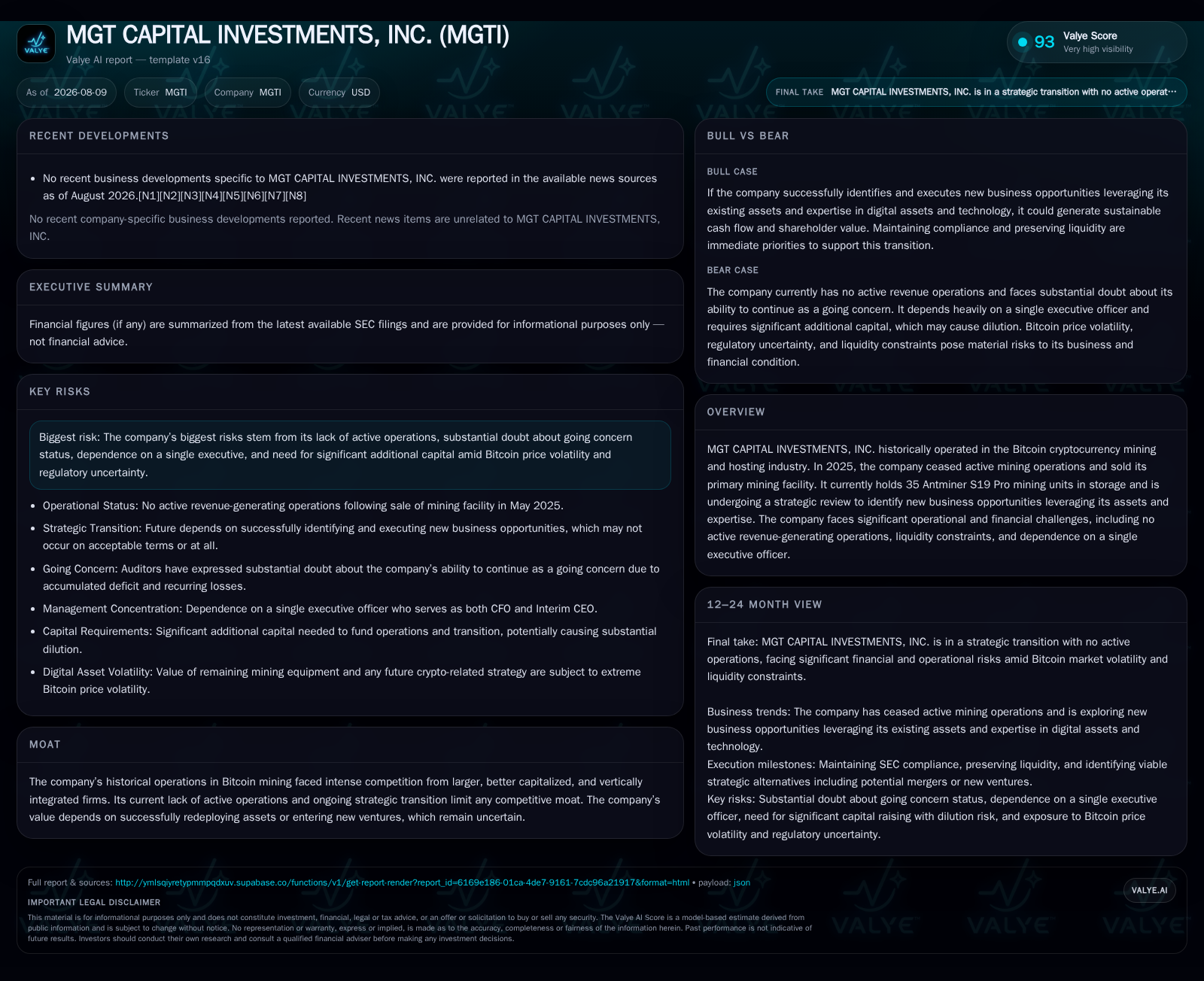
MGT Capital Investments, Inc. ceased active Bitcoin mining operations during 2025, culminating in the sale of its primary mining facility and the storage of 35 Antminer S19 Pro units. The company's latest quarterly filing confirms operational dormancy with no active revenue streams and a critical strategic review underway to identify new business opportunities leveraging existing assets. However, MGT faces a precarious liquidity position, dependence on key personnel, and substantial doubt about its ability to continue as a going concern. Industry dynamics highlight the difficulties such smaller operators face competing with large-scale, vertically integrated miners amid volatile cryptocurrency markets.
2026 Q2 Operating Update: The Reality of Operational Dormancy
MGT Capital Investments’ latest 10-Q filing dated August 7, 2026, confirms that the company remains dormant operationally since it halted active Bitcoin mining activities and sold off its primary mining facility in May 2025 [S2][S1]. Notably, MGT retains ownership of 35 Antminer S19 Pro machines—high-performance ASIC miners capable of delivering roughly 3 petahashes per second (PH/s) when fully operational—that are currently stored and not generating revenue [S1]. This status highlights an inactive asset base producing no block rewards or transaction fees, the primary revenue levers for cryptocurrency miners.
The absence of operational income exacerbates fixed expenses related to corporate infrastructure while locking significant value into idling equipment vulnerable to technological obsolescence. This leverages operating risk conversely—without utilization to spread costs—potentially accelerating cash burn despite limited overhead [S2]. Monitoring equipment redeployment or sale will be vital demand-side signals to adjudicate future earning potential.
From Active Mining to Asset Storage: Revisiting MGTI’s Business Model Shift
Historically, MGT operated within both self-mining and third-party hosting segments: deploying ASIC miners onsite at their LaFayette facility to directly mine Bitcoin receiving block rewards plus transaction fees while leasing out space and infrastructure to other miners [S1][S5]. Hash rate capacity and equipment utilization rates—core KPIs in this sector—drove revenue mechanics by translating computational power into crypto yield amid network difficulty adjustments.
However, with lease termination of key hosting clients in March 2025 and disposal of physical infrastructure thereafter in May 2025 [S1], the company effectively abandoned both sides of this capital-intensive business. The sale eliminated fixed asset burdens like power contracts and cooling infrastructure maintenance but severed ongoing service revenues. The transition pivoted MGT toward managing idle hardware assets as inventory rather than active operating units.
This shift transforms the company from an active participant capturing digital asset mining economics into an entity pondering asset redeployment options under severely constrained capital conditions—a less scalable proposition given depreciation rates on hardware like Antminer S19 Pros accelerate rapidly amid continuous technological advances in mining hardware.
Competitive Backdrop: How MGTI's Scale Compares in Bitcoin Mining Ecosystem
Within the broader cryptocurrency mining industry, MGT's current scale compares modestly against large vertically integrated operators such as Riot Platforms and Marathon Digital Holdings which command substantially higher hash rate capacities supported by established power supply agreements optimizing cost per kilowatt-hour and maintaining superior equipment utilization rates [S1]. These incumbents benefit from economies of scale driving stronger operating margins per mined coin.
Moreover, large operators typically operate data centers with robust cooling infrastructures ensuring uptime reliability critical for continuous blockchain validation where outages directly impair block rewards earned. In contrast, MGT’s absence from any facility operation eliminates these operational leverage points making it challenging to re-enter the market competitively without extensive capital infusion or partnerships.
Hosting services providers like Core Scientific diversify by offering co-location services extending value chain participation beyond direct mining—increasing resilience through customer diversification—which MGT lost with lease expirations during its strategic downscale [S1]. Without similar multi-faceted revenue streams or scale economics, MGT's path forward entails significant reinvention.
Strategic Review Underway: Redeployment Options and Execution Challenges
MGT explicitly acknowledges that its future hinges on successfully identifying new ventures that employ its existing asset base or technological expertise [S1][S3]. The ongoing strategic review contemplates possible mergers, acquisitions, or new lines leveraging digital assets or data infrastructure competencies. Yet execution risks are sizable given sparse resources stretched across compliance maintenance, minimal corporate overhead management, and acute dependence on interim CEO/CFO Jonathan Pfohl who also recently joined the board alongside independent director David Garrity [S3][S19].
This concentration intensifies control risks while limiting bandwidth for scouting or integrating complex strategic alternatives especially against a backdrop of market uncertainty driven by cryptocurrency volatility and evolving regulatory scrutiny [S1][S21]. Furthermore, redeploying stored ASIC miners demands constructive crypto price environments to justify reactivation capex alongside access to competitively priced electricity—a factor that historically restricts smaller operators without direct utility contracts.
Growth Constraints: Liquidity Shortfalls and Crypto Market Volatility
Financially, MGT grapples with constrained liquidity manifested by only $232K in cash against $693K in current liabilities at June 30, 2026 resulting in an unfavorable current ratio of approximately 0.33 [F1]. This deficit puts immediate pressure on working capital sufficiency for corporate expenses necessary to sustain regulatory compliance and support strategic initiatives.
While total debt figures remain stagnant at circa $311K (last reported at September 2020) [F1], present debt structure details are scant tying back to older notes; nonetheless the company executed a notable secured convertible promissory note exchange in mid-2026 indicating attempts to manage financial obligations via equity issuance [S13][S22]. Equity raises have been continuous but dilute existing shareholders substantially given low share price levels approaching penny stock designation which limit access to favorable capital markets [S12][S21].
Cryptocurrency price swings compound valuation uncertainty for reinvigorated mining operations should MGT pursue asset reactivation since rewards per block fluctuate closely with BTC prices adjusted further downward by mining difficulty increases post recent halving events (April 2024 halving reducing reward to ~3.125 BTC per block) [S1]. Such volatility challenges generating predictable cash flows needed for sustainable growth.
Watchpoints Ahead: Potential Catalysts, Financing Needs, and Milestones
Key near-term markers investors should observe include formal announcements concerning the fate of stored ASIC miners—whether sales, re-deployment into hosted operations elsewhere or conversion into alternative technologies [S2][S3]. Progress toward closing strategic transactions such as mergers or acquisitions aiming to diversify revenue bases would signal tangible advancement.
Equally crucial will be updates on any new financing arrangements addressing shortfall issues highlighted above; failure to secure fresh capital could precipitate insolvency scenarios under auditor expressed substantial doubt about going concern status made public during the last annual report cycle [S1][S2].
Corporate governance developments around bolstering board independence via additions like David Garrity reflect steps toward improving oversight though operational turnaround relies heavily on execution clarity which remains pending [S19].
Financial Profile Discussion: Liquidity Limits and Going Concern Implications
These stressed metrics underpin external audit opinions expressing substantial doubt about MGT's ability to continue as a going concern absent successful capital raises or operational renewals [S1][S2]. The recent conversion of secured notes into preferred stock and common shares hints at attempts to stabilize debt structures but also dilutes shareholder value extensively raising concerns about financing feasibility going forward [S13][S22].
Overall financial positioning constrains strategic flexibility forcing management to prioritize preserving liquidity while advancing redevelopment efforts cautiously amid volatile cryptocurrency market dynamics and intense competition.
MGT Capital Investments’ trajectory exemplifies the profound challenges faced by smaller cryptocurrency miners exiting active operations within a highly competitive industry dominated by better-capitalized peers benefiting from scale economies across hash rate capacity, energy procurement efficiency, and diversified business lines including hosting services. Their pivot toward asset storage coupled with ongoing strategic reviews exposes material execution risks compounded by thin liquidity buffers and management concentration. Monitoring any concrete redeployment plans or capital market actions will be critical to assess if dormant assets can be transformed into meaningful new revenue streams under prevailing crypto market conditions.
Disclaimer: This analysis is for informational purposes only and does not constitute investment advice or research views.
Disclaimer: This is research-only, informational analysis and not investment advice. It may include AI-generated interpretation and general industry context. Always verify important details using primary sources.

Comments