
Muncy Columbia Financial Strengthens Regional Community Bank Franchise with Solid Merger Execution and Stable Credit in Q2 2026
Recent quarterly results highlight steady operational performance and robust regulatory capital underpinning a locally focused community bank model after a 2023 merger.
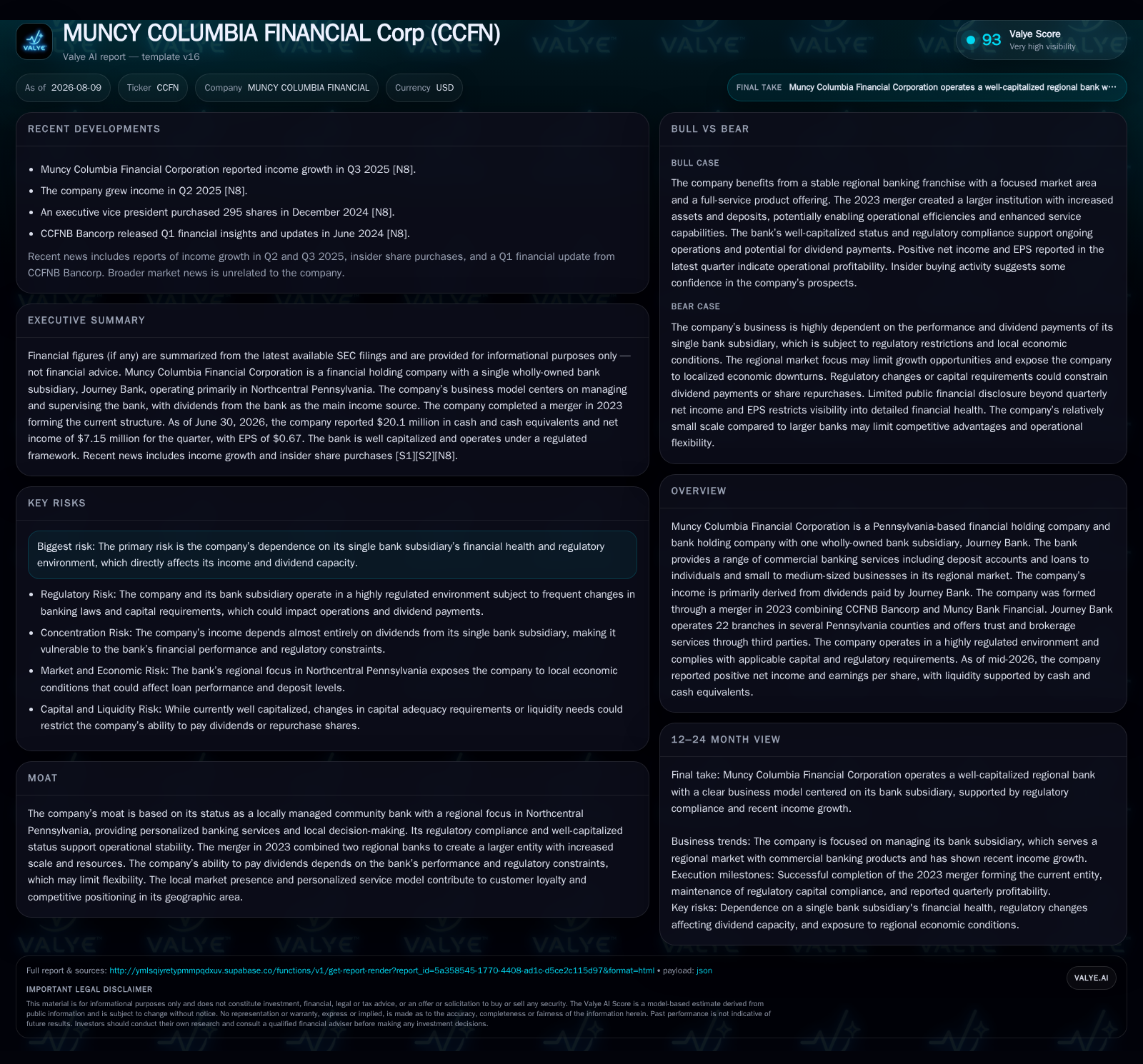
Muncy Columbia Financial Corporation reported its latest quarterly results showing continued operational steadiness following its strategic 2023 merger. With $1.7 billion in assets and a diversified loan portfolio concentrated on small to medium-sized businesses in Northcentral Pennsylvania, the company relies primarily on dividends from its wholly owned subsidiary, Journey Bank. The regulatory environment remains a critical factor influencing dividend capacity and growth opportunities, while local economic conditions impact credit quality and loan demand. Stable regulatory capital ratios and liquidity positions support ongoing operations amid competitive pressures from larger regional banks.
Recent Operating Update
Muncy Columbia Financial Corporation's latest quarterly filing for Q2 2026 provides the most current insight into its operating status post its transformational merger in late 2023. The company continues to benefit from dividends paid by Journey Bank, its sole wholly owned subsidiary, sustaining a positive net income trajectory consistent with prior quarters [S2][S3]. While precise earnings detail for Q2 was not enumerated in the excerpts, management's public statements confirm ongoing operational stability. This recent filing shows no material changes to previously disclosed risk factors or business conditions, underscoring an environment of predictable execution [S2].
The 2023 merger combined CCFNB Bancorp and Muncy Bank Financial into a single entity now operating under the Muncy Columbia Financial brand [S1]. This strategic consolidation effectively increased total assets to approximately $1.7 billion as of year-end 2025, with gross loans near $1.2 billion and deposits around $1.4 billion—a scale that situates it as a competitively sized regional community bank within Pennsylvania’s Northcentral region
Business Model Overview
Muncy Columbia Financial's business model revolves around its bank subsidiary Journey Bank, which functions as a traditional community bank focusing on providing deposit accounts, consumer loans, commercial loans, and mortgage lending primarily to individuals and small-to-medium-sized businesses (SMEs). The bank’s branch network—comprising 22 locations spread across Clinton, Columbia, Lycoming, Montour, and Northumberland counties—anchors its localized footprint where personalized customer relationships drive retention and growth [S1][S21]
Revenue principally arises from net interest income generated when Journey Bank deploys customer deposits into loans and investments [S1]. This interest margin is supplemented by fee-based income streams including trust services managed internally and brokerage services offered through third-party partnerships. The holding company itself earns most of its revenues through dividends distributed from the bank subsidiary rather than direct customer-facing activity
Given regulatory restrictions on dividend distributions by banks to their holding companies under Pennsylvania law plus supervisory guidelines at the federal level, Muncy Columbia’s ability to return capital to shareholders depends heavily on Journey Bank’s profit performance coupled with maintaining adequate capital buffers [S6][S8]. These factors place a natural ceiling on payout capacity but reinforce financial prudence.
Industry Structure and Competitive Position
Operating as a regional community bank places Muncy Columbia in an industry segment that is intensely local yet influenced by wider financial market dynamics. The company's direct competitors include similarly sized regional banks focused on SME lending and consumer deposits in defined geographies along with credit unions and thrifts serving overlapping clienteles. Larger national or super-regional banks also compete indirectly through digital channels or broad service offerings though typically lack local presence advantages held by community banks like Journey Bank [S19].
The firm's competitive moat lies in localized decision-making agility, personalized service amenities, broad suite product offerings calibrated to SME needs (including flexible credit policies), and trusted longstanding community relationships fostered via its branch network. However, competitive pressures arise due to limited scale relative to large banks that can leverage pricing flexibility or technology investments more efficiently [S19]. Additionally, emerging fintech lenders challenge core commercial loan segments by offering speed or alternative underwriting models
Growth Drivers
Several organic and strategic levers underpin Muncy Columbia's growth outlook:
- Loan Portfolio Expansion: Focusing on growing commercial loan originations targeted at SMEs combined with residential mortgage lending underpins asset growth potential while enhancing net interest income.
- Deposit Base Stability: Maintaining low-cost deposit accounts fuels loan funding capacity while controlling funding costs critical for net interest margin sustainability.
- Improved Credit Quality: Stringent credit policies aim to reduce loan loss provisions which enhances earnings quality over time.
- Fee Income Cross-Selling: Expanding trust department activities alongside brokerage services via affiliated parties provides noninterest revenue diversification.
- Merger Scale Benefits: The integration of CCFNB Bancorp with Muncy Bank Financial increased scale leading to improved operational efficiencies visible over successive quarters.
- Local Economic Conditions: Regional economic trends affecting employment levels and business activity directly influence loan demand, repayment performance, and deposit growth.
- Net Interest Margin Environment: Prevailing interest rate cycles impact the spread between yields earned on assets versus cost of funds; favorable rate conditions enhance margins.
These drivers rely heavily on stable or improving local economic fundamentals given community banking's intrinsic linkage to geographically concentrated markets.
Risks and Constraints
While the company's focused business approach offers advantages, it introduces several noteworthy risks:
- Local Economic Sensitivity: Concentration risk is significant since downturns specifically in central Pennsylvania would likely depress borrower repayment capacity causing increased delinquencies or charge-offs that pressure profitability [S27][S29]. SMEs targeted generally have less financial buffer against cyclical shocks.
- Regulatory Restrictions: Compliance costs remain elevated given complex banking regulations governing capital adequacy, dividend limitations, anti-money laundering rules, plus evolving consumer protection requirements enforced by federal authorities like CFPB. Regulatory changes could adversely affect product offerings or operational flexibility [S20].
- Credit Quality Volatility: Commercial real estate exposure features riskier repayment sources compared to residential mortgage loans; rising problem asset levels or foreclosure rates would necessitate higher loan loss provisions impacting earnings [S23][S27].
- Competition Pressure: Larger banks’ pricing power can erode margins while innovative fintech entrants may attract growth segments challenging traditional origination channels [S19].
- Capital Constraints: Stringent Basel III capital requirements limit the extent of balance sheet expansion without dilutive equity raises; this could impede credit growth during periods of heightened demand if deposit base proves insufficiently elastic [S8][S15].
Systematic monitoring of these risks via KPIs such as non-performing asset ratios, provision expense trends, efficiency ratio movement (cost control), capital ratios (Tier 1 leverage), and local economic indicators will be essential for gauging future stability.
What To Watch Next
Stakeholders should focus on key upcoming milestones and metrics:
- Quarterly earnings releases for confirmation of net income consistency alongside any commentary about changes in yield spreads or credit provision outlooks.
- Regulatory filings updating capital adequacy metrics especially Tier 1 leverage ratio trends relative to "well-capitalized" thresholds.
- Loan portfolio growth pace particularly commercial versus residential splits indicating demand shifts.
- Deposit growth data evidencing ability to maintain low-cost funding amidst competition.
- Management disclosure regarding further integration progress post-merger highlighting realized efficiencies or cost synergies.
- News around regulatory developments impacting dividend distribution capacity or compliance costs.
- Local economic reports including unemployment rates or business activity indexes within operating counties providing context for credit quality expectations.
Tracking these indicators will help clarify how successfully Muncy Columbia balances growth ambitions against regulatory constraints and competitive realities.
Financial Profile Discussion
As of June 30, 2026, Muncy Columbia Financial held approximately $20.1 million in cash and cash equivalents supporting liquidity needs amid ongoing operations [F1]. The latest available data indicates total debt outstanding near $40.6 million as of March 31, 2026, creating a net debt position of roughly $20.5 million [F1].
The holding company's dependency on Journey Bank dividends underscores the importance of subsidiary financial health for consolidated balance sheet resilience.
This analysis synthesizes information publicly disclosed by Muncy Columbia Financial Corporation through SEC filings complemented by industry-standard framing typical for regional community banking organizations. It aims to elucidate the company's durable strengths grounded in local market expertise post-merger integration while highlighting constraints imposed by regulatory demands and market structure dynamics. Investors should monitor quarter-to-quarter execution against outlined KPIs without presuming forward guidance not explicitly established by management disclosures.
Disclaimer: This is research-only, informational analysis and not investment advice. It may include AI-generated interpretation and general industry context. Always verify important details using primary sources.

Comments