
Consumer Portfolio Services Expands Debt Amid Subprime Auto Finance Pressure and Secures Liquidity via Securitizations
Latest quarterly results reveal increased securitized debt and warehouse borrowings as CPS deepens exposure in subprime auto financing.
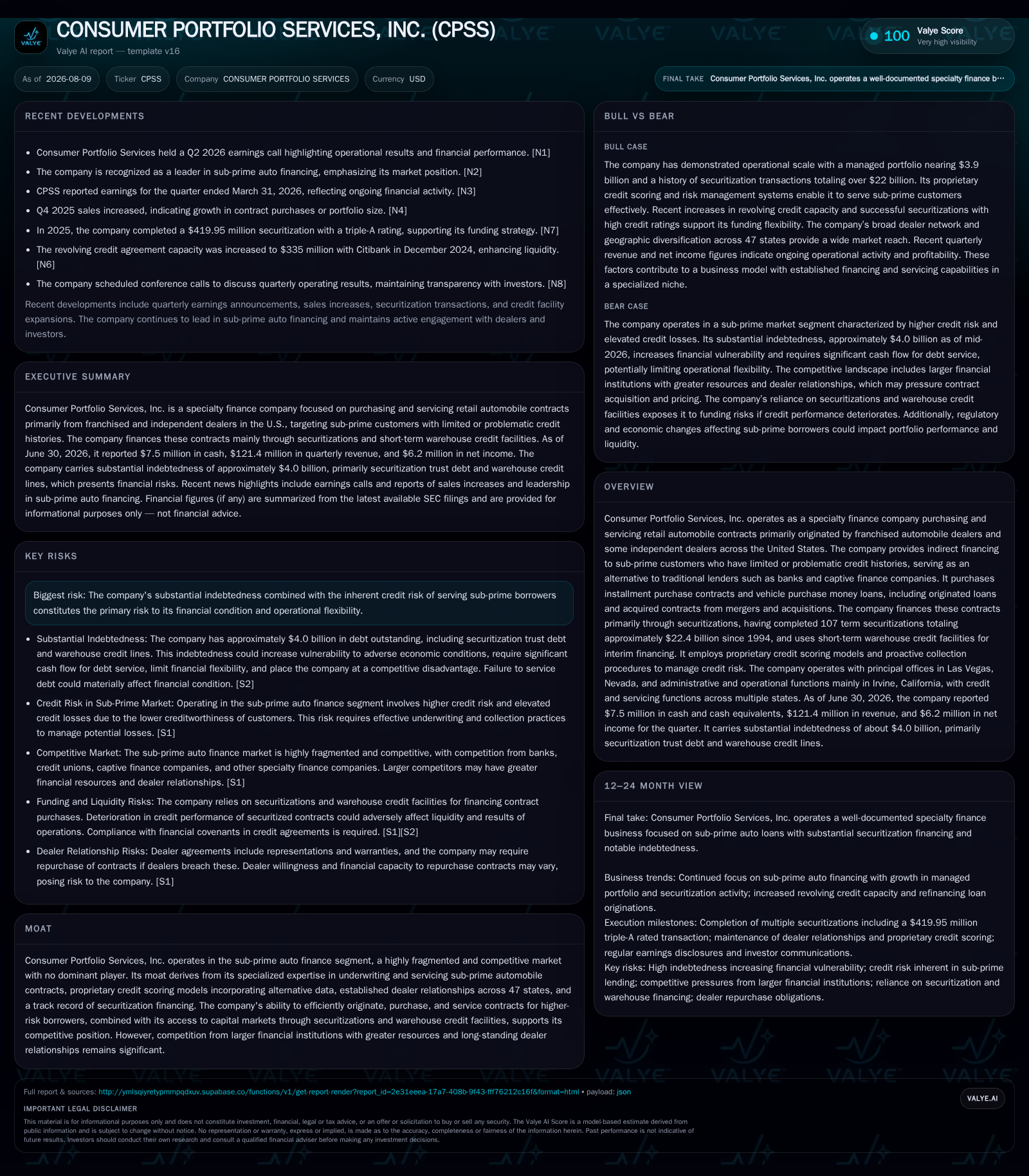
Consumer Portfolio Services, Inc. (CPSS) reported a notable rise in total indebtedness to approximately $4 billion by mid-2026, driven by expanded securitization trust obligations and increased warehouse lines of credit. Operating within the challenging subprime auto finance sector, CPS specializes in purchasing and servicing retail installment contracts for consumers with credit difficulties, using proprietary underwriting and leveraging capital markets funding. The company’s growth hinges on its dealer network breadth, credit modeling sophistication, and access to securitizations; however, rising leverage and cyclically sensitive credit losses pose risks to financial flexibility. Monitoring contract purchase volumes, delinquency trends, and securitization capacity will be critical for assessing CPS’s sustainable execution path.
Recent Operating Update: Elevated Indebtedness Reflects Funding Strategy
Consumer Portfolio Services (CPS) disclosed a substantial increase in total debt at June 30, 2026 to roughly $4.01 billion. This reflects growth in their securitization trust debt to $3.13 billion—up $144.5 million since year-end 2025—and a pronounced increase in warehouse lines of credit borrowings by $355 million to nearly $680 million [S2][S19]. The subordinated renewable notes outstanding remained relatively stable around $28.5 million. The spike in short-term warehouse facility borrowings suggests CPS is aggressively funding new retail installment contract acquisitions ahead of completing additional term securitizations.
This leverage expansion aligns with CPS's longstanding approach of using securitization as the primary vehicle to monetize pools of subprime automobile contracts and leveraging warehouse lines for interim liquidity. Such financing enables scaling of contract purchase volumes but simultaneously heightens vulnerability to disruptions in capital markets or portfolio performance deterioration.
Business Model: Specialty Subprime Auto Finance Intermediation
CPS operates as a specialty consumer finance company acquiring retail installment contracts predominantly originated by franchised automobile dealers across a broad geographic footprint encompassing 47 states [S1]. Their core customers are subprime borrowers — individuals with limited or troubled credit histories who have constrained access to traditional bank or captive finance options.
The company's revenue mechanics rest principally on interest income earned from these purchased automobile contracts. They monetize the spread between yields earned on the pooled loans and their cost of funds derived mainly through structured term securitizations supported by asset-backed notes plus short-term borrowings under warehouse facilities. Ancillary servicing fees contribute incremental revenue streams tied to managing collections and administering the contracts.
CPS invests continuously in proprietary credit scoring models that incorporate alternative data beyond traditional FICO scores; this capability aims to enhance underwriting precision thus optimizing risk-adjusted yields. Additionally, cultivating long-term dealer relationships through dedicated sales representatives who offer training and support forms an integral part of their sourcing strategy — facilitating steady inflows of new loan contracts for acquisition.
Industry Structure and Competitive Position
Operating within the fragmented specialty consumer finance segment focused on subprime auto lending places CPS amidst numerous competitors including specialized firms like Credit Acceptance Corporation, larger auto finance arms such as Santander Consumer USA or Ally Financial’s indirect divisions, and local/regional finance companies. Unlike captive auto lenders whose captive franchise ties provide scale advantages, CPS competes primarily through underwriting specialization and flexible structuring.
The industry value chain positions CPS squarely between auto dealers — the originators of installment purchase contracts — and capital markets investors who fund these assets via securitization issuance or warehouse lending arrangements. Maintaining extensive dealer coverage spanning multiple states enables diversification benefits but also adds operational complexity.
A competitive moat emerges from CPS's historical track record managing over $24 billion in purchased contracts since inception coupled with an established expertise balancing higher-risk borrower credit evaluation with scalable loan servicing infrastructure.
Growth Drivers
Several structural factors underpin potential growth avenues for CPS:
- Rising Subprime Financing Demand: Increasing vehicle sales among credit-challenged consumers fuel contract acquisition opportunities.
- Dealer Network Expansion: Broader dealer penetration expands access points for new automobile contract purchases.
- Enhanced Credit Models: Iterative improvements in proprietary underwriting algorithms can improve risk selection efficiency translating into stronger portfolio performance.
- Favorable Securitization Conditions: Access to capital markets at competitive terms supports scalable funding capacity.
- Technology Adoption: Advanced servicing platforms enhance collection rates and operational efficiency.
These dynamics collectively support incremental managed portfolio expansion measured via contract purchase volume which directly drives revenue growth given preponderance of interest-based monetization [S1]
Risks and Constraints
Despite opportunity vectors, CPS faces salient risks:
- Credit Risk Exposure: Subprime borrowers exhibit materially higher default probabilities leading to volatile delinquency and charge-off rates which pressure earnings stability.
- Leverage Burden: The substantial indebtedness constrains financial flexibility; prioritizing debt service reduces cash available for strategic investments or contingency buffering [S2][S19].
- Funding Market Dependence: Interruptions or repricing shocks within securitization markets or warehouse lending could hinder contract acquisition pacing.
- Regulatory Compliance: Ongoing changes in consumer lending laws impose compliance cost burdens; missteps could trigger adverse enforcement actions impacting reputation or operations [S8].
- Dealer Repurchase Risk: Contract repurchase obligations stemming from dealer breaches add contingent liabilities requiring vigilant contract quality controls.
- Competitive Pressure: Larger entities with deeper pockets may out-invest CPS in technology or dealer incentives reducing market share potential.
Recognition of these constraints is vital when assessing sustainable growth prospects amid macroeconomic cycles that disproportionately impact lower-credit cohorts.[S19]
What to Watch Next
Key upcoming milestones will be informative concerning CPS’s trajectory: - Monitoring quarter-over-quarter changes in contract purchase volume versus prior periods will signal originations momentum amid rising debt. - Delinquency rate trends especially early-stage delinquencies act as leading indicators for credit loss trajectory affecting provisions. - Securitization issuance volume and pricing spreads could reveal evolving funding cost dynamics directly impacting net interest margins. - Dealer relationship metrics such as acquisition counts or retention rates provide insight on pipeline health for loan supply continuity. - Regulatory developments particularly any CFPB or state-level regulatory actions could alter operational risk profiles. - Execution milestones related to IT system enhancements aimed at improving loan servicing outcomes should gradually influence operating expense ratios [N1][S3]
Financial Profile Discussion
As of June 30, 2026, CPS had cash and equivalents totaling approximately $7.5 million [F1]. Publicly available sources indicate total debt around $24.18 billion as of 2015, which likely understates current levels considering significantly increased reported indebtedness elsewhere [F1][S2]. Interest expenses linked to this sizeable debt load naturally consume a substantial portion of operating income generated from portfolio yields [S11][S17]. While this leverage facilitates scale expansion critical for revenue growth in the subprime niche, it inherently intensifies earnings volatility given sensitivity to portfolio performance fluctuations including provision for loan losses.
In conclusion, Consumer Portfolio Services continues its role as an intermediary bridging dealership-originated subprime auto loans with capital market investors by deploying specialized underwriting expertise buttressed by structured finance capabilities. The firm's strategic emphasis on leveraging proprietary models combined with an expansive dealer network underpins its competitive positioning despite mounting leverage levels introducing operational rigidity amid cyclical headwinds inherent in subprime finance sectors. Close attention should focus on contract acquisition trends, portfolio credit metrics, securitization activity, and regulatory developments as bellwethers shaping future financial health and strategic optionality.
This analysis is provided solely for informational purposes without investment research views.
Disclaimer: This is research-only, informational analysis and not investment advice. It may include AI-generated interpretation and general industry context. Always verify important details using primary sources.

Comments