
Republic Bancorp Strengthens Regional Footprint with Streamlined Operations and Diversified Lending in Q2 2026
Latest quarter confirms focus on core banking amid strategic divestitures and competitive SBA lending positioning.
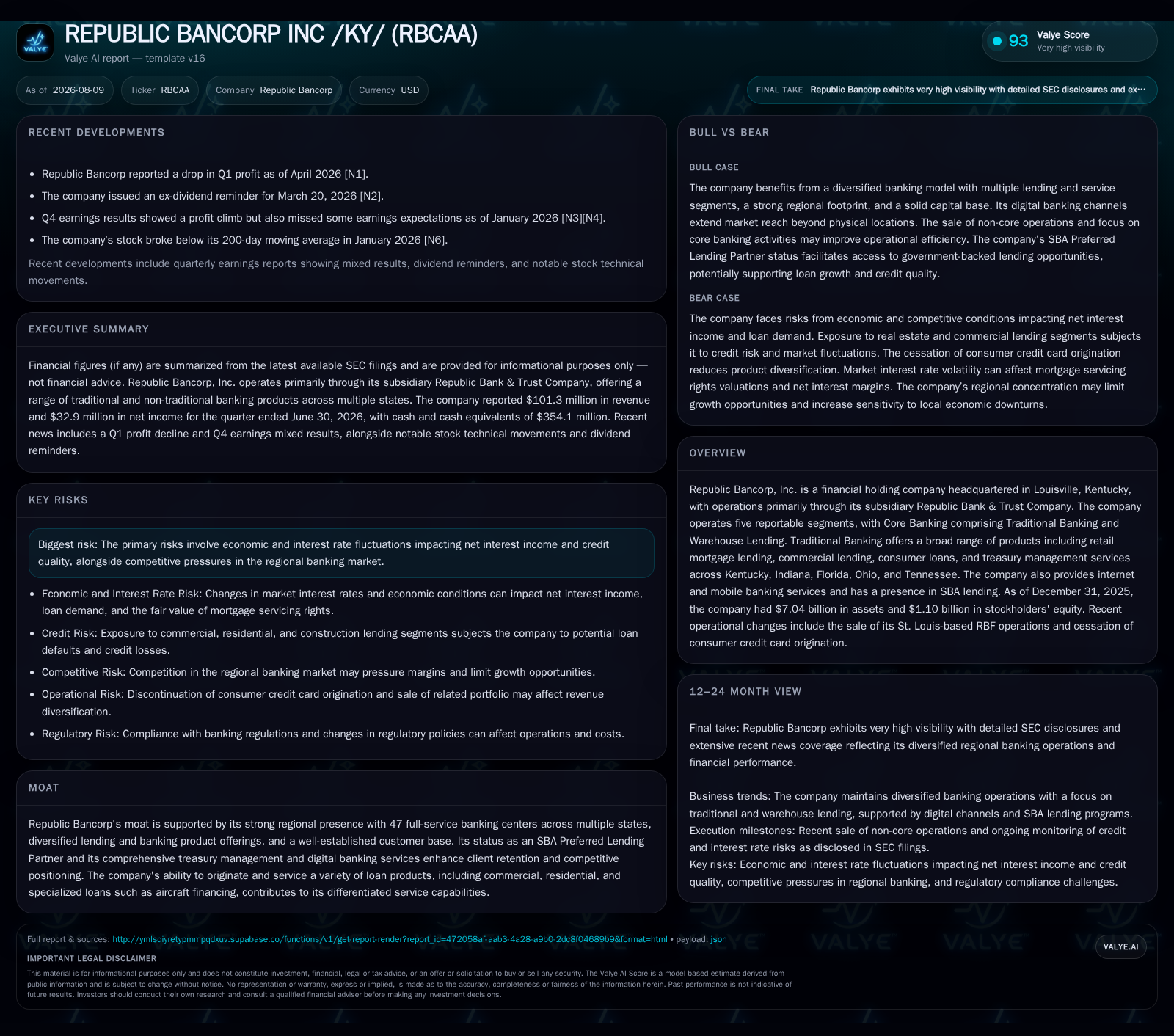
Republic Bancorp, Inc. reported steady operational updates in Q2 2026 reflecting its strategic decision to streamline operations by exiting its St. Louis-based Republic Bank Finance segment. The bank remains diversified across traditional retail and commercial lending, warehouse lending, specialized aircraft financing, and SBA-backed loans. Its robust presence across Kentucky and surrounding states supports a strong regional moat bolstered by treasury management services and digital banking channels. Key risks persist around interest rate sensitivity and deposit concentration, while growth hinges on loan portfolio expansion across product segments and leveraging SBA preferential status.
Recent Operating Update
Republic Bancorp’s Q2 2026 filing reaffirms its strategic focus on core banking operations following the divestiture of its Republic Bank Finance (RBF) division based in St. Louis. This sale closed in early 2026, generating a $6 million pre-tax gain that reflects the company’s intent to streamline its asset footprint away from small ticket leasing and specialized vendor finance toward core lending products [S2][S3][S7]. The latest quarterly data also reconfirms no material changes in risk factors compared to the prior fiscal year highlighting ongoing market sensitivity primarily related to interest rates and funding concentrations [S29].
Business Model Analysis
Republic Bancorp operates principally through its wholly owned state-chartered subsidiary Republic Bank & Trust Company, which offers a broad array of financial products through five reportable segments including Traditional Banking and Warehouse Lending as structural cornerstones [S1]. The Traditional Banking segment spans retail mortgage lending featuring single-family residential real estate loans indexed mostly to Prime or SOFR-based adjustable rates, commercial loan products encompassing commercial & industrial (C&I), commercial real estate (CRE), construction finance, home equity lines (HELOC), consumer loans excluding credit cards since 2024 cessation, plus specialized aircraft financing [S1][S5][S8].
Warehouse Lending supports the mortgage production ecosystem with short-term revolving credit facilities secured largely by pools of first-lien single-family loans held for sale. This enables mortgage bankers across the U.S. to finance loans temporarily within an average holding period of 15–30 days before sale to secondary market investors [S1]. Liquidity here is essential though duration is intentionally short to minimize interest rate risk.
A distinctive element is Republic's status as an SBA Preferred Lending Partner allowing expedited processing of SBA 7A and 504 owner-occupied CRE loans up to $3 million. This not only broadens their commercial loan portfolio but also mitigates credit risk through government guarantees while serving locally based small businesses—a competitive advantage in regional bank markets [S5]. These programs target CRE owner-occupied borrowers within the footprint primarily across Kentucky, Indiana, Florida, Ohio, and Tennessee where Republic has established branch presence.
The bank’s aircraft lending product originates creditworthy personal aviation loans up to $4 million with terms as long as two decades targeting wealthier borrowers who typically demonstrate above-average repayment capacity relative to typical consumer loan profiles [S8]
Republic funds lending primarily via granular customer deposits augmented by brokered deposits and borrowings from the Federal Home Loan Bank (FHLB). Moreover, reliance on brokered deposits or FHLB advances can increase cost of funds during tighter market conditions.
Non-interest income sources such as treasury management fees—including lockbox processing, remote deposit capture, online cash management—and interchange fee income provide valuable diversification away from purely interest margin dependent revenue streams [S1][S8]. Digital banking platforms encompassing internet and mobile apps further enable client acquisition beyond physical branch territories while reducing servicing costs over time
Industry Structure and Competitive Position
Republic Bancorp operates within the regional banking sector serving multi-state markets primarily focused on mid-sized metropolitan areas spanning parts of the Midwest and Southeast. Its competitive moat derives from a combination of broad product diversity across retail mortgages, commercial/non-commercial lending segments including construction finance, SBA-backed loans, treasury services sophistication, plus digital outreach anchored by a network of about 47 full-service banking centers.
This positioning contrasts with community banks that may lack scale or product breadth while larger regional peers like Fifth Third Bancorp or Regions Financial Corporation typically exhibit more extensive footprint but less nimbleness in localized relationship management. The ability to expedite SBA loan approvals because of Preferred Lender status confers notable competitive differentiation given rising importance of government-guaranteed lending amid economic cycles.
Moreover, Republic’s suite of aircraft financing loans positions it uniquely within niche affluent borrower segments less saturated by mainstream competitors. Warehouse lending further taps into institutional mortgage originators that require flexible liquidity solutions.
The landscape does entail risks inherent to regional banking: sensitivity to local economic disruptions especially within specific industries or real estate sectors impacts credit performance; regulatory compliance costs remain persistent; intense competition puts pressure on deposit pricing; technology adoption rates influence client retention particularly among younger demographics; finally, interest rate volatility frequently weighs on asset/liability spread management.
Growth Drivers
Key growth vectors include expansion of loan portfolios both in C&I/CRE segments driven by economic activity in Republic's primary markets. Increased origination volume for SBA-backed small business loans leverages Republic’s accredited underwriting expertise and Preferred Lender framework which accelerates turnaround times and reduces approval bottlenecks [S5]
Deposit growth supported through combined organic branch additions alongside ramped-up digital channel penetration helps maintain liquidity necessary for balanced loan-to-deposit ratios particularly important amidst rising benchmark rates impacting net interest margin spread economics.
Further cross-selling treasury management solutions into existing commercial client relationships enhances fee income diversity while strengthening switching costs.
Discontinued consumer credit card origination since early-2024 signals prioritization of higher-margin or lower-risk product lines alongside reduced regulatory complexity associated with credit cards [S8]. Strategic acquisitions or divestitures will likely be pursued selectively post-RBF exit focusing on high-return core market expansion rather than geographic proliferation without clear synergies.
Risks and Watchpoints
Interest rate volatility remains topical given Republic’s asset/liability mismatch risks highlighted around potential yield curve inversions that compress net interest margins when short-term liability costs rise faster than long-term asset yields [S1]. Monitoring shifts in large deposit relationships is crucial given roughly one-twelfth concentration among top depositors that could precipitate incremental funding cost pressures if lost.
Credit quality represents another watchpoint especially in CRE lending amid zone-specific economic headwinds or construction cycle downturns affecting new or ongoing projects underwriting assumptions. SBA policy changes at federal level may also influence volumes or terms altering projected credit loss profiles.
Technological enhancements must continue apace lest Republic cedes younger digitally native customers toward fintech disruptors offering seamless user experiences versus incumbent banks reliant on legacy systems.
Finally, execution risk around integrating acquired entities or achieving cost efficiencies post divestiture should be observed carefully — ineffective integration historically detracts from expected synergies causing market skepticism.
What To Watch Next
Upcoming milestones include monitoring quarterly trends in net interest margin reflecting evolving interest rate conditions and balance sheet mix shifts reported in upcoming filings post-Q2 2026 release cycle [S2][S10]. Deposit composition evolution relative to brokerage participation or FHLB dependance will signal liquidity robustness or emerging vulnerabilities.
Growth indicators like SBA loan origination volumes along with non-interest income trajectory from treasury services mark key metrics aligned with strategy execution fidelity. Management commentary addressing competitive dynamics particularly referencing regional market conditions would shed light on forward operational cadence.
Also critical will be tracking execution reviews related to RBF divestiture’s long-tail impact on revenue stability plus any announced plans for brick-and-mortar footprint optimization responding to digital channel traction.
Financial Profile Discussion
The company reported cash and equivalents of approximately $354 million as of June 30, 2026, reflecting a solid liquidity position [F1]
The company continues emphasizing expense control as evidenced by reallocation away from lower-return businesses such as RBF while investing selectively in digital infrastructure underpinning scalability over time.
In summary, Republic Bancorp's financial posture aligns suitably with its strategic shift toward core traditional banking activities reinforced by diversified loan categories and an expanding deposit base targeting stable regional SME ecosystems complemented by specialized lending niches like aircraft financing.
Disclaimer: This is research-only, informational analysis and not investment advice. It may include AI-generated interpretation and general industry context. Always verify important details using primary sources.

Comments