
Union Bankshares Strengthens Liquidity and Capital Metrics with Rising Net Interest Margin in Q2 2026
Union Bankshares reported improved liquidity management, net interest margin expansion, and solid capital adequacy in its latest quarterly results.
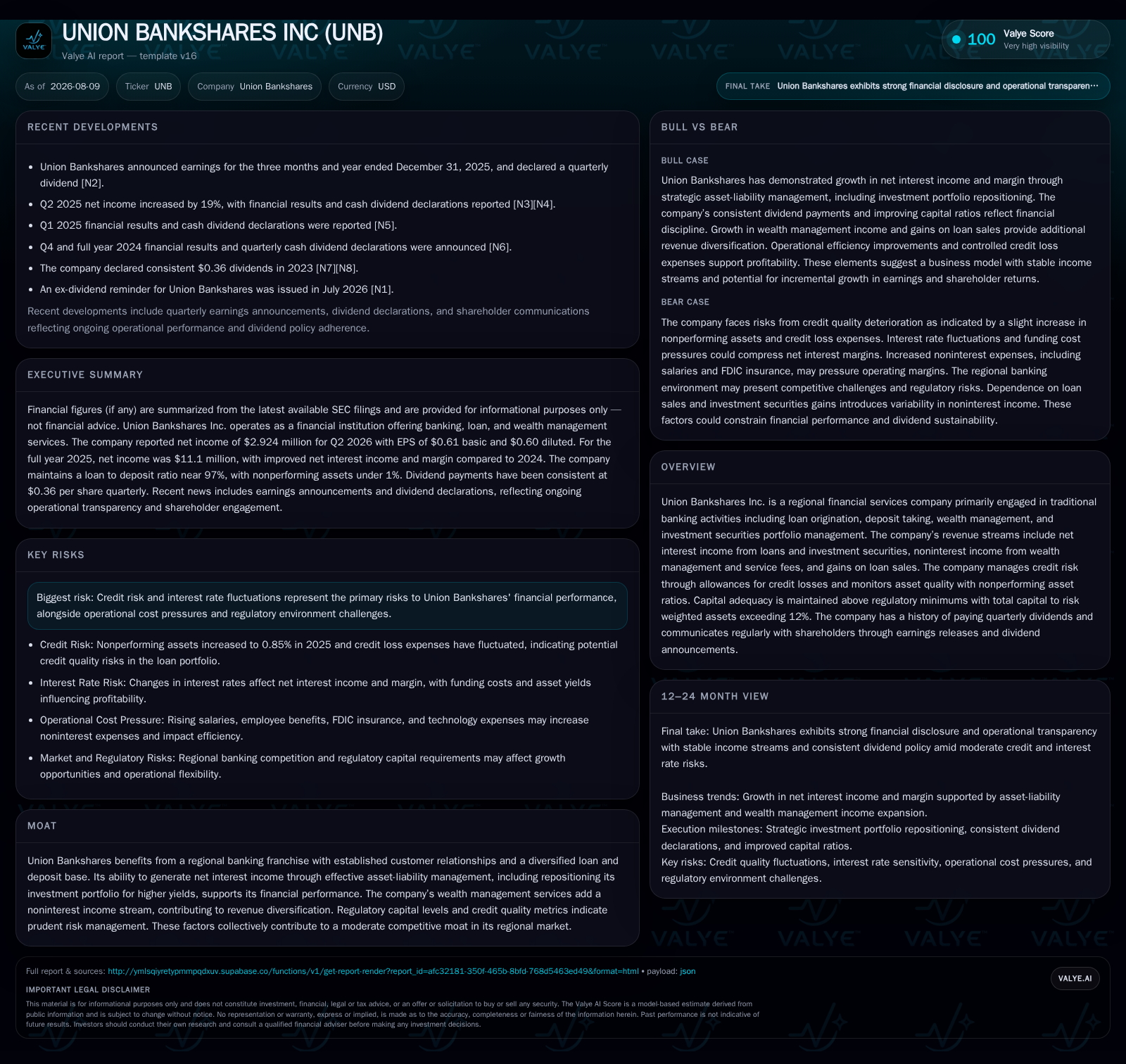
Union Bankshares Inc. demonstrated robust financial health in the second quarter of 2026, reflected by increased net interest margin to 3.01% and a higher loan-to-deposit ratio exceeding 100%. The company maintained prudent liquidity through diversified funding sources including Federal Reserve discount window advances and Federal Home Loan Bank borrowings while preserving capital ratios well above regulatory minimums. Nonperforming assets remained stable with consistent credit quality, supporting earnings stability amid a challenging interest-rate environment.
Recent Operating Update: Q2 2026 Financials and Strategic Liquidity Management
Union Bankshares disclosed its key operating results for the three and six months ended June 30, 2026, showing continued improvement in core profitability measures and liquidity management [S2]. The second quarter net interest margin (NIM) rose to an annualized 3.01% from 2.89% a year earlier, driven by disciplined asset-liability management and a deliberate repositioning of the investment portfolio toward higher-yielding securities [S2][S1]. Concurrently, the company’s loan-to-deposit ratio climbed to roughly 102.54%, suggesting effective loan deployment balanced against a growing deposit base—an important signal of earning asset utilization in regional banking.
Liquidity is managed via multiple channels including retail deposits, brokered certificates of deposit issued under a master program, Federal Home Loan Bank (FHLB) borrowings, and access to the Federal Reserve discount window where Union had a $21 million overnight advance outstanding as of June 30, 2026 [S2]. This facility was employed based on prevailing pricing and liquidity considerations, underscoring proactive funding management tools available to the bank amidst dynamic market conditions.
Business Model: Diversified Traditional Regional Banking
Union Bankshares operates primarily as a regional bank serving local customers with traditional offerings such as commercial and residential loan origination, deposit services, wealth management fees, and investment portfolio income [S1]. Revenue is principally driven by net interest income—the spread between interest earned on loans and investments versus interest paid on deposits and borrowings—with supplementary noninterest income from wealth advisory and service fees adding stability.
A hallmark of the business model lies in balancing pricing strategies on loans and deposits with careful funding cost control while preserving strong credit quality through allowances for credit losses (ACL) and monitoring nonperforming assets (NPA).
The company also manages investments classified as Available For Sale (AFS), using them not only to generate income but also as contingent liquidity sources which can be sold if needed [S2]. The ability to liquidate portions of the residential loan or investment portfolios helps buffer against sudden cash flow needs.
Industry Structure and Competitive Position
As a regional bank headquartered in Vermont with operations focused on local municipalities and commercial clients, Union competes alongside institutions like Regions Financial Corporation, Fifth Third Bancorp, M&T Bank Corporation, KeyCorp, and Zions Bancorporation within the U.S. regional banking landscape. These peers share comparable business models centered on deposit gathering, lending across commercial real estate and consumer segments, plus fee-generating wealth services.
The competitive advantage for Union stems from its embedded customer relationships in its geographic footprint coupled with prudent risk oversight evident in its ACL management under CECL standards. Moreover, its demonstrated capacity to reposition investments for yield enhancement amid shifting rate environments contributes to operating resilience.
Growth Drivers
Key growth drivers for Union include expansion in commercial lending particularly under government-guaranteed SBA/USDA programs—as indicated by $1.6 million guaranteed loans out of $2.1 million subject balance—and increasing commitments from public entities such as municipalities (noted fiscal-year cyclical commitments totaling $74.5 million as of mid-2026) [S2][S20]
Wealth management services continue to provide valuable noninterest revenue streams that support margin diversification. Additionally, strategic deployment of brokered deposits under its certificate of deposit program enhances funding flexibility without resorting to costlier wholesale funding channels.
The company also leveraged equity issuance through an at-the-market program during early 2026 raising gross proceeds over $7 million which can fund organic growth or potential acquisitions supporting long-term scalability [S11]
Risks and Watchpoints
Notwithstanding stable credit metrics—including an ACL ratio steady at approximately 0.75% of loans and NPAs hovering below 1%—credit risk remains a core industry vulnerability subject to economic shifts [S2][S1]. Furthermore, net interest margin sensitivity tied to evolving interest rates entails ongoing ALM vigilance especially given the company’s use of short-term borrowings like the FRB discount window.
Operational costs remain material; the efficiency ratio stabilized around mid-70%s but any inflationary pressures or technology investments might influence expense control going forward [S13]. Regulatory compliance demands constant capital adequacy maintenance as total capital ratios stood at comfortable levels (~13.78%) but must be monitored amid growth or macro turbulence.
Lastly, competitive pressures from fintech entrants or larger peers wielding scale advantages could challenge market share or fee income trajectories without continued service differentiation.
What to Watch Next
Upcoming monitoring points include quarterly tracking of net interest margin progression against Fed rate policy actions given their influence on asset yields and funding costs. Asset quality parameters such as changes in ACL levels or shifts in NPAs will signal credit trend direction.
On the liquidity front, evolution of brokered deposit balances relative to core deposits will reflect funding cost dynamics while utilization rates of FHLB lines or FRB facilities offer insight into contingency liquidity reliance [S2][S11]
Capital position maintenance relative to regulatory thresholds will remain critical especially if acquisition opportunities materialize.
Leadership transitions bear watching; notably Union named Carrie R. Locklin as CFO in July replacing her predecessor while retaining operational continuity through the COO role adjustment [S3].
Financial Profile Discussion
Union’s financial foundation appears sound with return on average equity near recent levels at about 13–14%, indicating steady profitability [S2]. The net interest margin increment to above 3% highlights effective balance sheet repositioning compared with prior periods around sub-3% margins typical for similar-sized regional banks.
Liquidity is managed through multiple sources including $71.3 million in time deposits exceeding FDIC insurance limits with staggered maturities, a $21 million overnight advance from the Federal Reserve discount window, and access to Federal Home Loan Bank borrowings which support earning assets and interest rate risk management [S2]. The company maintains a certificate of deposit program with a broker but had no purchased CDARS or ICS deposits and no outstanding advances on the correspondent line as of June 30, 2026 [S2].
Disclaimer: This is research-only, informational analysis and not investment advice. It may include AI-generated interpretation and general industry context. Always verify important details using primary sources.

Comments