
CKX LANDS Navigates Strategic Alternatives Amid Declining Oil and Gas Revenue
CKX is actively managing its southwest Louisiana land and mineral portfolio while evaluating strategic options to enhance shareholder value.
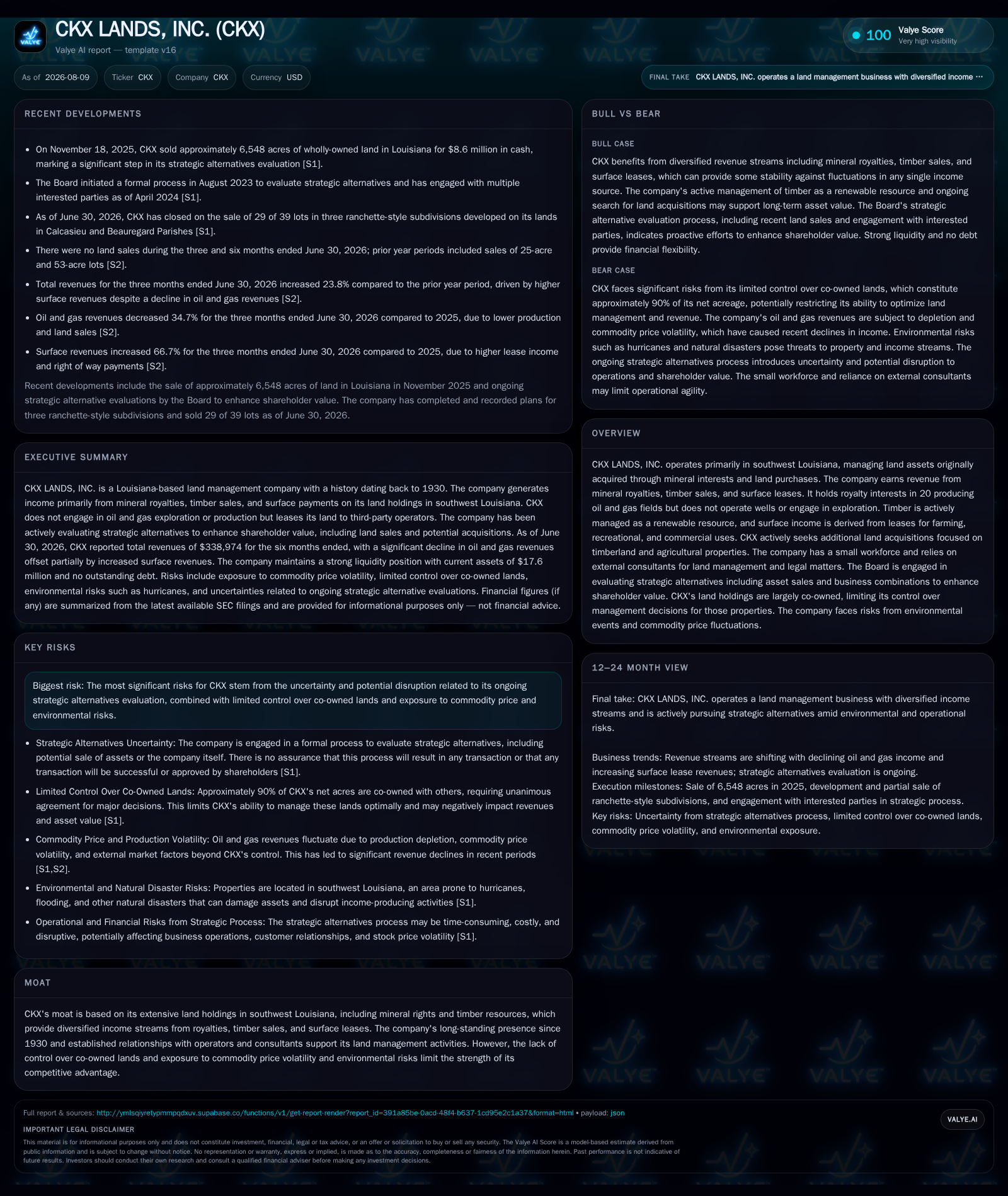
CKX LANDS, INC. reported a marked decline in oil and gas revenues for the first half of 2026 primarily due to asset sales and production decreases but saw growth in surface lease income. The company, focused on mineral royalties, timber sales, and surface leases from undivided land interests in southwest Louisiana, continues to manage renewable timber assets and cultivate land lease relationships. CKX is currently engaged in a rigorous strategic alternatives process including potential land partitions and asset sales, aiming to optimize its asset base amid commodity price volatility and depletion risks. Robust liquidity and absence of debt provide financial flexibility during this period of portfolio repositioning.
Recent Operating Update
CKX LANDS' latest quarterly filing dated August 7, 2026 highlights continuing efforts by the Board to explore strategic alternatives aimed at enhancing shareholder value. This ongoing evaluation encompasses a broad spectrum of options including land acquisitions, dispositions, business combinations, and reinvestment strategies [S2]. Notably, the Company has initiated efforts to partition its substantial acreage that is co-owned with other parties — a complex process given the legal uncertainties associated with such partitions. Management cautions that a court-ordered partition remains a possibility if negotiated agreements cannot be reached [S2].
The most material recent transactional event impacting financials was the November 18, 2025 sale of approximately 6,548 acres fully owned by CKX for $8.62 million cash proceeds [S1], [S8]. This dispositional step underlines the Company's tactical approach to optimizing its portfolio amidst shifts in underlying oil & gas production dynamics.
Business Model Insights
CKX operates primarily as an upstream landowner specializing in mineral rights management supplemented by timber resource sales and surface leasing activities within southwest Louisiana [S1]. It does not engage in exploration or production activities but instead licenses these rights to third-party operators who manage extraction. Revenues are generated from mineral royalties based on percentage ownership interests in producing wells; stumpage agreements realized through timber sales; and surface leases for agricultural or commercial purposes
This tripartite revenue model offers some diversification though none are immune to respective volatility factors: mineral royalties fluctuate with commodity prices (oil and natural gas), production volumes from wells on their lands decline over time due to depletion risk, and timber sales depend on regional market demand combined with sustainable forestry practices.
CKX’s royalty interests span twenty producing fields with individual stakes ranging from as little as 0.0045% up to a significant 7.62%, indicating varied income concentration across fields but overall passive ownership without operator control or access detailed reserve metrics [S1]. Surface leases provide more stable recurrent income streams as they are typically structured as fixed rental agreements or periodic payments tied to land use.
Acquisitions focus largely on timberland or agricultural properties suitable for sustainable management or future development opportunities — selection criteria emphasize land fitness for timber/agriculture alongside potential mineral value or improvements quality [S9]. These acquisitions aim both at growing acreage under control and augmenting steady-state revenues.
Management relies heavily on external consulting expertise spanning real estate valuation, forestry management, environmental assessment, agriculture advisory services, plus legal counsel specialising in corporate transactions, real estate law, minerals rights complexities — enhancing governance over co-owned undivided interests which constitute a large portion of CKX's holdings [S9].
Industry Structure and Competitive Position
Within the niche sector of Land and Mineral Rights Management — particularly in regional hubs like southwest Louisiana — CKX operates among peers ranging from timberland investment firms (e.g., Weyerhaeuser), royalty trusts focused purely on mineral income (e.g., Permian Basin Royalty Trust), and broader land management companies that blend multiple natural resource income streams.
CKX's competitive moat hinges on its extensive legacy acreage dating back decades combined with long-term relationships negotiated historically with operators active in the region; such entrenched positions are not easily replicated although limited by shared ownership complexities reducing unilateral control over parcel disposition or leasing decisions.
Compared to pure royalty trusts reliant solely on oil & gas production income exposed acutely to commodity cycles, CKX benefits slightly from balanced revenue sources including timber which is renewable if managed sustainably. However, its scale remains modest relative to major peer timberland investors or large diversified real estate holding companies active with natural resource overlays.
Commodity price fluctuations directly impact royalty returns; CKX does not hedge such exposures but rather accepts inherent cyclical risks stemming from global energy markets affecting oil/gas pricing fundamentals beyond its operational scope.[S1] Depletion risk remains structurally negative for long-term petroleum-derived revenues absent new discoveries or acquisition-led growth.
Growth Drivers
Principal levers for growth comprise:
- Strategic acquisitions of additional acreage emphasizing timberland/agricultural potential or unexplored mineral rights; expanding acreage boosts future royalty streams if developed.
- Potential increases in oil and gas production activity on leased lands should operators discover commercially viable reserves although CKX has no role controlling exploration timing or scale.
- Rising commodity prices for hydrocarbons or timber products would enhance per-unit revenue realization across respective operations.
- Expanding surface lease arrangements supporting agricultural uses or other commercial endeavors enhances recurring non-mineral income.
- Timber harvesting cycles optimized through active forest management can improve sustainable revenue contributions reflecting stand age/growth dynamics.
- Monetization via selective asset sales may generate capital for reinvestment into higher-return assets or deleverage concentration risks.
- A successful execution of strategic alternatives (including possible mergers or acquisitions) could unlock latent value through economies of scale or portfolio rationalization.
Risks and Watchpoints
Key risks include:
- Ongoing strategic alternative evaluations introduce uncertainty potentially disrupting business continuity or focus through distractions and resource diversion; failure to consummate beneficial transactions could stall value creation efforts.[S1]
- Limited direct control over co-owned properties complicates leasing optimization or disposition timing; failure to negotiate partitions amicably may force court interventions increasing costs/delays.[S2]
- Commodity price volatility directly impacts royalty revenue streams unpredictably; extended low-price periods exacerbate cash flow pressures given passive exposure.
- Mineral reserve depletion inexorably reduces future royalty bases absent new discoveries realized by third-party operators beyond CKX influence.[S1]
- Environmental regulations impacting land use or extraction practices could impose operational constraints or increase compliance costs.
- Counterparty concentration risk when major lessees/operators withdraw or relinquish leases could impair consistent cash inflows.[S1]
- Market fluctuations affecting stumpage prices may challenge timber revenue stability especially during economic downturns impacting construction/material demands.
- Litigation risk related to ownership disputes common in undivided interest holdings could impose legal expenses or restrict asset flexibility.[S1]
- Operational dependence on external consultants introduces execution risks linked to knowledge continuity or service costs.
What To Watch Next
Upcoming key indicators include:
- Progress updates regarding strategic alternative processes such as definitive transaction agreements finalized or shareholders’ approvals obtained; milestones here will clarify trajectory.[S2]
- Successful negotiation outcomes concerning partitioning co-owned land interests will test management effectiveness resolving ownership complexity barriers.[S2]
- Changes in oil & gas production volume reported indirectly via royalty receipts signaling field-level operator activity trends.
- Timber harvest volumes seasonally expected; tracking contract renewals or stumpage price benchmarks informs revenue sustainability.[S9]
- Surface lease occupancy rates expansions will indicate diversifying income robustness beyond volatile minerals market.[S16]
- Capital deployment decisions following any asset sales whether targeting yield-enhancing acquisitions or returning capital shareholders.
- Any regulatory developments within Louisiana potentially affecting mineral rights taxation levels impacting net realizable values.
Financial Profile Discussion
CKX's financials reveal a robust liquidity position at quarter-end June 30, 2026 with current assets totaling approximately $17.64 million against nominal current liabilities (~$142K), creating an exceptionally high current ratio exceeding 120x which highlights negligible short-term liquidity risks [F1]. The Company maintains zero outstanding debt providing significant financial flexibility for ongoing operations and prospective land acquisitions without near-term refinancing concerns [F1].
General administrative expenses experienced moderate increases tied chiefly to higher salaries/wages though partially offsetting prior franchise tax reductions without materially affecting operating margins.[S16] The Company continues emphasizing cost discipline while funding professional advisory functions critical amid strategic evaluation phases requiring comprehensive due diligence support.
Overall financial health conveys an efficient asset manager profile maintaining capital adequacy during transitional periods supported by disciplined cash stewardship enabling operational continuity alongside growth option pursuance.
This analysis synthesizes recent filings through August 7, 2026 ([S2],[S3],[S5],[F1]) contextualized within industry norms for landowner/lessor companies managing mineral rights portfolios augmented by renewable resource income streams. The strategic alternatives engagement marks a pivotal inflection point aiming at unlocking latent value constrained by legacy co-ownership complexities amid evolving commodity market conditions. Readers should consider this narrative an institutional-grade overview rather than prescriptive advice.
Disclaimer: This is research-only, informational analysis and not investment advice. It may include AI-generated interpretation and general industry context. Always verify important details using primary sources.

Comments