
Acorn Energy Expands IoT Monitoring Scope with Strategic AIO Partnership Amid Product Transition
Acorn Energy leverages proprietary communications and new product lines to strengthen its foothold in power generation and cathodic protection monitoring.
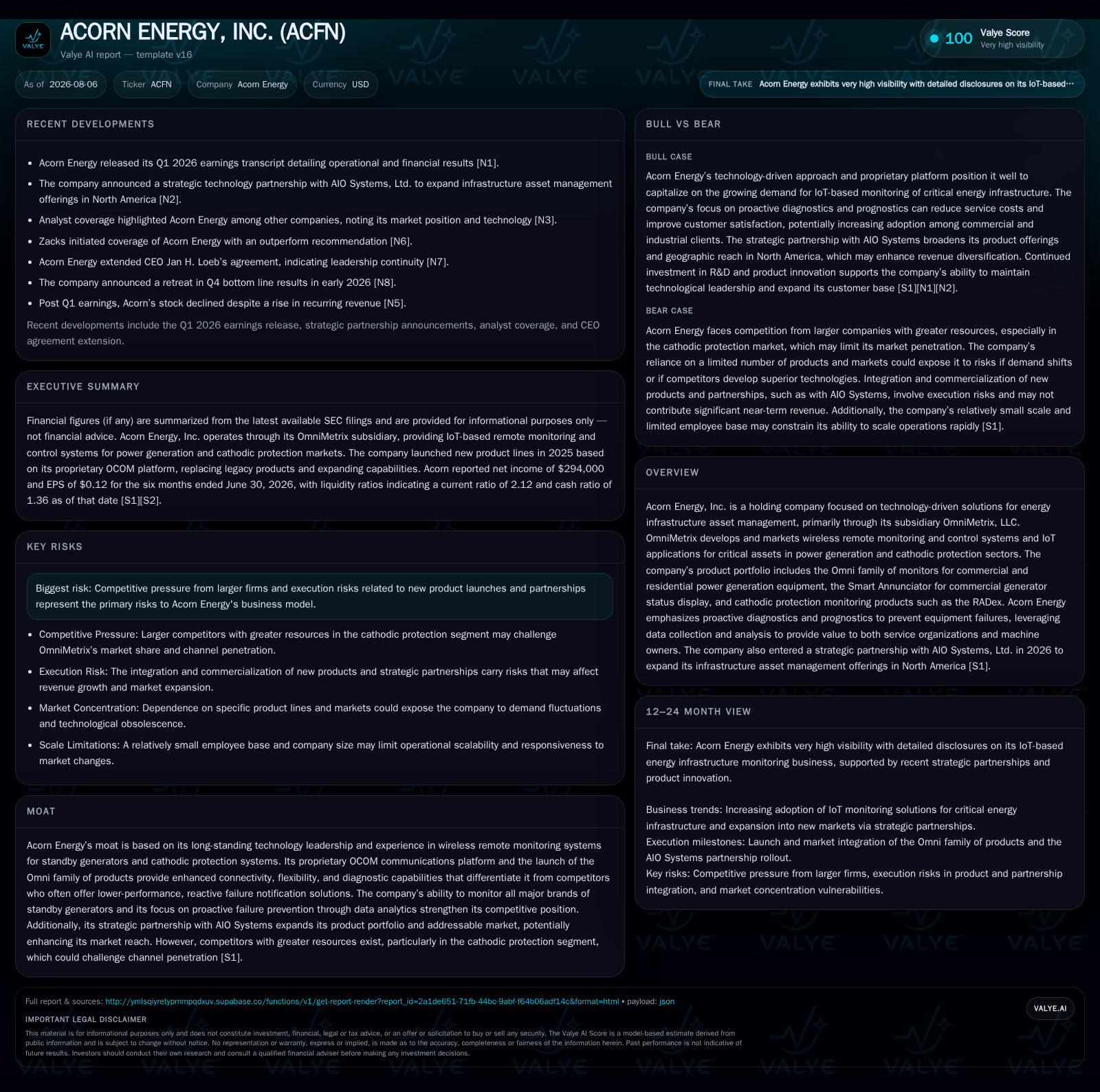
In Q2 2026, Acorn Energy maintained solid operational footing with $4.478 million in cash and $3.152 million in deferred revenue, signaling stable recurring revenue streams despite a mix-driven decline. Its OmniMetrix subsidiary drives innovation through the adoption of the OCOM connectivity platform, transitioning from legacy TrueGuard products to the higher-margin OmniPro family. The strategic partnership with AIO Systems, initiated in early 2026, extends Acorn’s reach into critical infrastructure asset management for cell towers and data centers via SaaS revenue sharing, positioning it well within the evolving industrial IoT sector. Key risks remain around competitive pressure and execution on new technology introductions.
Recent Operating Update
Acorn Energy's latest quarterly report for Q2 ended June 30, 2026 reveals a stable liquidity position with cash reserves of approximately $4.478 million contributing to working capital of $3.688 million after accounting for current liabilities [F1], [S2]. Deferred revenue—a key indicator of recurring SaaS and monitoring service obligations—stood at $3.152 million but declined by $257,000 sequentially as product mix shifted toward newer offerings that carry different revenue recognition patterns [S2]. This deferred revenue represents contracted fees yet to be recognized as income but generally involves low associated cash outlay, reflecting the subscription-like nature of their remote monitoring services.
The company confirmed continuing obligations under its strategic agreement with AIO Systems covering joint sales and revenue sharing stemming from cloud-based asset management solutions often deployed in telecommunication infrastructure such as cell towers and data centers [S2]. These arrangements tie Acorn’s future revenue streams to SaaS subscriptions linked to AIO’s product integrations under Acorn’s OmniMetrix brand.
Business Model Overview
Acorn Energy operates predominantly through its wholly owned subsidiary OmniMetrix, LLC which develops wireless remote monitoring systems primarily aimed at two verticals: Power Generation (PG) equipment such as standby generators (commercial, industrial, residential) and Cathodic Protection (CP) systems used in gas pipeline corrosion prevention [S1]. The company monetizes through a combination of hardware device sales—wireless sensors and monitors—and recurring revenue from remote monitoring services typically delivered via Internet-of-Things (IoT) platforms.
Hardware sales provide upfront revenue upon sale and installation but generally feature lower gross margins (60%), while the subscription-type monitoring services yield high incremental gross margin (94-95%) due to minimal direct costs beyond communication networks and cloud infrastructure [S23]. This creates an attractive margin profile that improves over time as installed units generate ongoing surveillance fees compared to one-time hardware transactions.
OmniMetrix recently transitioned product lines from legacy TrueGuard models to an advanced family branded OmniPro (commercial) and Omni residential monitors built atop the proprietary OCOM communications core developed internally by Acorn. OCOM is designed for enhanced connectivity performance, modular expansion capability, easier installation processes, and improved diagnostic detail—features aligned with expectations for modern machine-to-machine (M2M) IoT applications crucial for proactive asset management [S1].
In addition to hardware plus SaaS offerings for generator health monitoring with OEM compatibility across brands such as Caterpillar, Generac, Kohler, Cummins etc., Acorn delivers specialized CP system devices including the RADex launched in 2025 [S1]. RADex presents a technologically upgraded extension enabling remote AC mitigation disconnection alongside cathodic protection level measurements enhancing operator safety and cost efficiency
Overall, Acorn’s business model relies upon scaling the number of monitored devices deployed—both PG and CP units—while expanding recurring service contracts in long-tail customer relationships typical of backup power infrastructure maintenance critical for utilities, telecommunications networks, hospitals, government facilities, and industrial clients.
Industry Structure & Competitive Position
Acorn sits at the intersection of IoT hardware manufacturing (sensors/monitors), software platform development providing analytics/services dashboards, and subscription-based remote asset management deployment. This multitier positioning requires sustained investment in research & development (R&D) not only to evolve wireless sensor technology but also to anticipate changing customer needs related to predictive maintenance analytics—a growing sector within energy infrastructure asset management.
Peers span from larger industrial conglomerates like Generac Holdings focused on generator markets, Emerson Electric's industrial automation offerings, Schneider Electric’s broad IoT energy management suites to Honeywell's asset-monitoring platforms. Acorn is distinguished through its proprietary OCOM core platform which enables flexible integration with diverse OEM equipment brands—a differentiating factor versus commoditized or reactive failure notification competitors that tend toward limited device compatibility or lower data granularity.
Attractive moat elements include longstanding presence in targeted niches combined with technological IP protecting unique connectivity protocols integrated into increasingly sophisticated commercial-grade monitoring devices. The strategic partnership established with AIO Systems expands reach into emerging adjacent markets like critical telecom infrastructure where similar remote monitoring promises enhanced network resilience amid grid uncertainty demands.
Nonetheless, industry risks include heightened competitive pressure from resource-rich firms accelerating broader IoT solution portfolios that may leverage economies-of-scale or cross-selling synergies unavailable to smaller players like Acorn. Additionally, fast-moving technology cycles necessitate effective execution on new product rollouts such as RADex along with integration challenges inherent in supporting multiple OEM ecosystems without compromising reliability or ease of installation.
Growth Drivers
Core growth vectors center on increasing market penetration within existing PG and CP verticals through:
- Rising demand for reliable backup power solutions amidst growing frequency of grid interruptions driven by natural disasters or cybersecurity threats.
- Regulatory mandates boosting cathodic protection system sophistication particularly in gas pipeline safety frameworks incentivizing remote compliance monitoring deployments.
- Expanding adoption of IoT-enabled predictive maintenance favoring proactive diagnostics over reactive alerts aligning with customers’ operational continuity objectives.
- Strategic partnerships like AIO broadening addressable markets by enabling cloud-based integrated asset management platforms for high-growth infrastructure segments including telecom towers and data centers.
- Incremental upsell potential leveraging SaaS subscription revenues scaling with installed base growth enhancing recurring income stability highlighted by declining deferred revenue balances reflecting transitions toward service-heavy offerings.
- Continued improvements in wireless sensor technology coupled with analytics capabilities driving differentiation versus legacy or lower-end competitor products thereby improving renewal rates.
These factors stimulate KPIs such as monitored units count expansion, average monthly revenue per monitored unit increase driven by premium service features and contract renewals indicating sticky customer relations underpinning predictable cash flow streams.
Risks & Watchpoints
Key constraints revolve around:
- Execution risk exposing delivery timelines on technology upgrades like RADex which must meet safety-critical reliability standards delaying commercialization or increasing costs.
- Competitive intensity especially from multi-national industrial tech conglomerates possibly encroaching via bundled solutions challenging unit economics or pricing leverage.
- Customer concentration risks given dependency on several key accounts especially large telecom operators where contract renewals heavily influence recurring revenue visibility.
- Potential cybersecurity vulnerabilities embedded within IoT communications platforms threatening device uptime or confidential data integrity prompting regulatory scrutiny or increased compliance investment.
- Supply chain disruption risks impacting access to specialized components restrained by global macroeconomic conditions potentially constraining production ramp-ups.
- Gradual erosion or commoditization of device hardware margins requiring continuous innovation to retain premium pricing structures alongside expanding software-driven revenues.
Close observer metrics include deferred revenue trajectory trends validating SaaS uptake velocity along with renewal rates for monitoring contracts serving as indirect gauges of solution stickiness amid intensifying competition.
What To Watch Next
Investors should monitor:
- Quarterly updates on monitored device counts split between PG vs. CP segments revealing end-market adoption strength.
- Revenue composition shifts between hardware sales versus higher-margin recurring subscriptions providing insight into margin expansion sustainability.
- Progress updates on rollout milestones for next-gen products like RADex elucidating timing on potential contribution riffs.
- Financial disclosures quantifying impact from AIO collaboration especially tracking SaaS-related deferred revenues tied to this partnership reflecting early traction within new domains.
- Announcements regarding additional partnerships or co-investment activities indicative of strategy execution toward broader industrial IoT ecosystem plays.
Collectively these factors will shape medium-term growth outlook balancing technology leadership against competitive pressures within fast-evolving energy infrastructure monitoring markets.
Financial Profile Discussion
Acorn Energy demonstrates a clean financial position bolstered by a strong current ratio at 2.12 as of June 2026 evidencing ample short-term liquidity beyond immediate obligations ($6.978 million current assets vs $3.29 million current liabilities) [F1]. The company remains essentially net cash positive after factoring possible debt exposures ($4.478 million cash vs eventual total non-current debts last reported at $2.303 million though dated) [F1], suggesting capacity to sustain R&D pipelines without external financing stress.
Gross profit margins increased materially from 73% in 2024 to 77% in 2025 driven largely by shifts toward sale of higher-margin OmniPro products combined with incremental rise in recurring service streams boasting gross margins near 95% sustaining operating leverage prospects [S23]. Research and development spending grew modestly consistent with incremental engineering staffing expansions aimed at fortifying product differentiation ahead of competitors illustrating prudent reinvestment discipline aligned with strategic objectives [S23].
In absence of reported significant debt maturities or covenant pressures noted currently,[F1], the balance sheet supports ongoing operating cash flow funding future innovation spending needed amidst dynamic industrial IoT energy infrastructure markets while safeguarding operational flexibility during uncertain macro environments impacting demand timing nuances common among capital goods reliant sectors.
This analysis synthesizes SEC filings up through August 6th, 2026 integrating operating updates supported by detailed annual context without making projections or research views. It is designed as an internal analytical briefing emphasizing durable business qualities within evolving Industrial IoT energy asset management landscapes.
Disclaimer: This is research-only, informational analysis and not investment advice. It may include AI-generated interpretation and general industry context. Always verify important details using primary sources.

Comments