
Centrus Energy Advances HALEU Production and Contract Backlog Amid Capital Needs
Centrus Energy strengthens its U.S. uranium enrichment capacity with long-term contracts supporting advanced reactor fuel supply while navigating capital requirements.
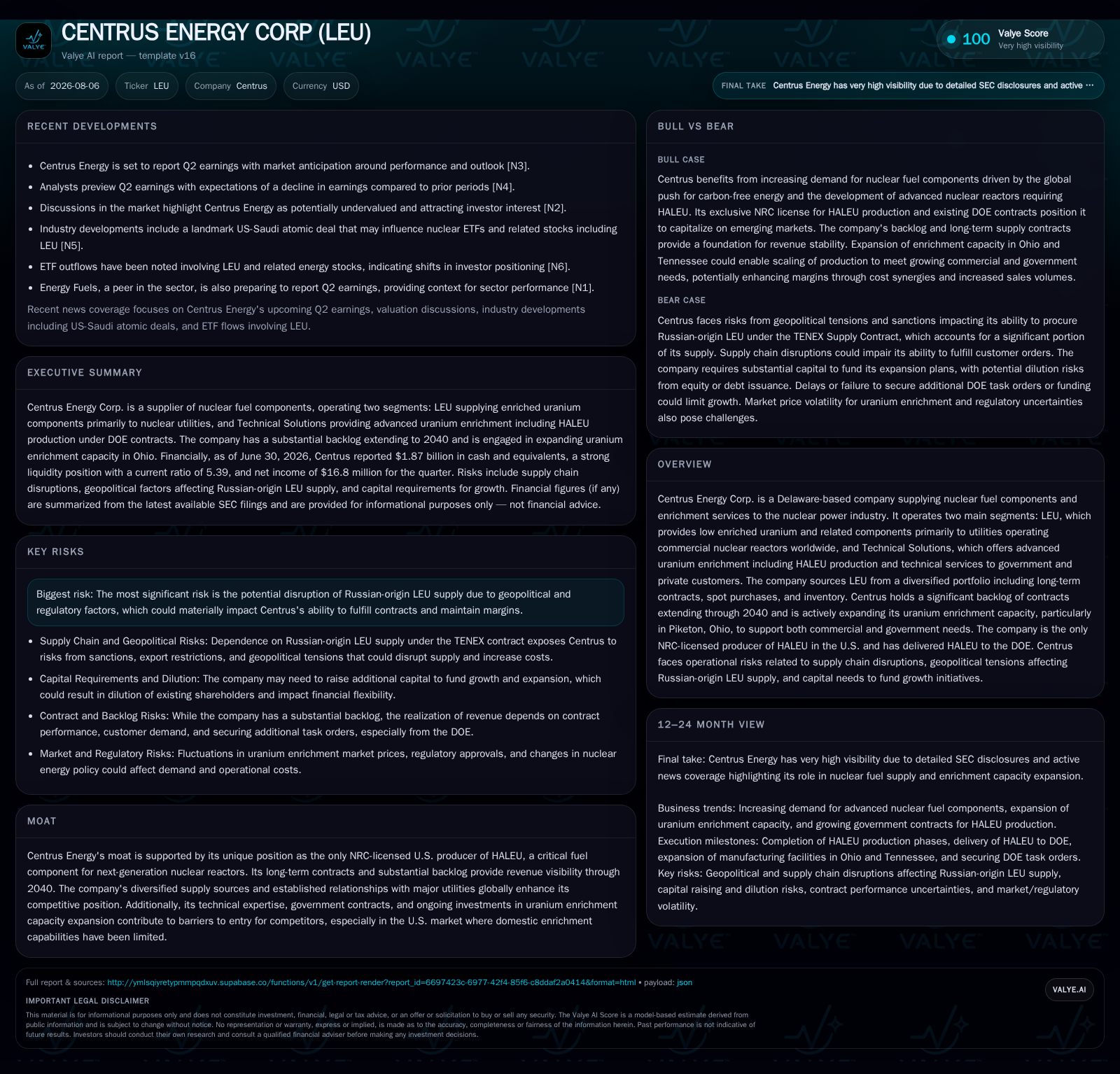
Centrus Energy Corp. reported in its latest quarterly filing that it remains the sole NRC-licensed U.S. producer of HALEU, with a growing backlog of LEU and HALEU contracts extending through 2040, including a significant new contract with X-energy for advanced reactor fuel supply. The firm is investing heavily in expanding enrichment capacity at Piketon, Ohio, supported by substantial Department of Energy (DOE) task orders, but faces financing risks tied to capital intensity and potential dilution from equity offerings. Despite geopolitical complexities impacting Russian-origin LEU supplies, Centrus leverages diversified procurement and long-term contracts to maintain resilience within the nuclear fuel cycle midstream segment.
Recent Operating Update
In its Q2 2026 Form 10-Q filing dated August 6, Centrus Energy Corp. reconfirmed its position as the sole NRC-licensed domestic producer of high-assay low enriched uranium (HALEU), a crucial fuel component enabling advanced nuclear reactors [S2]. The company announced a material contract with X-energy LLC executed concurrently on August 6 [S3][S13]: this agreement calls for supplying both low enriched uranium (LEU) and HALEU for X-energy’s advanced reactor projects starting deliveries from Centrus’ American Centrifuge Plant in Piketon, Ohio by 2030. This milestone underscores Centrus' expanding role in the nuclear fuel supply chain during rising governmental and commercial interest in next-generation nuclear technology.
The firm also disclosed ongoing DOE-backed commercial-scale HALEU capacity expansions under task orders valued at $900 million awarded in early 2026 [S19][S23]. These expansions aim to elevate operational output and underpin HALEU delivery commitments extending into the early 2030s. However, final funding and timelines remain subject to negotiation and Congressional appropriations.
Business Model Analysis
Centrus functions primarily as a midstream supplier within the nuclear fuel cycle, specializing in uranium enrichment services that transform raw uranium hexafluoride (UF6) into LEU and HALEU sold mainly to domestic and international utility operators of commercial reactors as well as government customers [S1][S29]. Its business splits into two segments: the bulk LEU segment supplies enriched uranium components primarily measured by separative work units (SWUs), while Technical Solutions focuses on enriched product development including HALEU production.
Revenue monetization hinges on long-term contracts providing fixed or indexed pricing mechanisms based on SWU volumes delivered over contracted periods extending up to two decades. This backlog delivers predictable revenue streams but is sensitive to price adjustments tied to inflation indices or market price references [S19][S24]. Centrus supplements contracted deliveries with spot market procurements and inventory management to buffer supply chain variabilities.
Importantly, Centrus' unique NRC licensing for HALEU production creates a significant competitive moat in the U.S., given the stringent regulatory landscape limiting new entrant capacity [S1]. The company’s enriched uranium products serve both current light water reactors requiring LEU (4–5% U-235 content) and prospective advanced reactor designs necessitating HALEU (19.75% U-235 content), which commands higher technical complexity and value creation potential.
Industry Structure and Competitive Position
The nuclear fuel supply industry is highly capital-intensive and tightly regulated due to safety, proliferation controls, and geopolitical considerations. Major global peers include Urenco Group (Europe-based enrichment services provider), Orano (France-based integrated fuel cycle services), and Kazatomprom (large-scale uranium mining). However, these competitors have limited or no domestic U.S. HALEU production licenses.
The U.S. government plays an outsized role in shaping market dynamics through DOE contracts incentivizing domestic enrichment capacity restoration post-decline of Russian-origin imports due to sanctions [S1][S28]. Centrus' longstanding DOE relationship grants it preferential positioning for task orders funding advanced capabilities like commercial-scale HALEU delivery.
Supply diversification has become paramount given disruptions under the Import Ban Act and related export restrictions on Russian-sourced LEU affecting many utilities’ security of supply [S28]. Centrus mitigates this risk by combining contracted long-term procurements under agreements such as TENEX Supply Contract—benefitting from favorable cost resets since 2019—and opportunistic spot market purchases alongside internal inventory buffers [S1][S29].
Growth Drivers
Several structural trends drive growth prospects for Centrus:
- Advanced Nuclear Reactor Development: With a growing coalition supporting net-zero carbon emission targets, governments and private developers are accelerating deployment of advanced reactor technologies requiring HALEU fuels not readily available elsewhere [S3][N9][N25].
- Government Incentives & Security Objectives: The DOE's direct investment into Piketon facility expansion illustrates federal prioritization of secure domestic fuel supply chains reducing reliance on adversarial foreign sources [S23].
- Backlog Visibility: Medium- to long-term sales contracts extending through 2040 provide significant forward revenue visibility rooted in utility demand forecasts coupled with contractual pricing protections [S19][S24].
- Capacity Expansion Investments: Planned capital expenditure at Piketon, Ohio, supports scaling enrichment throughput aligned with contract commitments though subject to regulatory milestones [S2][S23].
Risks and Watchpoints
Centrus faces several prominent risks warranting continued focus:
- Financial Capital Requirements: Expansion efforts require substantial capital outlays; while current cash balances exceed $1.8 billion against roughly $1.2 billion debt (net cash position approx -$660 million) with an ample current ratio of ~5.39 highlighting liquidity strength, ongoing funding needs may compel equity issuances diluting shareholders or increased leverage raising financial risk [F1][S15].
- Geopolitical Supply Constraints: Continued sanctions affect availability of Russian-origin LEU inputs despite favorable TENEX pricing adjustments; any escalation could disrupt supply balance or increase costs unfavorably versus global peers [S28][N2].
- Regulatory Approvals: Licensing delays or operational hurdles at enrichment facilities may impact timing of commercial deliveries critical for revenue recognition [S28][S23].
- Contract Award Uncertainty: Additional task orders under DOE IDIQ agreements remain contingent on future appropriations and policy shifts introducing backlog execution uncertainty despite existing award pipeline [S19][S23].
- Competitive Foreign Enrichment Activity: Government-backed foreign enrichment entities could exert pricing pressure or impede market share gains internationally restricting Centrus’ commercial reach beyond domestic government pursuits [S28].
- AI Integration Risks: Adoption of AI-driven systems introduces operational compliance risks per latest filings that may affect process reliability or regulatory adherence if not properly managed [S28].
What to Watch Next
Investors monitoring Centrus should focus on:
- Progress updates on DOE-led Piketon enrichment facility expansions including milestone achievements under the $900 million task order.
- Execution timeline details related to the X-energy contract starting delivery in 2030 — particularly ramp planning for HALEU production.
- Updates regarding additional DOE task orders awarding expansion funding or technical service contracts beyond current backlog.
- Market price trends for SWUs and uranium inputs influencing margin trajectory alongside potential renegotiations linked to inflation indices.
- Capital raising developments under ATM programs or debt issuance announcements indicating financial flexibility or dilution risk.
- Regulatory decisions impacting facility licensing renewals or new license applications critical for capacity scaling.
Financial Profile Discussion
As of June 30, 2026, Centrus reported approximately $1.87 billion in cash and equivalents against total debt near $1.21 billion based on end-2025 figures [F1]. Current assets of $2.32 billion and current liabilities of $429 million imply a current ratio of about 5.39, reflecting strong short-term liquidity coverage [F1].
Nonetheless, management explicitly flagged capital raising as a potential need to finance growth initiatives at Piketon and Oak Ridge facilities along with strategic acquisitions or partnerships [S15]. The company maintains an ATM sales agreement allowing equity issuance up to $1 billion but cautions that stockholder dilution could ensue alongside possible debt incurrence increasing financial leverage constraints.
Given the cyclical nature of utility contract awards and regulatory dependencies intrinsic to the sector, maintaining disciplined cash management will be critical for balancing elevated capex needs against operational cash flows generated from its sizable backlog of sales commitments stretching into the late 2030s [F1][S19]
This analysis leverages currently available SEC filings through August 6, 2026 alongside industry context specific to nuclear fuel supply dynamics without offering investment research views or precise forward projections. All conclusions reflect documented data points or substantiated regulatory disclosures only.
Disclaimer: This is research-only, informational analysis and not investment advice. It may include AI-generated interpretation and general industry context. Always verify important details using primary sources.

Comments