
Fox Corp's Earnings Strengthen Amid Streaming and Advertising Shifts
Fox Corp’s latest quarterly results underscore its resilience through advertising market fluctuations and digital platform growth.
In its most recent quarter ended March 31, 2026, Fox Corp sustained stable broadcasting revenue despite industry-wide advertising cyclicality, supported by solid audience ratings and affiliate fees. The company’s multi-platform business model balances traditional broadcast and cable advertising revenues with growing subscription and digital income streams. Programming investments continue to drive viewer engagement, while a strong balance sheet maintains strategic flexibility amid competitive pressures from diversified media giants and streaming pure-plays. Risks remain from regulatory changes and cyclical advertising markets, warranting close monitoring of operational trends and platform expansion execution.
Fox’s Q3 Results Reveal Stability in Broadcasting Revenue during Industry Transition
The latest quarterly filing for the period ending March 31, 2026 reports that Fox Corp maintained stable operating performance despite an environment marked by cyclical fluctuations in advertising spending [S2]. Advertising revenue—a major cash inflow source for Fox—showed resilience on its broadcast networks even as broader market softness impacted certain cable channels. This relative stability is significant because advertising budgets are highly sensitive to macroeconomic conditions; consistent ad revenue inflows suggest Fox's content continues to attract advertiser spend effectively. Audience ratings remained steady across principal broadcast properties, reinforcing the company's ability to maintain viewer engagement during a fragmented media landscape where consumer attention has shifted increasingly to digital platforms. Such ratings underpin both ad inventory value and affiliate fee negotiations, critical to sustaining revenue flow. Confirmation of ongoing ratings strength or further ad revenue stabilization in subsequent quarters would reinforce the sustainability of Fox's traditional broadcast franchise.
Monetizing Content: Balancing Advertising Sales with Subscription Growth Streams
Fox’s business model blends several monetization pathways typical of diversified media companies: advertising sales on broadcast networks and cable channels; subscription fees from digital or pay-TV platforms; affiliate fees paid by distributors for network carriage; plus content licensing and syndication revenues [S1], [S2]. The filings emphasize strategic focus on balancing legacy strongholds—heavy advertising exposure—with accelerated growth in subscription-based revenue streams tied to digital services. Affiliate fees provide recurring cash inflows with relatively stable margin profiles, helping offset the volatility inherent to advertising sales linked to economic cycles. Notably, rising programming costs reflect investments in original or acquired content designed to retain and grow audiences essential for monetization across platforms. This mix points to evolving margin dynamics: while ad sales carry high contribution margins when robust, subscription revenues often provide steadier but lower-margin cash flow. Tracking shifts in this revenue mix alongside programming cost changes offers insight into margin outlooks and cash conversion efficiency.
Competitive Dimensions: Fox’s Position Relative to Diversified and Streaming Peers
Within the media ecosystem, Fox operates in a competitive arena populated by diversified giants like The Walt Disney Company—offering expansive content suites across film, TV, and streaming—and Comcast Corporation with its extensive cable distribution footprint. In contrast, streaming-only peers such as Netflix represent a distinct competitive vector focused solely on direct-to-consumer digital content delivery without legacy broadcast constraints. While Fox lacks precise public market share or subscriber count disclosures for its streaming assets, it benefits from an established brand presence in national broadcasts coupled with cable network reach. This dual presence supports diversified revenue streams but also demands agility amid technological shifts toward OTT (over-the-top) consumption models. The company faces trade-offs between preserving profitable legacy operations and investing in new digital platforms which expand advertising inventory and attract subscription dollars but entail upfront costs. Fox's ability to integrate these approaches underpins its competitive strategy, balancing breadth of content with distribution scale against peer benchmarks.
'Content is King': Programming Costs Drive Viewer Engagement Metrics at Scale
Programming expenditures remain a core driver of Fox’s audience retention efforts. As reported in its annual filing, the company allocates considerable resources toward acquiring rights or producing original programming tailored to maximize viewer attraction on both broadcast and cable channels [S1]. These costs are substantial fixed investments that influence operating margins but are justified by their role in securing higher audience ratings which directly enhance monetization potential via advertising rates and subscriber willingness to pay. Effective management of programming costs against engagement outcomes is critical; excessive spending without commensurate viewership gains would pressure profitability. Conversely, selective reinvestment that sustains live event coverage—such as sports or news—and popular scripted series can reward downstream revenues across platforms including syndication or streaming licensing deals. Observing future trends in programming spend efficiency relative to rating improvements will be instructive for assessing long-term content strategy effectiveness.
'Structural Headwinds and Growth Levers': Industry Pressures Meet Digital Opportunity
Fox navigates industry headwinds involving advertising cyclicality influenced by wider economic factors alongside structural shifts as audiences increasingly consume entertainment via digital streaming rather than traditional TV sets. Regulatory environments also shape operational parameters around content distribution rights and ownership rules impacting network carriage agreements [S1], [S2]. Meanwhile, digital platforms present growth levers by offering expanded capacity for targeted advertising inventory beyond linear schedules plus opportunities for subscription fee income through direct-to-consumer offerings. Recent public discourse highlights Fox’s initiatives to broaden its digital footprint—including acquisition moves such as Roku—that position it better within the streaming ecosystem [N12], providing incremental growth avenues amid an evolving media consumption landscape. Continued innovation in technology-driven content delivery could offset legacy revenue pressures if executed effectively.
'Watchpoints Ahead': Regulatory, Competitive, and Market Risks Under Focus
Key risks facing Fox derive from fluctuating advertising markets sensitive to macroeconomic downturns that could compress pricing power or reduce buyer demand [S1], [S2]. Intensifying competition from both traditional media conglomerates ramping up their streaming presence and nimble pure-play streaming providers adds pressure on viewer engagement metrics vital for advertiser confidence. Potential regulatory changes concerning content ownership limits or distribution mandates might alter contractual economics with affiliates or disrupt established syndication deals. Moreover, rising programming costs pose profitability challenges if not offset by commensurate yield improvements through ratings or subscriptions. Monitoring upcoming quarterly metrics relating to ad revenue trends, audience share relative to competitors, regulatory developments, and subscriber growth/churn rates on digital platforms will be crucial indicators of how these risks evolve.
Financial Resilience: Liquidity and Leverage Profile Enables Strategic Optionality
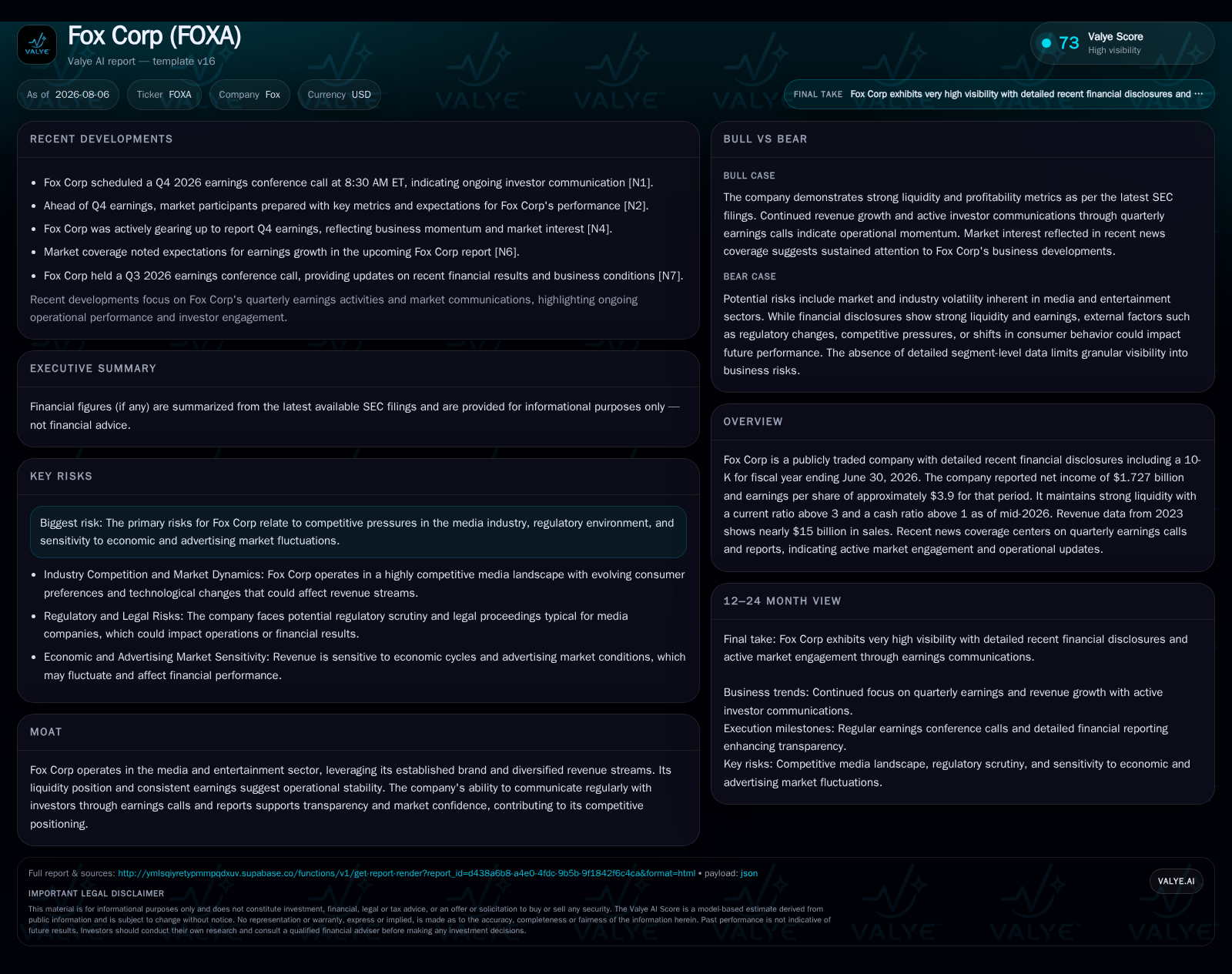
From a financial standpoint, Fox maintains a solid liquidity position with a current ratio of approximately 3.17 as of June 30, 2026 [F1]. Current assets exceed $8.45 billion compared to liabilities around $2.67 billion at quarter-end enabling comfortable near-term operational funding flexibility [F1]. Total debt stands near $6.65 billion with net debt after cash deductions approximating $3.83 billion — manageable leverage providing breathing room for continued capital expenditures on programming investment or strategic acquisitions [F1]. The balance sheet strength coupled with multi-channel monetization reduces financial risk compared to streaming pure-plays heavily reliant on external funding during rapid growth phases.
Maintaining disciplined capital allocation aligned with evolving media consumption trends remains essential for sustaining long-term shareholder value creation.
Fox Corp's demonstrated ability to balance legacy broadcast strengths with advancing digital initiatives positions it well amid continuing industry transformation. Key confirmatory signals include sustaining or growing advertising revenues alongside rising affiliate fees; improving audience ratings across platforms; efficient programming cost control aligned with engagement objectives; successful expansion of digital subscription bases; alongside maintaining solid financial ratios that support future investment agility.
Conversely, emerging weakness would manifest if persistent declines appeared in core ad revenues without offset from digital segments; if programming expenses outpaced rating gains reducing margins; or if regulatory/legal uncertainties constricted distribution rights materially affecting cash flow stability.
Investors should closely monitor sequential quarterly operating metrics supplemented by management commentary from earnings calls such as those highlighted recently [N1] as near-term barometers of execution on the delicate balancing act between traditional media sustenance and digital evolution.
Disclaimer: This analysis is for informational purposes only based on publicly available SEC filings and reputable news sources as of August 2026 and does not constitute investment advice.
Disclaimer: This is research-only, informational analysis and not investment advice. It may include AI-generated interpretation and general industry context. Always verify important details using primary sources.

Comments