
AquaBounty Shifts from Biotech Aquaculture Amid Financial and Strategic Pressures
Latest quarterly results underscore AquaBounty’s liquidity crisis and strategic pivot toward energy infrastructure, deepening operational risks beyond its core GMO aquaculture business.
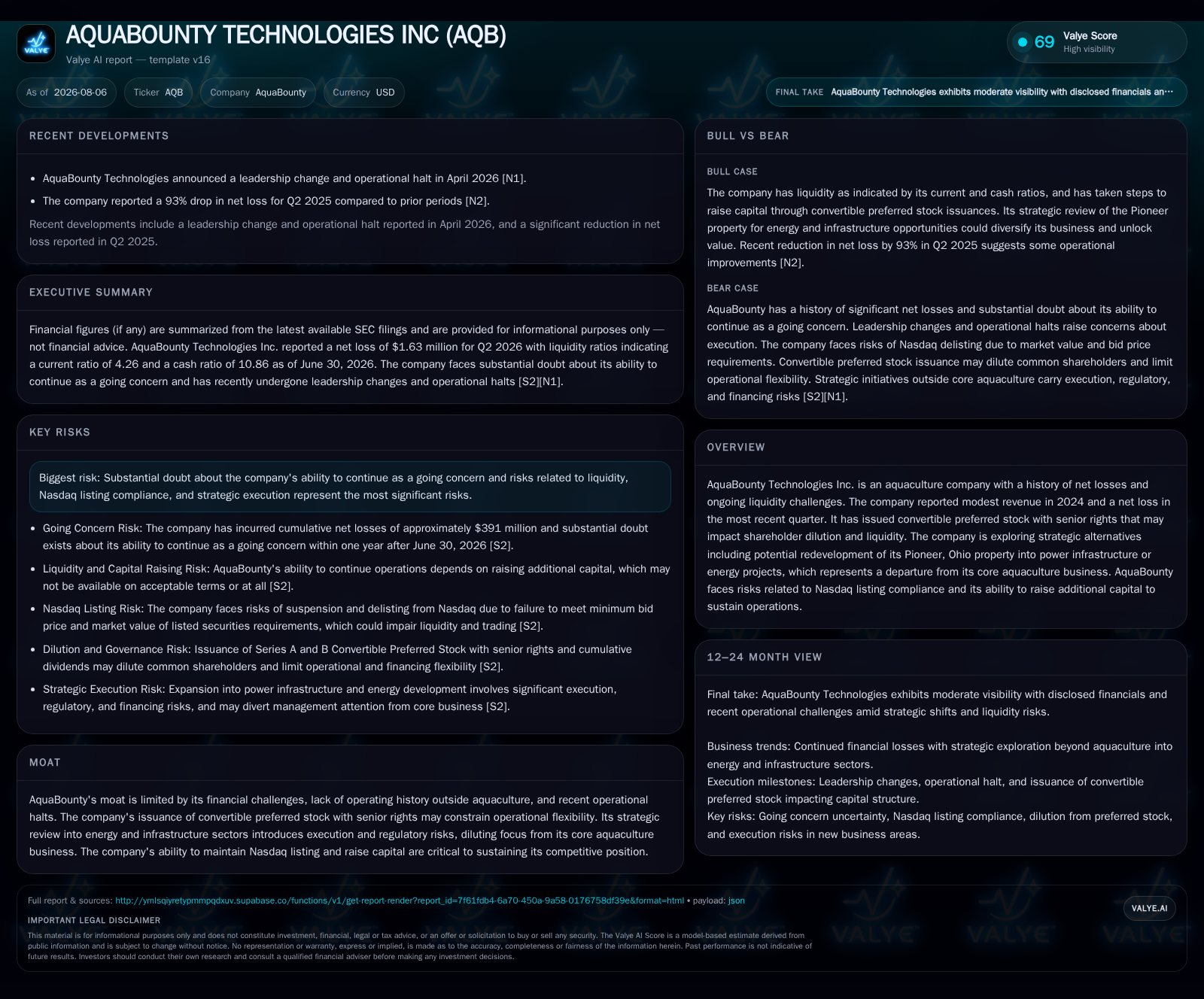
AquaBounty Technologies Inc.’s latest 10-Q reveals continuing net losses with a critical liquidity shortage, casting substantial doubt on its ability to continue as a going concern without new capital. Amid these financial strains, the company has pivoted away from exclusive focus on genetically engineered aquaculture by initiating a strategic review of redeveloping its Pioneer, Ohio property for power and energy infrastructure projects. This diversification introduces significant execution and regulatory risks in unfamiliar sectors. The issuance of senior convertible preferred stock with stringent protective provisions further constrains financial flexibility and raises dilution risk for common shareholders. AquaBounty operates in a highly capital-intensive biotech aquaculture niche facing regulatory and market acceptance hurdles, with peers generally better positioned by scale and financial stability. Maintaining Nasdaq listing is an ongoing challenge given low market capitalization and persistent negative equity, contributing to the company’s precarious outlook.
Recent Operating Update Highlights
Recently completed private placements issued Series A and Series B Convertible Preferred Stock bearing cumulative dividends at an onerous 18% per annum rate. These preferred shares hold senior liquidation preferences over common stockholders along with redemption rights that add pressure on liquidity as obligations accrue whether paid or unpaid [S2][S3][S10][S24]. Moreover, these securities impose protective provisions requiring preferred holders’ consent for significant corporate actions—materially constraining operational agility during capital raising challenges.
In a significant strategic shift announced in July 2026 through public Form 8-K disclosures, AquaBounty expanded the scope of its strategic review process for the Pioneer facility in Ohio to consider sale or redevelopment as power generation or energy infrastructure assets [S16][S19]. This direction deviates sharply from the company's historical core competency in genetically modified aquaculture farming operations. While potentially unlocking new value avenues during failing core operations, this pivot exposes the company to execution risk outside its proven expertise along with material regulatory hurdles typical of energy project development that differ fundamentally from those faced in biotech food production.
Business Model Analysis
AquaBounty operates within the intersection of aquaculture farming and biotechnology by breeding genetically modified salmon engineered to grow faster using inserted growth hormone genes [S1]. Its revenue generation relies fundamentally on selling these enhanced products directly or indirectly to food producers or distributors interested in sustainable protein sources—a market segment growing yet challenged by regulatory approvals and consumer acceptance variability globally.
Revenue mechanics integrate volume sold (biomass production), pricing linked partially to premium biotechnology endorsement claims versus conventional fish products, feed conversion efficiency reducing input cost ratios, and cycle time improvements speeding turnover. Intellectual property protection around genetic engineering underpins potential licensing revenue streams but remains secondary given current operational scale.
However, AQB's ability to scale operations profitably is impaired by high capital expenditures necessary for controlled aquatic facility development coupled with risks inherent in biological yield variability such as survival rates and disease outbreaks [S1]. Regulatory approvals for GMO aquatic organisms impose often unpredictable delays affecting commercialization schedules across jurisdictions. Costs related to environmental compliance also weigh heavily on margin structures compared to traditional fish farming peers.
The introduction of convertible preferred stock further complicates monetization from a capital structure standpoint as cumulative dividends increase fixed obligations while dilution risks undermine common shareholder value metrics upon conversion or default-triggered liquidity events.
Industry Structure and Competitive Positioning
The biotech-enhanced aquaculture sector where AquaBounty competes forms a niche segment characterized by intensive R&D efforts aimed at improving biological yields through genetic modification mechanisms while navigating complex regulatory landscapes governing GMO applications in food supply chains.
Peers like Benchmark Holdings focus on aquaculture genetics but may leverage broader product portfolios spanning other aquatic species genetics besides GM salmon. Intrexon’s biotech expertise provides benchmarks in R&D spend efficiency but differs in market application focus.
Compared with traditional fish farming companies emphasizing volume scale and operational cost control in open-net pens or recirculating systems without GM components, AquaBounty confronts higher capital intensiveness per biological unit produced alongside limited commercial history. Market acceptance challenges due to GMO concerns dampen pricing power relative to conventional seafood.
Nasdaq listing compliance adds another competitive stress layer; ongoing delisting threats because of share price below thresholds/persistent negative equity create illiquidity that hinders access to growth capital as peer companies enjoy stronger balance-sheet positions supporting expansions.
Growth Drivers
Key industry tailwinds supporting long-term value creation include rising global protein demand especially sustainable alternatives to wild fisheries stressed by overfishing/environmental degradation. Advances in genetic technology improving growth rates or disease resistance may enhance operational scalability if regulatory pathways clear expediently.
Regulatory approvals expanding geographic penetrations boost addressable markets though timelines remain uncertain creating cyclical headwinds.
Strategic partnerships with food producers/distributors could provide distribution scale benefits; however recent halts/delays indicate difficulties securing such arrangements thus far.
The exploratory repositioning of the Pioneer site into energy infrastructure may unlock alternative monetization potential distinct from core operations but requires substantial project finance expertise lacking currently.
Risks and Watchpoints
Financially the most critical risk centers on liquidity shortfalls evidenced by minimal cash reserves relative to existing expenses compounded by heavy dividend obligations on preferred stocks threatening insolvency absent rapid capital infusion [S2][F1]. Regulatory risks persist particularly around obtaining necessary authorizations for GMO fish proliferation impacting operational cycles.
Market backlash against GMO foods may limit adoption delaying revenue ramp-ups.
The convertible preferred stock structure limits management flexibility via protective covenants restricting major transactions without holder approval potentially delaying turnaround initiatives.
The strategic pivot into non-core energy sectors introduces considerable execution risk including financing availability at acceptable terms plus securing government permits—a process historically fraught with delays even for established players.
Nasdaq delisting risks threaten trading liquidity impeding shareholder exit options which could depress share prices further impairing capital raise feasibility.
What To Watch Next
Key milestones include any announcements regarding completion or termination of the asset redevelopment strategic review process tied to the Ohio facility announced mid-2026 which could dramatically change asset utilization profiles [S19]. Monitoring announcements for potential sales/leases/joint ventures into power generation would be crucial.
Near-term financial markers like cash burn rate trends versus capital raise success serve as proxies for survival horizon extension particularly given cumulative dividend obligations increasing accrued liabilities [S15]
Regulatory developments concerning GMO salmon approvals domestically or internationally that would enable broader sales channels should be tracked closely given their direct impact on revenue evolution.
Any changes toward securing Nasdaq continued listing compliance such as reverse splits (enabled by shareholder vote) or market price interventions warrant close attention due to liquidity implications [S25]
Financial covenant negotiations or restructuring attempts around preferred stock terms would signal evolving capital structure dynamics possibly affecting shareholders’ rights or control balances.
Financial Profile Discussion
AquaBounty’s financial profile at mid-2026 remains precarious with approximately $1.9 million cash against current liabilities near $2.75 million but balanced partially by sizeable current assets totaling roughly $11.7 million yielding a strong current ratio around 4.26—indicative of some short-term solvency though not necessarily sufficient for sustained operations without fresh funding injections [F1]
The outstanding total debt figure recorded at circa $8.7 million (latest available) combined with accrued dividend obligations on two series of high-rate (18%) convertible preferred stock creates structural constraints over profitability turnarounds due to obligatory fixed costs increasing irrespective of top-line performance [F1][S2][S3]
Net losses continue unabated reflecting high operating expenses tied primarily to R&D investments alongside facility upkeep impacting gross margins negatively—a typical pattern among early phase biotech firms grappling with commercial execution lags vs research advances [F1].
Overall financial leverage together with impending cash constraints underscores reliance on successful transactions related to either asset monetization via strategic pivots or significant capital raises yet carries elevated uncertainty weighing on viability assumptions embedded within ongoing reporting frameworks [S2][S16]
Disclaimer: This analysis is based solely on publicly available SEC filings as cited and industry knowledge frameworks without offering any investment opinions or research views.
Disclaimer: This is research-only, informational analysis and not investment advice. It may include AI-generated interpretation and general industry context. Always verify important details using primary sources.

Comments