
Strategy Inc’s Hybrid Model Strains Under Digital Asset Volatility and Funding Needs
Q2 2026 results expose how bitcoin price fluctuations dominate financial outcomes, while software operations struggle to cover expenses amid heavy reliance on external funding.
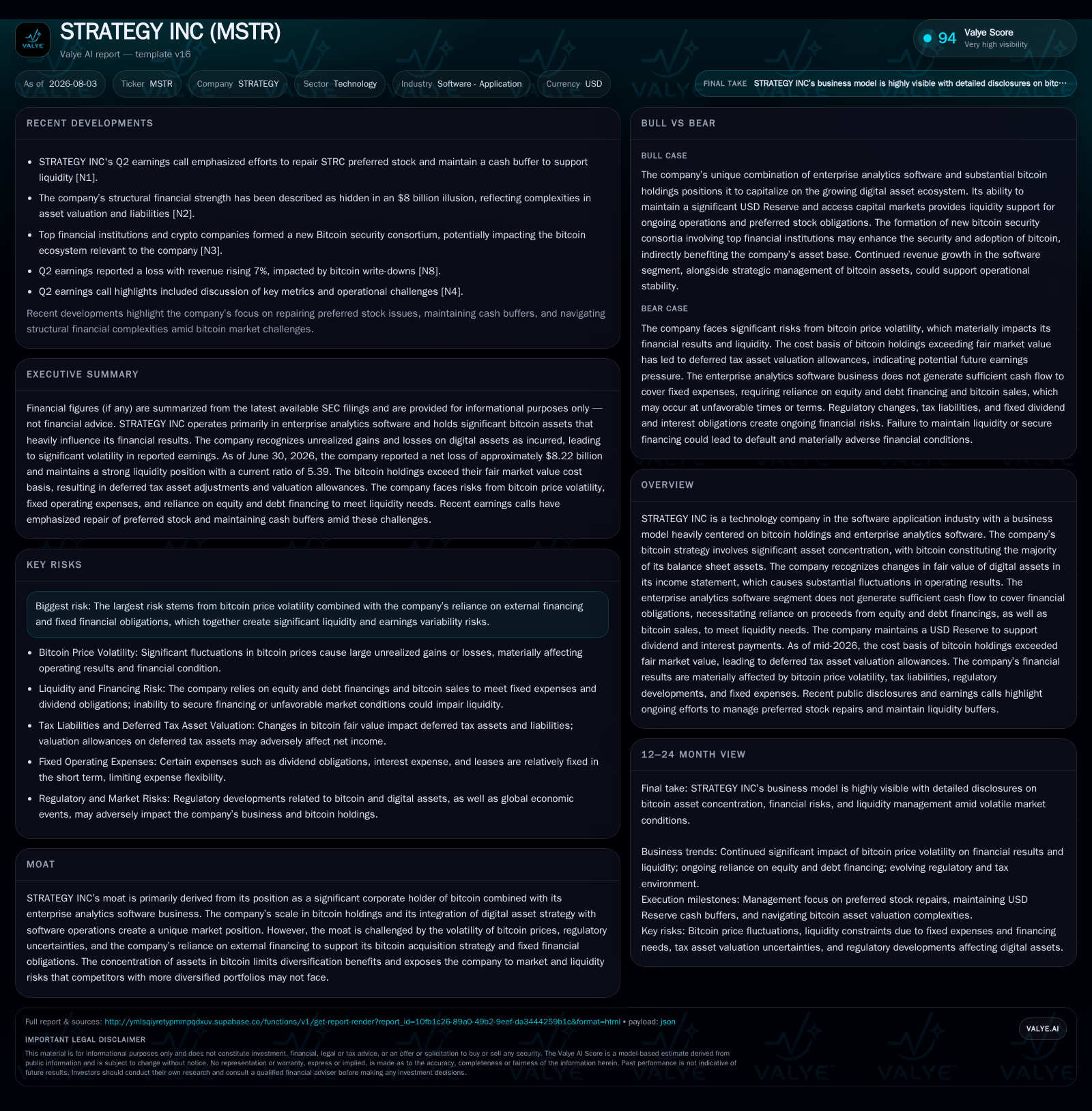
Strategy Inc’s Q2 2026 filing illustrates the material impact of bitcoin fair value accounting on its earnings and liquidity profile. The company’s enterprise analytics software segment generates recurring revenue but remains cash-flow negative, necessitating ongoing equity and debt issuance along with bitcoin sales to meet obligations. Market volatility in digital asset valuations continues to inject significant earnings unpredictability, while deferred tax assets face valuation challenges due to bitcoin carrying costs exceeding market prices. These dynamics underscore the risk tradeoffs inherent in Strategy’s dual business model and capital structure.
Q2 Operating Release Highlights Bitcoin-Driven Earnings Fluctuations
In its 10-Q filing for Q2 ending June 30, 2026, Strategy Inc disclosed marked swings in operating results primarily attributable to fluctuations in the fair value of its sizable bitcoin holdings [S2]. Under ASU 2023-08 adopted starting in 2025, the company records unrealized gains or losses on digital assets directly in its consolidated statements of operations. This fair value accounting treatment translates bitcoin price volatility into immediate income statement impacts that overshadow the underlying performance of its enterprise analytics software business [S1].
The second quarter saw revenue growth within the software segment; however, operating expenses and fixed financial charges continued to outpace cash generation from these operations. As a result, the software business itself remains unable to generate sufficient free cash flow to meet dividend obligations on preferred stock or interest expense on substantial debt [S2]. Meanwhile, the bitcoin portfolio's large swings drive pronounced net income volatility quarter-to-quarter.
Hybrid Business Model Dynamics: Enterprise Software Meets Digital Asset Concentration
Contrastingly, bitcoin holdings form the majority of Strategy’s balance sheet assets per latest filings [F1], making asset valuation central to its financial health. Given that bitcoin is marked at fair market value each period end but was valued below its carrying cost as of mid-2026, deferred tax asset (DTA) valuation allowances had to be recorded — signaling potential limitations on future tax benefit realization tied to these assets [S2], [F1]. This accounting dynamic introduces asymmetric risk rarely encountered by standalone SaaS firms.
Competitive Landscape: Where Enterprise SaaS Metrics Collide With Volatile Crypto Holdings
Within the broader universe of public enterprise SaaS providers focused on data analytics and business intelligence solutions — companies like Salesforce or ServiceNow serve as proxies — Strategy’s software segment faces typical market pressures including customer acquisition cost management, churn mitigation, platform innovation speed, and ecosystem integration demands. Yet unlike these peers, Strategy's valuation comparability is clouded by substantial crypto asset exposure which injects high earnings volatility unrelated to operational software metrics.
Similarly, companies holding significant digital assets typically encounter valuation complexity due to unpredictable mark-to-market income effects. Financing availability also tends to correlate with cryptomarket sentiment cycles more than with SaaS unit economics or ARR momentum. This dual character influences investor perception and capital market dynamics distinctly from pure play SaaS competitors.
Capital Structure Constraints: Reliance On Equity Sales, Debt Financing, And Bitcoin Liquidations
Strategy continues to demonstrate strong dependence on external capital markets activity for liquidity. The firm maintains an active at-the-market (ATM) offering program with a recently increased capacity totaling $21 billion available for new equity issuance following depletion of prior capacity [S3]. Concurrently, total debt stood at approximately $6.7 billion against cash reserves near $1.7 billion at quarter end [F1], leaving net debt around $5 billion—a significant leverage position given ongoing operating losses.
The company uses proceeds from ATM stock sales along with BTC monetization programs systematically to fund preferred stock dividends and servicing interest obligations alongside corporate operating expenses [S2], [S3]. A dedicated USD Reserve policy prescribes maintenance of a minimum cash buffer intended solely for dividend payments and interest coverage [S23], helping mitigate immediate liquidity stress risks but still requiring replenishment via capital transactions.
Growth Prospects Through SaaS Metrics Despite Asset Concentration Risks
In its software segment—the strategic growth engine—Strategy pursues growth via expanding seat licenses within its existing customer base as well as exploring new product launches and platform enhancements aligned with evolving enterprise analytics requirements [S1]. Key performance indicators such as ARR growth rates and customer retention trends act as signals of product-market fit and competitive positioning.
However, despite modest revenue increases reported recently [N7], incremental gains have yet to offset high fixed costs embedded in legacy infrastructure, R&D outlays, and financial service obligations including preferred dividends. This tight margin structure constrains free cash flow conversion ability relative to best-in-class SaaS peers who typically demonstrate higher gross margins and positive operating leverage.
Risk Factors Spotlight: Earnings Volatility, Liquidity Management, And Regulatory Uncertainty
Primary risks stem from bitcoin price volatility which materially disrupts earnings consistency due both to mark-to-market accounting rules and potential realized gains or losses triggered by asset sales below carrying basis [S2]. This contributes directly to unpredictable quarterly net income swings complicating operational planning and investor confidence.
Liquidity risk follows closely given Strategy’s reliance on continuous access to equity market programs (e.g., ATM offerings) alongside bond market issuance to meet dividend payments and interest servicing costs [S3], [F1]. Depletion scenarios for their USD Reserve increase pressure on forced liquidation strategies potentially resulting in value destructive BTC disposals at lower prices.
Further headwinds originate from regulatory developments surrounding blockchain technologies including compliance burdens that may escalate operational costs or restrict certain digital asset transactions possibly affecting corporate strategy execution[S15], [S20]. Deferred tax asset valuation allowance uncertainties linked to sustained negative markdowns represent additional financial reporting risks impacting net asset values.
Monitoring Points: Customer Metrics, Bitcoin Price Trends, And Financing Execution
Investors and analysts should closely monitor updates from forthcoming quarterly calls concerning net retention rates within the enterprise analytics software business—an important predictor for recurring revenue stability alongside gross churn levels which influence upsell potential [N3]
Bitcoin spot market movements will govern next-period fair value gains or losses reported in income statements; hence price trend tracking remains critical for anticipating earnings trajectory shifts beyond operational factors [N6]. Furthermore, execution details regarding pace of ATM share issuances or any new debt financings provide updates on liquidity runway duration and capital structure evolution [S3].
Financial Profile Discussion: Balance Sheet Strength, Deferred Tax Assets, And Funding Programs
As of June 30, 2026 balance sheet highlights show cash & equivalents approximating $1.7 billion versus total debt near $6.7 billion resulting in a current ratio exceeding 5x due primarily to working capital configurations [F1]. Nevertheless, net debt stands near $5 billion reflecting heavy leverage accentuated by operating deficits within core software units.
Deferred tax asset valuations related to bitcoin holdings are encumbered by significant valuation allowances caused by sustained disconnect between cost basis acquisition prices and prevailing market prices as disclosed in recent filings; this represents latent risk case should recovery fail [S2].
Updated capital programs include extension of ATM equity offerings enhanced with a recent $21 billion capacity increase supporting ongoing financing needs while USD Reserve policies focus specifically on liquidity preservation for dividend & interest commitments aiming at reducing forced asset disposal frequency [S3], [S23]. This structure underscores continuing dependence on external funding despite scale maturation.
This analysis reflects data available as of early August 2026 from public filings and relevant market disclosures. It provides an integrated perspective on Strategy Inc’s operating complexity shaped by convergent forces from recurring software revenues alongside volatile crypto asset management—the interplay creating distinct challenges compared with traditional enterprise SaaS peers. Strategic monitoring around operational KPIs alongside financing cadence will remain essential for assessing progression toward sustained financial stability within this hybrid model framework.
Disclaimer: This article is an industry analysis without investment advice or research views. Readers should consider multiple sources before forming views about any security.
Disclaimer: This is research-only, informational analysis and not investment advice. It may include AI-generated interpretation and general industry context. Always verify important details using primary sources.

Comments