
Space Asset Acquisition Navigates Sponsor Control and Capital Structure in Pre-Combination Phase
The SPAC maintains strong liquidity and sponsor ownership concentration while progressing toward an initial business combination focusing on the global space economy.
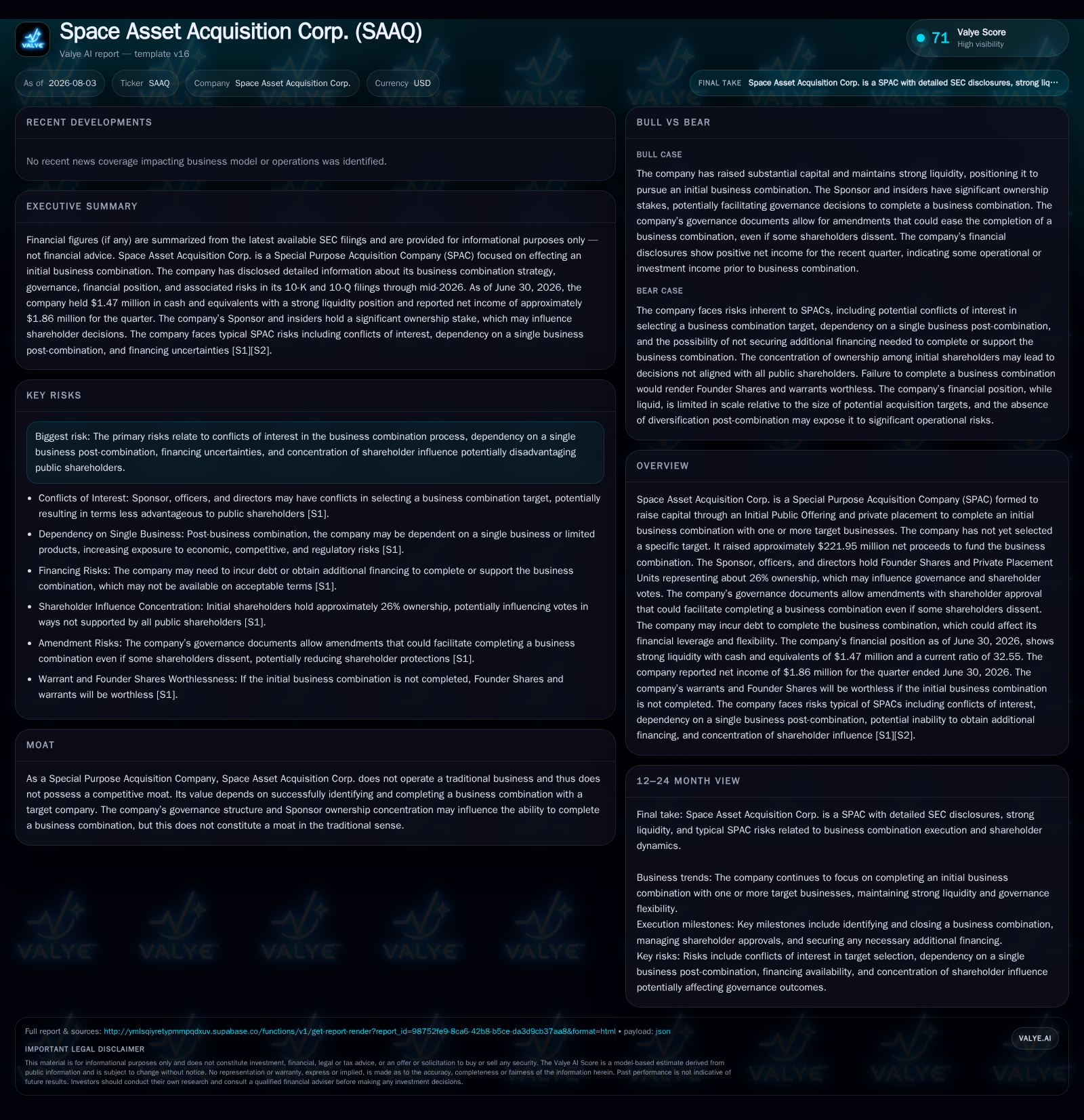
Space Asset Acquisition Corp., a Cayman Islands-based SPAC formed in 2025, completed its IPO and private placement in early 2026, raising net proceeds of roughly $221.95 million that are held in a trust account invested conservatively. The company currently holds founder shares and private placement units representing about 26% ownership, creating a governance dynamic tilted toward its sponsors during the pre-combination phase. It has yet to identify or merge with a target but intends to focus on companies within the technology and defense sectors tied to the expanding global space economy. The operating results thus far reflect typical SPAC pre-combination losses, mainly corporate overhead, with no revenue generation.
Recent Operating Update
Space Asset Acquisition Corp. filed its most recent quarterly report on August 3, 2026, reaffirming its status as an emerging blank-check company focused on completing an initial business combination but having not yet identified any target [S2]. The quarter showed no material operational changes or progress toward closing a merger; instead, activity consisted primarily of maintaining the trust account balance and managing regulatory compliance obligations. As of June 30, 2026, cash and cash equivalents stood at approximately $1.47 million [$F1], reflecting cash held outside the trust after underwriting fees and expenses were settled, while total current assets were $1.53 million against nominal current liabilities of $47 thousand [$F1].
Operating income during this period was negative $91,627 [$F1], entirely consistent with ongoing administrative expenses typical for a pre-combination SPAC without any revenue sources. Net income figures from prior periods similarly show losses driven by formation and general corporate costs [S1]. Notably, the company has not begun generating operating revenues or commercial activity until completion of an initial business combination [S1].
Business Model Analysis
As a Special Purpose Acquisition Company (SPAC), Space Asset Acquisition's business model centers on capital raising through an IPO — completed successfully on January 29, 2026 — supplemented by private placements to affiliates including its Sponsor [S1]. The gross proceeds totaled about $236.45 million before underwriting fees and costs [S1]. Net proceeds available to fund its forthcoming business combination equal roughly $221.95 million [S1]. Importantly, these funds are legally segregated into a Trust Account invested conservatively in short-term U.S. Treasury obligations or qualifying money market instruments [S1]. This structure protects public investors by preserving liquidity until a merger consummation or liquidation event.
The company's equity structure after IPO includes Founder Shares issued predominantly to the Sponsor amounting to approximately 25%–26% ownership post-IPO [S1]. Alongside Private Placement Units purchased at IPO pricing ($10 each) by both Sponsor and underwriters totaling $6.45 million invested pre-merger [S1], these holdings bolster sponsor governance influence by granting them substantial voting power disproportionate to their capital at risk relative to public shareholders.
SPACs like Space Asset Acquisition generate no revenue from operations pre-merger; instead their economic model is anchored in transaction-related income streams including possible underwriting fees recognized over time, warrant exercises post-merger granting upside leverage for founders, and capital appreciation from successful de-SPAC transactions [S1]. Until a target is acquired via business combination — typically structured as a reverse merger allowing the private company to become publicly traded without traditional lengthy IPO processes — there is minimal business activity aside from legal, accounting, and general corporate overhead
Industry Structure and Competitive Position
Space Asset Acquisition is situated within the broader SPAC sector characterized by blank-check companies vying for suitable private enterprises primarily for public listing access via business combinations. The firm intends to focus its acquisition efforts on entities operating within the global space economy — encompassing technology developments related to satellite communications, defense applications linked to aerospace innovation, and broader industry expansion fueled by government contracts and venture investments [S1].
While the company itself lacks any inherent commercial moat or operational differentiation typical among active businesses (having no products or services), its competitive strength derives from sponsor pedigree, capital size raised in IPO/private placements ($220+ million net), timing advantages afforded by Cayman Islands incorporation flexibility, and governance provisions facilitating transaction execution despite shareholder dissent clauses embedded in its organizational documents [S1]. However, this concentration of ownership may also be perceived as a governance risk factor among public investors wary of conflicts between sponsors’ incentives (who stand to lose their founder shares if no deal closes) versus minority shareholder interests [S1][S2].
Comparable SPACs such as Churchill Capital or Social Capital Hedosophia have demonstrated that large scale capital raises combined with compelling sector focus can attract quality targets but also invite regulatory scrutiny concerning dilution impact from warrants issued alongside founder units.
Growth Drivers
Growth drivers for Space Asset Acquisition hinge predominantly on external capital market conditions favoring SPAC structures alongside increasing investor appetite for alternative public market avenues enabling private companies faster liquidity events than traditional IPOs permit. The general rise of interest in space economy ventures — including satellite deployment projects, space-based defense technologies, earth observation analytics platforms — provides fertile ground for selecting promising targets aligned with emergent geopolitical priorities and escalating government budgets targeting space dominance initiatives.
With expanding institutional participation historically improving underwriting support for sizeable IPO offerings along with regulatory clarifications supporting SPAC transparency measures underway across jurisdictions like the SEC’s heightened reporting requirements for blank-check companies [S1], Space Asset Acquisition is positioned well to capitalize provided it executes efficiently within mandated timelines typically set around two years post-IPO for completing an initial business combination.
Attracting high-profile advisors or developing partnerships with established aerospace investment groups could further augment deal sourcing capabilities. Additionally, demonstrating governance practices balancing sponsor interests with transparent shareholder protections could reduce redemption risk during eventual shareholder votes on any proposed mergers.
Risks and Watchpoints
Moreover, failure to complete a transaction within prescribed deadlines obliges return of Trust Account balances minus permissible transaction expenses back to shareholders whilst wiping out Founder Shares value entirely — pressures management teams intensely toward deal closure even if valuations become unattractive [S1]. Governance document provisions allowing amendments facilitating deals notwithstanding dissenting shareholders underscore these tensions.
Compliance with new SEC regulations pertaining specifically to disclosures around conflicts of interest associated with affiliates or connected parties involved in target companies also represent ongoing watchpoints impacting transaction structuring risk profiles.
What To Watch Next
The immediate milestones include timely announcement regarding prospective target(s) within stated sector focus areas followed by scheduled shareholder votes preceding any proposed mergers. Key performance indicators signaling positive progress comprise disclosure of evaluation pipelines indicating robust deal flow activity measured perhaps by number of targets assessed; maintenance or increase in Trust Account balances absent excessive administrative cost drain evidencing prudent capital stewardship; favorable governance approval rates ensuring Sponsor-backed combinations meet regulatory thresholds; moderate shareholder redemption rates post-announcement signaling confidence among retail/professional investor cohorts.
Additionally monitoring for debt financing arrangements necessary to supplement Trust Accounts for larger acquisition sizes will inform leverage considerations impacting post-merger capitalization strategies.
Operating losses incurred remain modest (-$91k) stemming principally from standard administrative overhead characteristic of pre-revenue blank-check entities [$F1]. No significant debt obligations were reported given absence of acquisition-related borrowings so far.
This financial posture aligns closely with peer SPACs at similar lifecycle stages where burn rates remain low but fixed costs persist around regulatory compliance activities necessitating robust cash reserves until major transactions consummate.
This analysis is based strictly on information available as of August 3, 2026 from SEC filings without projecting outcomes or giving investment advice. The dynamics described reflect typical structural characteristics inherent in SPAC vehicles combined with Space Asset Acquisition’s particular capitalization and governance profile evident prior to completing any merger transaction.
Disclaimer: This is research-only, informational analysis and not investment advice. It may include AI-generated interpretation and general industry context. Always verify important details using primary sources.

Comments