
First Interstate BancSystem Strengthens Profitability and Liquidity with Diversified Loan Portfolio in Q2 2026
Strong quarterly earnings and substantial liquidity underpin First Interstate BancSystem’s profile amidst sector risk factors.
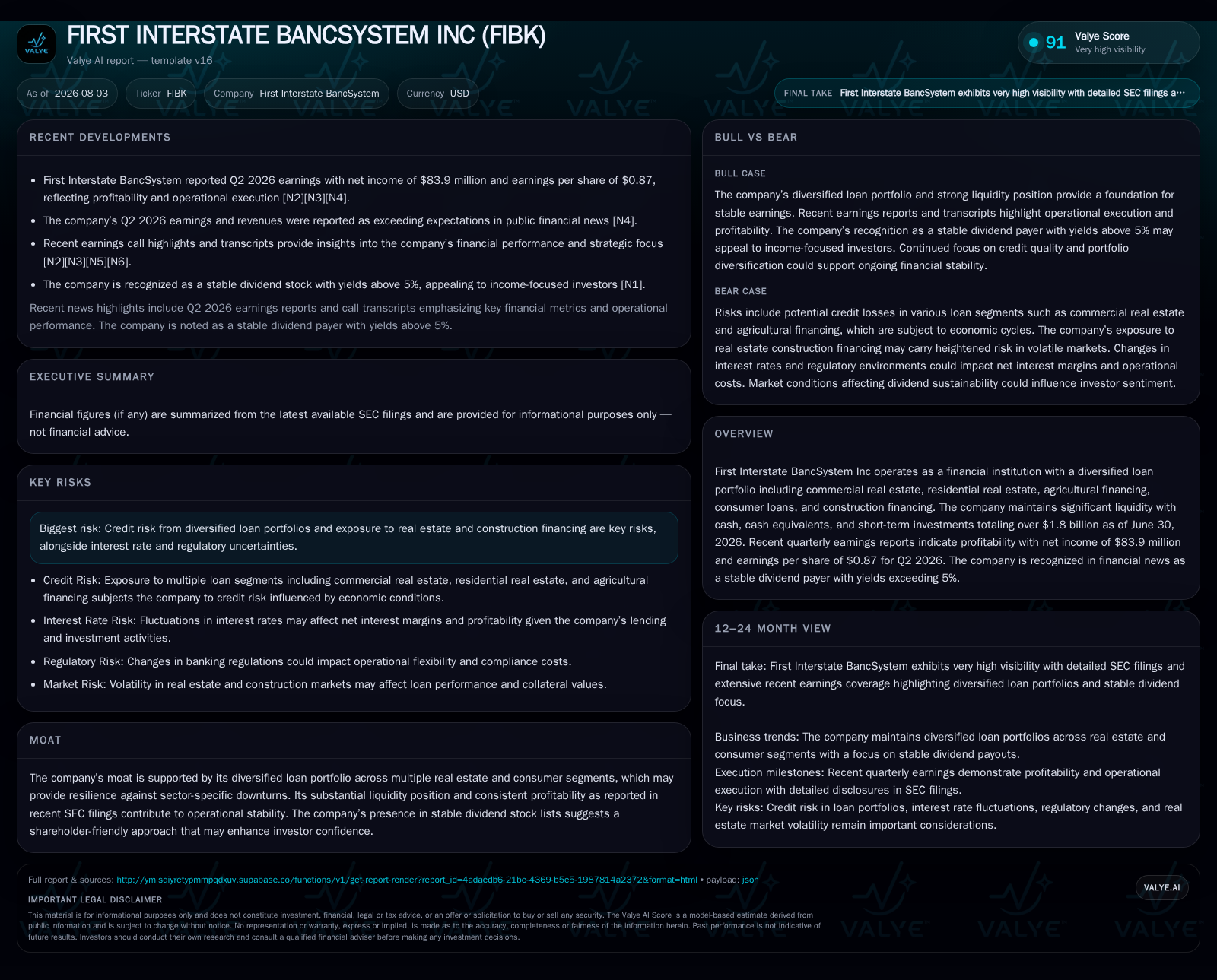
First Interstate BancSystem Inc. reported solid profitability in Q2 2026, with net income of $83.9 million and EPS of $0.87, supported by a diversified loan portfolio spanning commercial real estate, residential mortgages, agriculture, and consumer financing. The company maintains robust liquidity, holding over $1.8 billion in cash, equivalents, and short-term investments as of June 30, 2026. These strengths are balanced against credit risk concentrations in commercial real estate and agricultural lending as well as regulatory and interest rate headwinds common in regional banking. Dividend yields above 5% highlight the firm’s shareholder-return focus within a competitive environment influenced by fintech entrants and evolving regulatory scrutiny.
Recent Operating Update: Q2 2026 Earnings and Balance Sheet Highlights
First Interstate BancSystem filed its latest quarterly report on August 3, 2026 [S2], marking a continuation of profitable operations with net income for Q2 reaching $83.9 million and earnings per share at $0.87 [N2]. This performance underscores resilient revenue generation primarily from net interest income — the spread between loans issued across diverse sectors and deposit costs — supplemented by fee income from ancillary financial services. Critical for liquidity management, the company holds over $1.8 billion in cash equivalents and short-term investments at quarter-end [S2], a substantial buffer that supports lending capacity and absorbs potential stress from loan losses.
Recent commentary positions First Interstate as a stable dividend payer with yields surpassing 5%, signaling consistency in capital returns despite challenging financial sector volatility [N4]. This fiscal discipline balances shareholder expectations with regulatory capital demands integral to banking compliance.
Business Model: Diversified Regional Lending with Fee Income Support
First Interstate operates as a classic regional bank providing deposit-taking alongside an extensive variety of loan products including commercial real estate (CRE), residential mortgages, agricultural finance, consumer loans, and construction financing [S1][S2]. The business model centers on monetizing net interest margin (NIM) — essentially earning more interest on deployed funds than what it pays on deposits — complemented by fees for loan origination and deposit services.
The geographic breadth is focused on local markets where strong relationships foster customer retention but also expose the bank to regional economic shifts. Its diversified loan book aims to mitigate sector-specific cycles: while CRE loans form a dominant share (approximately 69% of loans held for investment) [S1], exposure to agricultural borrowers adds dependence on commodity pricing dynamics that can affect repayment capacity.
Revenue scalability links closely to loan growth rate and deposit inflows. Fees contribute marginally but help smooth earnings volatility when interest margins compress due to macroeconomic factors like policy rate shifts or increased competition.
Industry Structure and Competitive Position
Within the U.S. regional banking sector — comprising peers such as Regions Financial Corporation and Zions Bancorporation — First Interstate occupies a niche balancing scale with local market intimacy. Peer banks face similar pressures: rising operational costs from regulatory compliance increases post-Dodd-Frank reforms; competition not only from traditional institutions but also fintech lenders offering digital-first platforms often at lower prices; plus cyclical credit quality changes driven by real estate valuations or commodity price swings.
Competition compels maintaining efficiency ratio discipline (operating expenses over revenue) to preserve returns on assets (ROA) and equity (ROE). Meanwhile, evolving Consumer Financial Protection Bureau (CFPB) oversight targets fee structures like overdraft or late fees that have historically contributed ancillary income streams [S1]. Also notable is the emerging impact of open banking standards under Section 1033 of Dodd-Frank which potentially shift data access paradigms — benefiting fintech partners but introducing integration complexities for banks.
Growth Drivers
Key growth vectors include expanding loan portfolios aligned with favorable economic development within served regions — particularly in commercial real estate markets showing selective strength, residential housing demand driven by demographic factors, and agricultural lending tied to crop cycles and commodity price regimes.
Deposit base expansion underpins loan funding capability; thus consumer savings habits or business deposit inflows matter materially. In an environment where interest rate movements influence NIM positively when rates rise but potentially dampen loan demand due to higher borrowing costs, carefully navigating portfolio mix is critical.
Opportunities also exist in broadening fee-based financial services or optimizing branch network footprint through strategic acquisitions or divestitures mentioned in past filings [S1]. Digital banking adoption trends represent another lever for competitive relevance.
Risks and Watchpoints
Credit risk remains paramount given concentrated exposures in commercial real estate lending where borrower cash flow is intrinsically tied to property market health [S1]. Recent tangible losses include an impairment-related charge-off of approximately $15.8 million tied to CRE loans adversely affected by deteriorating borrower conditions during late 2025 [S1]. Agricultural financing similarly subjects the institution to risks from commodity price volatility; unexpected downturns can lead to borrower stress especially in highly cyclical sub-sectors like grain producers.
Interest rate risk also demands vigilant asset-liability management since margin compression can result if deposit betas rise faster than loan yields or if repricing mismatches occur.
Regulatory landscape intensification increases compliance burden and uncertainty — particularly surrounding CFPB's shifting supervision focus towards consumer protection mandates involving fee structures or data access rights [S1]. Strategic branch divestitures raise operational risks related to potentially losing associated deposits which historically subsidize lending growth internally.
Moreover, growing competition from non-bank fintech entities able to leverage technology-driven cost advantages challenges traditional revenue streams especially among younger customer demographics favoring digital convenience.
What to Watch Next
Stakeholders should monitor key operating metrics such as sequential loan growth rates across major portfolio segments (CRE, residential mortgages, agriculture), deposit growth velocity reflecting core funding stability, non-performing loan ratios indicating emerging credit stress levels, and quarterly provision for credit losses signaling conservative versus aggressive risk recognition.
Dividend payout sustainability merits attention given yield attractiveness balanced against retained earnings needed for capital adequacy under Basel III regulatory frameworks.
Strategic announcements regarding branch network rationalization or digital platform investments will offer insight into adaptation efforts amid evolving customer preferences.
Subsequent quarterly reports will clarify trajectory amid volatile macro-economic influences including monetary policy adjustments impacting borrowing costs and repayment behaviors.
Financial Profile Discussion
Overall financial health balances conservative liquidity management with profitable asset deployment ensuring durable operations despite cyclical headwinds impacting regional banking sectors broadly.
This analysis synthesizes publicly filed quarterly reports along with broader industry context without providing investment advice or research views. It focuses on current operating performance drivers, industry structural factors influencing First Interstate BancSystem’s positioning into mid-2026.
Disclaimer: This is research-only, informational analysis and not investment advice. It may include AI-generated interpretation and general industry context. Always verify important details using primary sources.

Comments