
Medifast Advances Metabolic Health with Coach-Driven Model Amid Competitive Pressures
Medifast leverages its integrated coach network and scientific nutrition products to pursue sustainable growth in the metabolic health market.
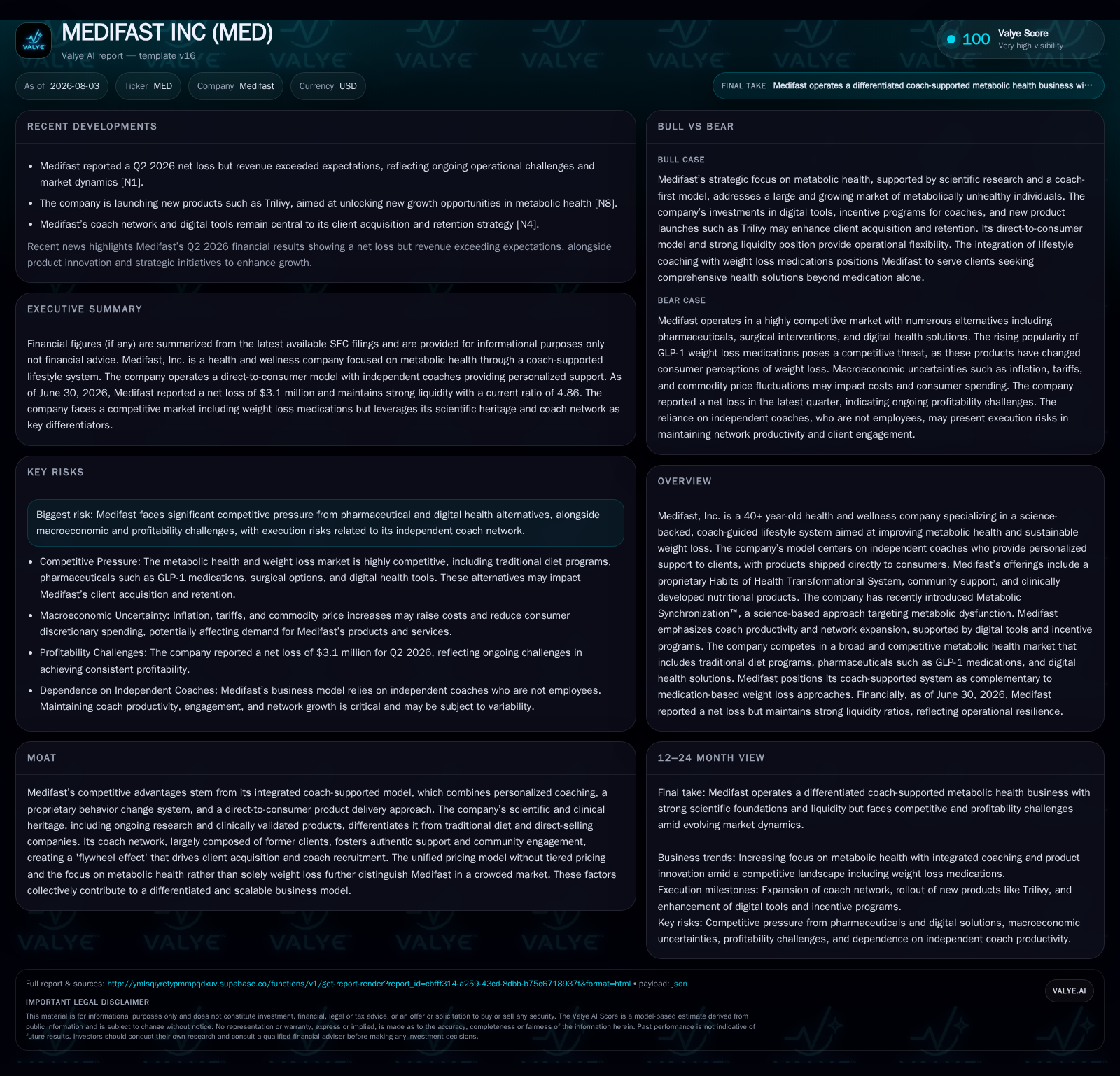
In Q2 2026, Medifast continued to execute its strategic shift towards a broader metabolic health focus supported by an expanding and more productive independent coach network. The company’s direct-to-consumer model combines clinically backed nutritional products with personalized coaching and community engagement, creating a differentiated offering in a crowded field challenged by pharmaceuticals and digital health platforms. While recent quarters report profitability challenges, Medifast benefits from strong liquidity and an effective incentive framework geared toward coach expansion and retention. Key drivers include innovation in behavior change programs and digital tools targeting coach productivity, while risks center on regulatory scrutiny and intensifying competition.
Recent Operating Update
Medifast’s second quarter ending June 30, 2026 showed continued strategic momentum as the company transitions from transformation to execution within the larger metabolic health market. The quarter’s performance aligned with expectations for revenue beating estimates albeit at a loss-making level consistent with ongoing investments [S2][N1]. The firm emphasized improvements in coach productivity—a linchpin metric reflecting sales generated per active earning coach—while also focusing efforts on network expansion through targeted incentives such as the EDGE program launched in 2025 which rewards progressive business-building behaviors across new and seasoned coaches [S1]. These moves aim to amplify Medifast's "flywheel effect," where new clients feed into elevated coach recruitment that in turn drives further client acquisition.
Business Model
Medifast operates a hybrid manufacturing-distribution model combined with an independent contractor coaching network placed at the center of its value chain. Approximately 16,100 active earning independent coaches engage clients one-on-one using a proprietary Habits of Health Transformational System that goes beyond weight loss to target underlying metabolic dysfunction—a growing public health concern [S1][S12][S29]. Coaches provide personalized support augmented by community engagement and science-backed nutritional products shipped directly to consumers under several brands owned or controlled via subsidiaries including Jason Pharmaceuticals
Revenue is primarily product-sales driven; customers purchase consumables often on an auto-ship basis (Premier+ program) supporting recurring revenue streams. Coach productivity—the average revenue generated per engaged coach—is critical since it dictates overall top-line scalability without excessive incremental SG&A cost. Supplementary revenue flows arise from coaching incentives which reinforce behavioral change system adoption and help convert clients into future coaches, thereby fueling internal growth cycles.
Clinically developed products backed by ongoing research provide differentiation versus typical MLM or direct selling competitors. The company underscores its scientific advisory board's role in embedding emerging evidence into product innovation and plan enhancements—a cornerstone of Medifast's competitive moat that blends human touchpoints with high-quality nutritional offerings [S13][S29].
Industry Structure and Competitive Position
Medifast occupies a midstream role bridging product development/manufacturing to end-user behavior change via its distributed coaching network. Its peers broadly span traditional diet companies like Nutrisystem or Weight Watchers (WW), direct selling herbal nutritionists such as Herbalife, digital-first platforms like Noom, and pharmaceutical incumbents producing GLP-1 based weight-loss drugs exemplified by Novo Nordisk.
While traditional diet programs compete largely on convenience or price points, Medifast’s differentiation rests on personalized coaching delivered by former clients who build authentic relationships coupled with proprietary behavior change programs—a rare combination creating loyalty advantages amid commoditization pressures [S12][S29]. Unlike multi-tiered pricing structures common in MLMs, Medifast maintains unified pricing making it more transparent for coaches and clients alike.
However, rising penetration of pharmaceutical solutions has redefined consumer expectations about efficacy and convenience in weight loss/metabolic health [S12]. Though presenting a threat particularly among medically supervised cohorts, Medifast positions its offerings as complementary; pharmacotherapy requires sustained lifestyle change which Medifast facilitates through coaching support—thus anchoring itself within shifting market ecosystems
Growth Drivers
Key growth drivers stem from escalating consumer awareness regarding metabolic health beyond aesthetic goals towards sustainable wellness outcomes. This macro trend aligns with proactive demand for personalized coaching backed by clinical validation rather than one-size-fits-all diet plans.
Network effects fuel growth: as new coaches join—mostly graduates of the program themselves—they stimulate new client inflows enabling higher volume product sales [S1][S15]. Digital tools introduced recently improve administrative efficiency allowing coaches to allocate time toward client-facing tasks enhancing coach productivity metrics that correlate strongly with revenue scaling capacity
Innovation pipelines anchored by the Scientific Advisory Board integrate cutting-edge research ensuring products meet evolving nutritional standards enhancing client outcomes. Subscription-based auto-ship models such as Premier+ underpin recurring revenue stability while discount tiers incentivize client retention—critical given seasonality impacts around diet resolution seasons [S1][S15]
Furthermore, incentive programs like EDGE reward desirable behaviors forecasting improved recruiting/retention trajectories within the coaching ecosystem, strengthening the flywheel effect essential for longer-term compounding growth.
Risks & Watchpoints
Regulatory risks remain prominent due to evolving scrutiny around direct selling practices especially concerning MLM income disclosures and advertising claims regulated by the FTC [S5][S6][S25]. Pending or possible rule modifications could compel structural adaptations negatively impacting compensation or operational flexibilities
Product liability exposures inherent in consumable wellness products necessitate vigilant quality controls though insurance coverage mitigates some risk extent; nevertheless unexpected adverse events could deter consumer confidence or trigger legal action harming reputation or finances [S5].
Competitive pressures heighten risk given rapid adoption of GLP-1 medications attracting segments traditionally served by coaching-led solutions; whether Medifast can convincingly integrate these pharmacological adjuncts into comprehensive metabolic care plans remains a pivotal question influencing client retention rates [S12]
Macroeconomic conditions including inflationary pressures could depress discretionary spending which comprises much of coaching-driven wellness purchasing behavior; supply chain cost volatility similarly threatens margin stability despite vertically integrated manufacturing facilities compliant with FDA/USDA standards providing partial protection [S15][S24]
Operational execution also hinges critically on managing coach churn rates and sustaining enrollment momentum—areas highlighted as significant levers yet susceptible to external competitive lures or internal dissatisfaction.
What to Watch Next
Future milestones include tracking quarterly trends in active earning coaches count alongside average revenue per coach metrics that signal growing adoption efficiency. Client acquisition rates combined with subscription renewal statistics will reveal success of initiatives like Premier+ auto-ship enhancements introduced last year.
Monitoring incremental uptake of new clinically designed products or behavioral programs licensed through the Scientific Advisory Board offers insight into innovation cycle effectiveness. Regulatory developments emanating from the FTC’s ongoing reviews on MLM income disclosure policies represent an execution watchpoint given potential need for compensation adjustments.
On financials, reductions in operating losses or margin improvements tied to scaling benefits would validate the long-tenured business model pivot towards broader metabolic health solutions beyond traditional weight loss. Engagement metrics evidencing rising community participation fostered through coach networks serve as proxies for deeper customer loyalty underpinning durable competitive positioning.
Financial Profile Discussion
At quarter-end June 2026, Medifast reported no outstanding debt liabilities reflecting a conservative capital structure beneficial for operational flexibility amid uncertain regulatory landscapes [F1]. The balance sheet shows $71.9 million cash and equivalents against current liabilities of roughly $41.6 million yielding a strong current ratio near 4.86 indicative of solid short-term liquidity preparedness [F1]. These metrics provide headroom for continued investments in digital platform enhancements and programmatic rollouts targeting coach network expansion or product innovation.
Despite robust liquidity, operating income remained negative (-$14.2 million) at latest fiscal year-end December 2025 reflecting elevated marketing spend, incentive payouts, and investment into emerging programs aimed at driving sustainable talent pipeline growth within coaching ranks [F1]. Net losses also underscore near-term margin pressures common when scaling service-enabled direct selling businesses aggressively amid intensifying competition.
Overall cash flows need monitoring for signs that incremental scale achieves improved leverage of fixed costs associated with manufacturing facilities and administrative functions given that gross margins derive partly from controlled in-house production representing about 40% of unit sales volume [S12][S24]. Organic sales growth fueled by coach-driven client acquisition remains vital for reversing operating losses into profitability over medium term horizons.
This analysis synthesizes currently available SEC filing data alongside contextual industry expertise reflecting Medifast's evolving strategy within the health & wellness direct selling ecosystem. It does not constitute investment advice but aims to inform understanding of underlying business dynamics shaping future prospects.
Disclaimer: This is research-only, informational analysis and not investment advice. It may include AI-generated interpretation and general industry context. Always verify important details using primary sources.

Comments