
Douglas Dynamics Expands Distributor Network and Innovates Amid Seasonal Demand Fluctuations
Douglas Dynamics leverages its extensive North American distribution network, lean manufacturing, and product innovation to sustain market leadership in fluctuating snow and ice control markets.
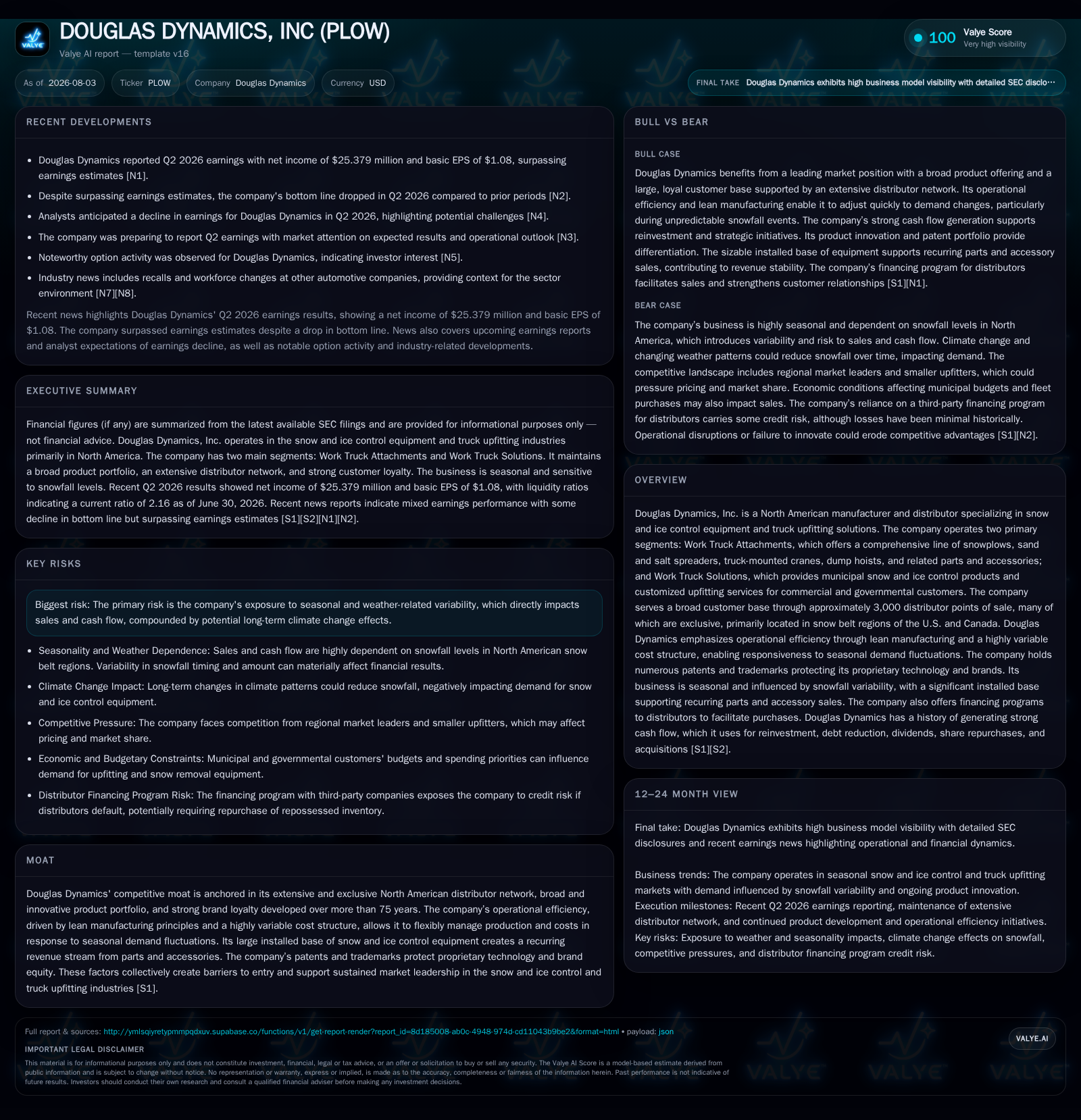
Douglas Dynamics reported results for Q2 2026 showcasing resilience amid seasonal variability common to the snow and ice control equipment market. The company’s extensive distributor network of roughly 3,000 points of sale drives broad market access primarily in North America’s snow belt regions, supporting their leading presence in specialized truck attachments. Operational efficiency via lean manufacturing and a variable cost structure enables Douglas Dynamics to respond flexibly to demand spikes, while a diversified product portfolio spanning snowplows, salt spreaders, truck-mounted cranes, and upfitting services maintains revenue stability. Nevertheless, weather dependency and climate trends remain structural risks. Investment in product innovation and distributor expansion underpin growth opportunities going forward.
Recent Operating Update
Douglas Dynamics’ Q2 2026 filings present a business continuing to navigate the intrinsic seasonality embedded in the snow and ice control equipment market. Results disclosed on August 3 highlight modest impacts from fluctuating snowfall patterns that traditionally modulate demand across their core regions—the U.S. Midwest, East Coast, Northeast, and southern Canada [S2][S3]. The company’s press release accompanying the quarter-end affirms expectations that sales volumes remain closely tied to winter weather intensity and timing.
This recent quarter underscores that despite short-term dips potentially induced by lower snowfall or offseason softness, Douglas Dynamics sustains competitive advantages through operational agility and deep market penetration. Notably, there are no material changes in risk factors since the prior year-end filing, reaffirming ongoing structural weather sensitivity alongside commodity price risks such as steel inflation
Business Model
Douglas Dynamics operates principally through two segments: Work Truck Attachments and Work Truck Solutions. The former manufactures an extensive range of products including snowplows branded under FISHER®, SNOWEX®, WESTERN®, alongside salt and sand spreaders, truck-mounted cranes (under VENCO®/VENTURO®), dump hoists, and related parts and accessories [S1]. These products serve professional snowplowing contractors—commercial customers requiring reliable equipment for contractual snow removal operations.
The Work Truck Solutions segment complements this by focusing on municipal snow and ice control products plus customized truck upfitting services targeting governmental customers such as Departments of Transportation (DOTs) and municipalities [S1][S9]. These upfits involve specialized vehicle outfitting with racking systems, storage solutions (under HENDERSON®/DEJANA® brands), fulfilling niche requirements for commercial fleets.
Revenue mechanics depend primarily on sales through a network of approximately 3,000 distributor points of sale across North America’s snow belt regions—a scale the company claims as uniquely extensive within this industry [S12]. Many distributors maintain exclusive agreements with Douglas Dynamics which serves as a barrier to entry for competitors by limiting alternative distribution channels. Distributors also provide critical real-time inventory data and customer feedback that inform product development cycles.
Pricing power is supported by steady product innovation that increases ease of use, durability, reliability, serviceability—and justifies premium positioning in pricing relative to peers without similar technical breadth or brand recognition [S1][S6]. Aftermarket parts and accessories sales generate recurring revenue from an installed base estimated at over 500,000 units predominantly active within professional snow removal fleets [S15]. This aftermarket component smooths revenue volatility as parts replacement occurs independent of new equipment sales cycles.
Importantly, Douglas Dynamics' cost structure emphasizes a highly variable labor model augmented by lean manufacturing principles enabling flexibility in production scaling during peak seasons or sudden demand spikes following unexpected snowfall events [S6][S26]. Approximately 10-15% of their workforce during average snowfall years consists of a sizable temporary labor pool utilized to ramp capacity efficiently without long-term fixed cost burdens.
Industry Structure & Competitive Position
The industrial manufacturing niche for work truck attachments and snow/ice control equipment is characterized by relatively few large players predominately serving the North American winter markets. Key competitors generally share focus on innovation rate in product design improvements; network breadth in distribution; operational efficiency to manage seasonal production swings; and brand equity cultivated among professional operators.
Douglas Dynamics positions itself as the market leader underpinned by three pillars: its unmatched distributor reach with exclusive agreements (~3,000 points), broadest product portfolio including integration of newly acquired truck-mounted crane lines (Venco Venturo acquisition in 2025), and continuous new product introductions each year which drive differentiation [S1][S14]
Peer companies typically range from manufacturers focused solely on truck attachments or municipal upfitting specialists to smaller regional providers lacking Douglas Dynamics’ scale or innovation pipeline. By contrast, Douglas Dynamics’ vertical integration extends from proprietary manufacturing processes protected by patents spanning hydraulics to electronics combined with trademarked brand names fostering customer loyalty built over more than 75 years [S10][S14]. This layered moat complicates competitor attempts to penetrate their territory at scale.
Growth Drivers
Several growth avenues have been articulated:
- Expanding Distributor Network: Management targets increased penetration especially into underpenetrated territories beyond the core snowbelt areas including heavier-duty truck markets where existing share is perceived below 50%, leveraging exclusive distributorships along with training/support programs aimed at strengthening partner capabilities [S4][S26].
- Product Innovation: Sustained investment in R&D delivers new or redesigned products tailored to evolving customer needs—improving operational productivity or ease-of-use while concurrently embedding lean manufacturing concepts into development helps reduce time-to-market [S4][S6].
- Aftermarket Expansion: Growing installed base naturally fuels demand for replacement parts/accessories providing stable recurring revenue less sensitive to seasonal timing nuances [S15].
- Upfit Market Penetration: Work Truck Solutions segment aims at deepening customized upfitting services across commercial vehicle classes via enhanced customer responsiveness aligned with specialized fleet requirements from governmental entities or large commercial operators [S9][S13].
- Strategic Acquisitions & Vertical Integration: The recent purchase of Venco Venturo adds truck service cranes/dump hoists expanding portfolio breadth while offering cost synergies; further acquisitions remain under consideration selectively within adjacent markets complementing core competencies [S18].
- Regulatory & Infrastructure Spending: Regulatory mandates requiring efficient snow/ice clearance in colder jurisdictions drive baseline demand; likewise increased municipal/commercial expenditure on infrastructure upgrades can lift volume over multi-year horizons.
Risks / Watchpoints / Growth Constraints
Despite strengths there are headwinds inherent in Douglas Dynamics’ model:
- Weather Dependency: Sales are heavily influenced by seasonal snowfall quantity/timing causing inherent quarter-to-quarter volatility. This exposure is compounded by climate change trends implying potential longer-term structural declines in snowfall levels across core markets reducing replacement demand frequency over time [S11][N6].
- Commodity Price Inflation: Input costs like steel remain volatile; while mitigated partially through vendor negotiations or price adjustments to end-users these fluctuations pose margin pressure risk particularly if sharp surges occur unexpectedly between ordering cycles [S10].
- Supply Chain Stability: Component availability disruptions could affect production lead times impacting shipping performance metrics—a critical KPI due to urgent nature of client needs post-snowfall events [S11].
- Customer Concentration & Budget Variability: Approximately half revenues derive from dealer channels while government/municipal contracts form a substantial portion subject to public budget cycles creating potential funding uncertainty especially under economic downturns affecting capital spend pacing [S13][N3].
- Labor Availability: Dependence on temporary workforce segment for capacity adjustment introduces risk related to labor market tightness or regulatory changes affecting employment mix during peak seasons [S6].
- Competitive Innovation Pressures: Failure to maintain pace with technological advancements or product desirability could erode market share.
What To Watch Next
Key performance indicators for forthcoming periods include:
- Order Backlog Levels & Seasonal Preorders: Monitoring pre-season order activity provides early insight into anticipated volume shifts before retail seasons commence given proactive pre-season order programs incentivizing distributors timely commitments [S4].
- New Product Launch Outcomes: Tracking introduction cadence effectiveness through reception among distributors/end-users reflects innovation program health.
- Distribution Network Changes: Growth in distributor points especially exclusive agreements signals market expansion success.
- Pricing Actions & Margin Trends: Adjustments reflecting raw material cost pass-through effectiveness alongside operational leverage would be evidenced in margin movement.
- Aftermarket Parts Revenue Percentage: Rising contribution indicates strengthening recurring streams buffering cyclical exposure.
- Shipping Performance Metrics: On-time delivery rates assess operational responsiveness under volatile demand spikes.
Financial Profile Discussion
As of June 30, 2026, Douglas Dynamics held $342 million in current assets against $158 million in current liabilities, yielding a current ratio near 2.16, indicating ample short-term liquidity available to fund working capital needs amid seasonal billing cycles [F1][S2]. Total debt was approximately $144 million as of December 31, 2025, with net debt post cash adjustments around $137 million [F1].
Capital expenditures remain modest relative to cash flow reflecting low fixed asset intensity allied with strategic investments targeted towards productivity enhancements rather than expansionary capacity buildup—consistent with flexible manufacturing stance enabled by variable workforce deployment models discussed earlier. This disciplined capital allocation supports ongoing dividends payments along with share repurchase programs fitted within broader financial optimization strategy outlined by management [S5][N1]. As typical for industrial manufacturers serving seasonal B2B niches reliant on durable goods replaced cyclically rather than annually, cash generation remains tightly linked to snowfall-dependent volume but balanced over multi-year averages by aftermarket revenue growth.
This analysis synthesizes the latest SEC disclosures alongside industry context reflecting Douglas Dynamics’ operating environment within North American work truck attachments focused on snow and ice control equipment. While weather-related demand volatility poses persistent cyclical risk amplified by climate change trends over longer horizons, the company’s entrenched distribution footprint coupled with continuous innovation investment underpin its leading position within this specialized niche. Financially sound liquidity paired with flexible lean manufacturing equips it well for operational responsiveness during peak periods fostering strong customer loyalty supported by branded value propositions leveraging over seventy-five years of heritage expertise.
This report does not constitute investment advice but aims to clarify operational dynamics shaping Douglas Dynamics’ business trajectory through detailed evidence-based evaluation.
Disclaimer: This is research-only, informational analysis and not investment advice. It may include AI-generated interpretation and general industry context. Always verify important details using primary sources.

Comments