
Diversified Healthcare Trust’s Portfolio Resilience Amid Operational and Financial Challenges
DHC reports Q2 2026 results highlighting ongoing operational strains and elevated leverage within a specialized healthcare real estate portfolio.
Diversified Healthcare Trust (DHC) continues to operate a broad portfolio of senior living, medical office, life science, and wellness properties that benefit from structural demand drivers in healthcare real estate. However, the latest quarter reflects operational execution challenges tied to tenant credit stresses and missed financial targets. The company’s high leverage position underscores the importance of managing refinancing risk amid interest rate volatility. Joint ventures and third-party management remain strategic tools for growth and diversification but have yet to fully offset sector headwinds. Monitoring occupancy trends, lease renewals, and FFO generation will be critical to assessing the durability of DHC’s recovery path.
Recent Operating Update
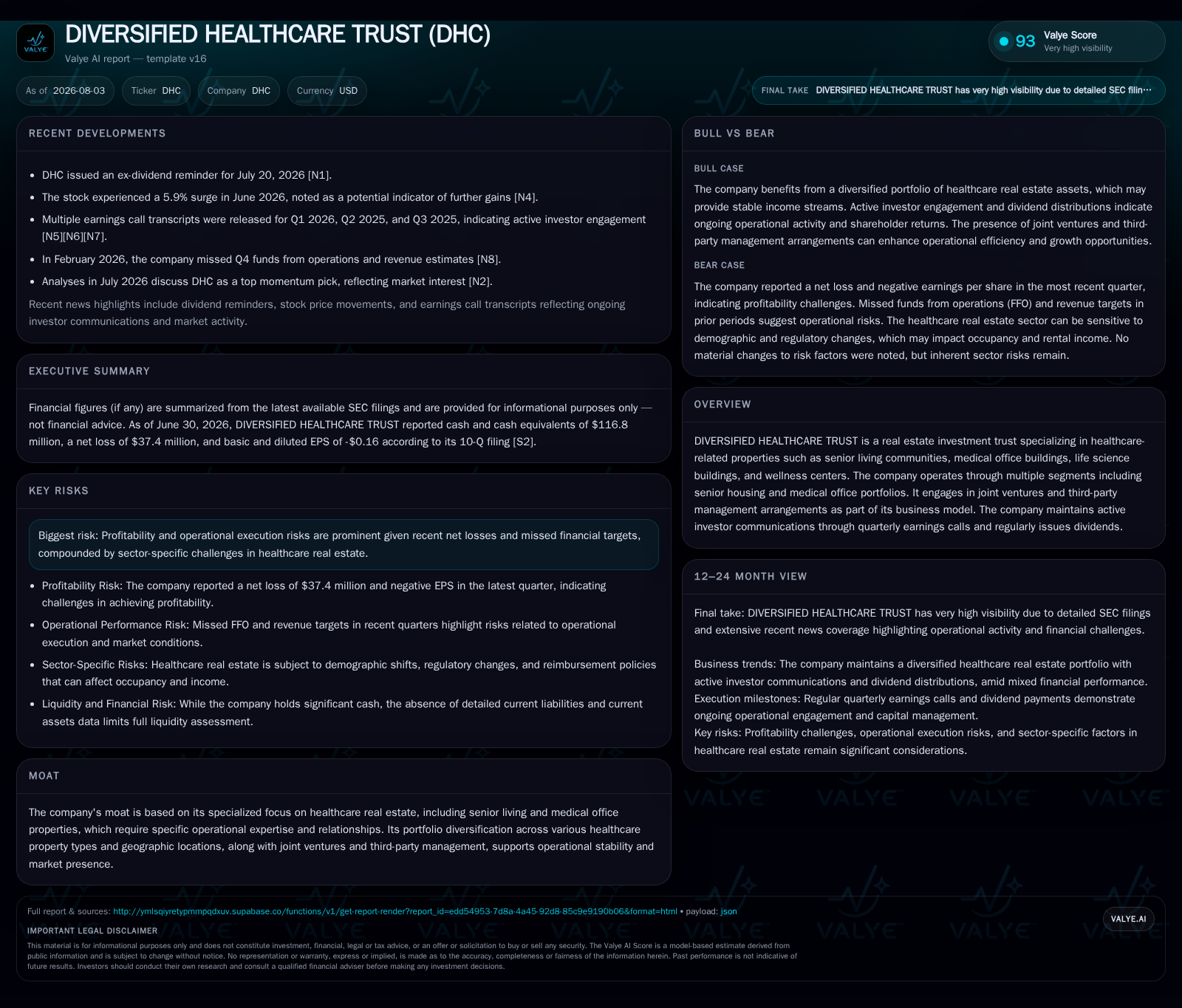
In its Quarter 2 report filed August 3, 2026, Diversified Healthcare Trust (DHC) provided the latest insight into its operating environment characterized by ongoing headwinds across healthcare real estate sectors [S2][S3]. The company continues to incur net losses—a reflection of challenging tenant conditions and operational disruptions—although some metrics like funds from operations (FFO) outperformed analyst estimates [N1][S2]. This mixed performance points to a nuanced recovery path where core leasing revenues coexist with rising operating expenses or impairments.
The filing highlights no material changes to previously disclosed risk factors but underscores that profitability remains under pressure during competitive leasing dynamics and tenant credit concerns in senior housing operations. Simultaneously, joint ventures and third-party management arrangements are active components of the business model that contribute non-rental income but have yet to fully offset softness in legacy portfolios [S1][S3]
Business Model Overview
As a Healthcare Real Estate Investment Trust (REIT), DHC specializes in ownership and leasing of healthcare-related properties including senior living communities that encompass independent living through skilled nursing facilities, medical office buildings (MOB), life science buildings designed for biotech customers, and wellness centers focused on preventive care [S1]. The business monetizes primarily through rental income streams secured by lease agreements with healthcare operators who provide services to end-users such as elderly residents or medical patients.
The complexity inherent in this model arises from the specialized nature of healthcare assets which require active asset management to maintain occupancy rates amidst regulatory scrutiny of tenants’ operations—particularly in the senior living segment where payor mix between private payers, Medicare, Medicaid, or other insurers affects tenant financial stability [S1]. Ancillary revenue from joint ventures or third-party management contracts adds diversification but typically carries lower margins than direct leasing
Revenue growth drivers hinge on raising occupancy rates across diversified geographic markets while renewing leases often with embedded rent escalations. Tenant credit quality materially influences collectability of rental income given many operators face reimbursement pressures or changing demographics impacting demand patterns.
Industry Structure and Competitive Positioning
Healthcare REITs operate as landlords providing essential infrastructure within an ecosystem of healthcare delivery without directly engaging in clinical services themselves. This places them downstream from tenants but upstream of end-care consumers.
DHC's portfolio diversification across senior housing, medical office space, and life sciences allows it to spread risk across property types subject to different demand elasticities. However, it competes against larger peers such as Ventas (VTR), Welltower (WELL), and Healthpeak Properties (PEAK), which benefit from scale advantages enabling more aggressive capital deployment and better negotiating power on lease terms. These peers also tend to have higher-quality tenant mixes or more developed life sciences exposure reducing concentration risk compared with DHC's current profile.
Operationally, DHC must navigate headwinds unique to healthcare real estate: regulatory changes affecting Medicare/Medicaid funding impact tenant viability; increased competition among operators can suppress lease renewal pricing; capital-intensive nature requires careful cost control; and evolving care delivery models shifting towards outpatient services may modulate demand for traditional senior facilities versus ambulatory medical offices.
Growth Drivers
The fundamental demographic tailwinds supporting DHC's long-term outlook remain strong. An aging US population is projected to drive sustained demand for senior living accommodations as well as outpatient medical services necessitating growing MOB space. Meanwhile, life science facility demand continues benefiting from biotech R&D expansion requiring specialized labs—a niche driving premium rents.
Strategic deployment through joint ventures expands footprint without overstretching balance sheet constraints while supplementing fee income streams enhancing earnings stability. Geographic targeting towards urban centers experiencing population growth further supports market fundamentals.
Additional growth catalysts include:
- Lease renewal rate improvements signaling better tenant retention.
- Incremental development or property acquisitions adding accretive assets.
- Expanding third-party management mandates which can generate recurring revenues outside traditional rent flows.
- Healthcare policy initiatives promoting investment in infrastructure upgrades.
Nevertheless, these are contingent upon improving operational execution metrics amid persistent macroeconomic uncertainties.
Risks and Watchpoints
Key risks persist around tenant credit quality—particularly if operator partners encounter reimbursement cuts or capitalize limits tightening access to working capital—as well as elevated interest rate environments increasing financing costs given significant borrowings with variable coupons or impending maturities [F1][S13].
Portfolio concentration risk exists if specific regional markets soften or certain property types fall out of favor due to shifts in care models. Operational execution risks arise from managing complex asset types alongside outsourcing partner relationships inherent in joint ventures/third-party management.
Market valuations remain sensitive amid uncertainty around healthcare policy reforms which could alter utilization patterns or reimbursement rates impacting rental income assumptions over time.
Rising capital expenditure requirements for facility upgrades or compliance may pressure free cash flow absent commensurate rent growth.
What to Watch Next
Investors should prioritize monitoring:
- Quarterly updates on occupancy rates across major segments demonstrating recovery or deterioration trends.
- Lease renewal statistics reflecting pricing power or tenant turnover dynamics within senior housing versus MOB/life sciences.
- Refinancing milestones related to upcoming debt maturities within next two years amid prevailing interest cost inflation.
- Joint venture expansions or third-party management contract wins signifying strategy execution progress.
- Dividend distribution sustainability aligned with funds from operations improvements or sustained profitability gains.
- Any guidance revisions or commentary tying operational markers like rental collections performance directly to FFO projections.
Financial Profile Discussion
DHC’s balance sheet as of June 30, 2026 shows total debt around $2.44 billion paired with cash reserves close to $117 million yielding an estimated net debt figure near $2.33 billion—highlighting substantial leverage typical for capital-intensive REITs but also necessitating prudence in managing refinancing risk given current interest rate levels [F1]
While net income was negative at year-end 2025 illustrating ongoing challenges in translating rental revenues into profitability under current cost structures [F1], funds from operations—which better capture cash-generative core operations—have recently exceeded street estimates suggesting incremental improvement potential [N1][S2].
Interest coverage ratios remain a critical metric especially with floating-rate exposures embedded within mortgage notes maturing between 2028-2030 timeframe [S13], emphasizing need for disciplined capital management strategies including potential asset sales or equity issuances if market conditions change adversely.
This analysis provides a comprehensive view into Diversified Healthcare Trust’s current operating environment anchored by its Q2 2026 disclosures alongside contextual industry framing. It is intended solely for informational purposes without any research view regarding investment decisions.
Disclaimer: This is research-only, informational analysis and not investment advice. It may include AI-generated interpretation and general industry context. Always verify important details using primary sources.

Comments