
Unitil’s Capital Investment and Rate-Setting Landscape Define Medium-Term Stability
Unitil’s recent acquisitions and regulated growth model reflect a cautiously expanding footprint supported by steady cash flow and methodical financing.
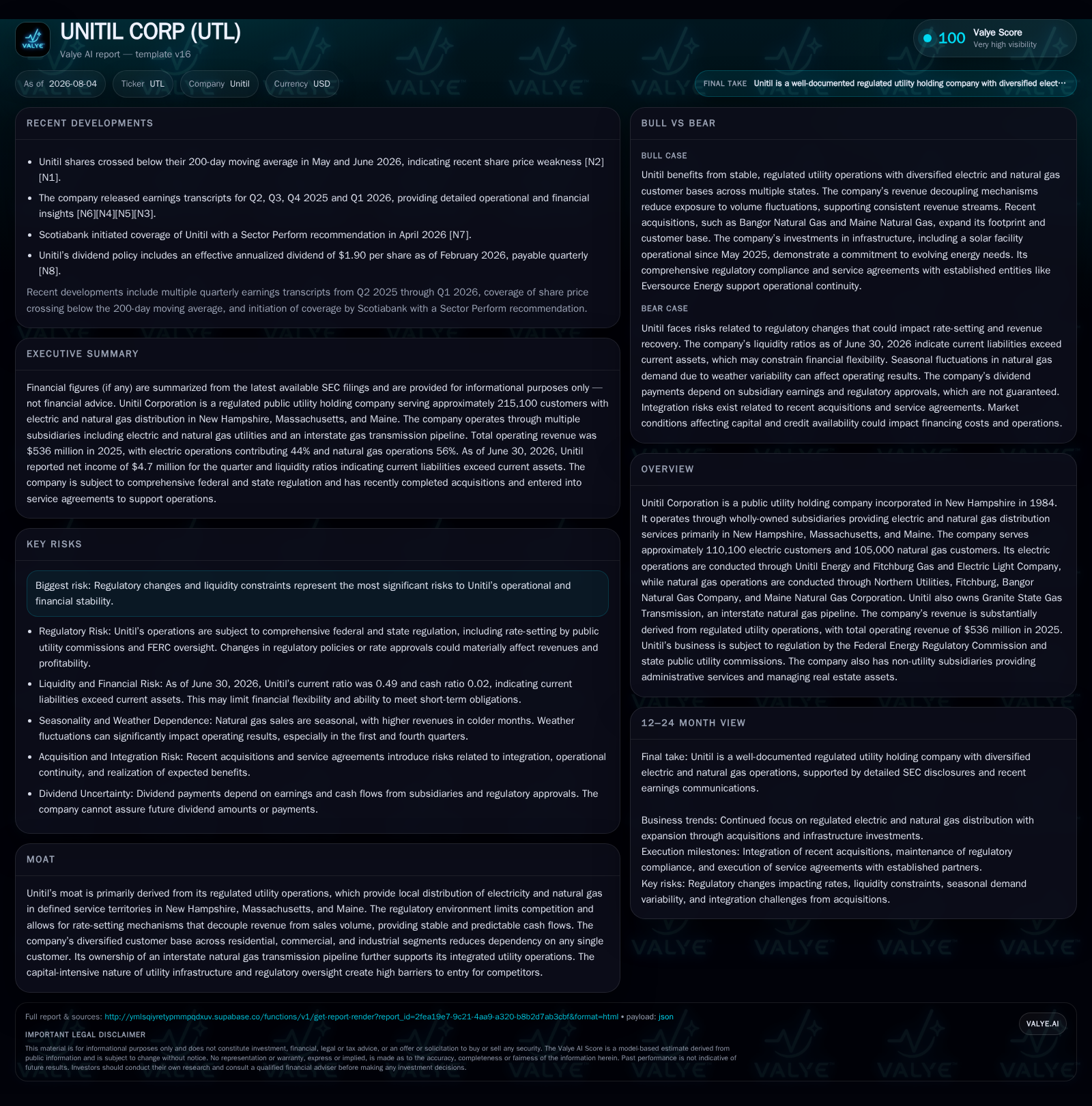
In Q2 2026, Unitil Corporation completed key acquisitions expanding its natural gas distribution footprint in New Hampshire, financed through an amended credit facility. The company operates a highly regulated electric and natural gas utility business with stable, largely volume-decoupled revenues from a diverse customer base. Unitil’s investments in infrastructure modernization underpin rate base growth potential amid regulatory oversight. However, regulatory changes and increased leverage raise caution on medium-term operational and financial flexibility.
Recent Operational Shifts Driven by Targeted Acquisitions and Financing Moves
Unitil Corporation expanded its regional footprint with the June 30, 2026 closing of its acquisition of Aquarion Water Company-New Hampshire (AWC-NH) and Abenaki Water Co., paying $42.1 million plus approximately $0.6 million for working capital adjustments [S3]. To fund this expansion, Unitil drew $42.7 million under an amended credit agreement executed concurrently with The Bank of Nova Scotia as agent and lender [S3]. This credit facility also supports prior acquisitions such as Maine Natural Gas Corporation ($86 million borrowed in October 2025) [S3].
The company mitigated integration risks by establishing a five-year Operating and Transition Services Agreement with Eversource Energy—a regional voluntary association—whereby AWA affiliates continue operating AWC-NH and Abenaki substantially consistent with historical practices while Unitil governs the transition of key functions [S3]. This approach preserves service reliability during asset absorption.
This strategic expansion strengthens Unitil’s presence primarily within New Hampshire while extending its reach into complementary markets. The acquisitions align with a measured growth strategy but increase leverage levels necessitating disciplined financial stewardship.
Regulated Utility Model Anchoring Revenue Stability Amid Market Expansion
Unitil’s business centers on regulated electric and natural gas utility operations serving roughly 110,100 electric customers (through Unitil Energy Systems and Fitchburg Gas & Electric) alongside approximately 105,000 natural gas customers via Northern Utilities, Bangor Natural Gas Company, Maine Natural Gas Corporation, AWC-NH, and Abenaki across New Hampshire, Massachusetts, and Maine [S1][S29].
Revenues derive largely from state public utility commission-approved rate structures allowing cost recovery plus authorized returns on invested capital—the regulated rate base. Volume decoupling mechanisms active in Massachusetts and New Hampshire further insulate revenues from seasonal demand volatility common in energy consumption patterns [S1]. This regulatory framework provides predictable cash flows essential for capital-intensive utilities.
A diversified customer mix across residential, commercial, and industrial segments reduces concentration risk while supporting steady operating income [F1]. Reported operating income was $101.2 million for fiscal year-end December 2025 indicating resilient core profitability despite demand variability
Competitive Landscape: Regional Peers and Infrastructure Integration Implications
Within the New England region dominated by utilities such as Eversource Energy (ES), Unitil holds a smaller yet strategically diversified position. Ownership of Granite State Gas Transmission—an interstate natural gas pipeline regulated by FERC—adds vertical integration beyond local distribution networks enhancing supply chain control relative to peers focused solely on retail delivery like NiSource Inc. or ONE Gas Inc. [S1].
FERC regulation introduces additional oversight complexities but also creates high barriers to entry fostering protected service territories. Multi-state operations hedge exposure to jurisdictional regulatory shifts but require adept management of distinct state commission relationships.
Growth Trajectory Evaluated Through Capital Investment and Rate Base Trends
Capital expenditures prioritize system modernization including grid enhancements, pipeline safety projects, and technology upgrades aimed at maintaining reliability amid aging infrastructure challenges while driving growth in the regulated rate base [S1][S2]. These investments underpin future revenue increases as new assets enter the allowed return framework after regulatory approval.
Incremental electrification trends support gradual electricity demand growth while natural gas penetration selectively replaces other heating fuels within core territories. Regulatory review cycles govern timing for capex inclusion in rate base ensuring prudency before cost recovery.
While expanding rate base enhances potential earnings through embedded returns on equity typically ranging near 9–10%, excessive or ill-timed capital spending risks regulatory pushback labeled as overcapitalization necessitating balanced investment aligned with regulator expectations.
Risks from Regulatory Volatility and Operational Complexity Impacting Outlook
Operational risks stem from hazards inherent in energy distribution—such as leaks or infrastructure failures—amplified by acquisition-related integration complexity that could affect safety metrics like system reliability indices (SAIDI/SAIFI) though specific values are not publicly disclosed here [S1][S16]. Insurance coverage mitigates some exposures but residual risks remain.
Regulatory uncertainty remains a critical factor: changes in rate-setting policies or decoupling mechanisms could reduce allowed returns or cash flow stability. Increased leverage tied to acquisitions elevates financial risk particularly if operational disruptions compress margins temporarily [S16][S3]. Cybersecurity concerns also heighten given reliance on complex digital systems integral to utility operations.
Effective management requires proactive engagement with multiple regulators alongside careful execution of transition services contracted mainly from Eversource affiliates for up to five years—reducing immediate management burden but extending contractual obligations during integration [S3].
"What’s Next": Milestones in Transition Services and Regulatory Filings to Watch
Key upcoming milestones include evaluation of transition services performance over their multi-year term concluding around mid-2031 if uninterrupted—assessing successful migration of historically outsourced functions without degradation of service quality or operational metrics [S3][S26]
Simultaneously, filings to integrate newly acquired assets into the regulated rate base represent valuation inflection points influencing future earnings once approved by public utility commissions following prudency reviews that typically span several quarters post-acquisition close.
Monitoring credit facility covenants will remain important given funded debt capitalization nearing the 65% maximum threshold tested quarterly per lending terms; any breach could affect financial flexibility amid ongoing capital deployment [S3][S13]
Financial Profile Discussion: Debt Structure, Liquidity Overview, and Investment Capacity
As of June 30, 2026, Unitil reported total debt near $725 million with net debt approximately $716 million after deducting roughly $9.2 million cash balances reflecting limited liquidity buffers relative to overall indebtedness [F1]. Current assets totaled about $198.5 million against current liabilities near $404.5 million resulting in a current ratio below one at approximately 0.49—a reflection of typical working capital timing inherent in utility receivables/payables cycles rather than acute liquidity stress [F1].
The amended Credit Agreement offers borrowing capacity supporting acquisitions already partially drawn alongside general corporate funding lines subject to customary affirmative/negative covenants including capped Funded Debt to Capitalization ratio at 65% measured quarterly—a standard protective measure for capital-intensive utilities balancing leverage with stable cash flows from regulated operations [S3][S12][S13]
This analysis synthesizes publicly filed information as of August 2026 without constituting investment advice or forecasts. Observations rely exclusively on verified SEC disclosures without speculative projections.
Disclaimer: This is research-only, informational analysis and not investment advice. It may include AI-generated interpretation and general industry context. Always verify important details using primary sources.

Comments