
FMC's Q2 Recalibration: Cost Optimization, Regulatory Advances, and Financing Moves Shape Outlook
FMC’s latest quarterly disclosures reveal a multifaceted operational pivot centered on manufacturing restructuring, strategic divestments, regulatory progress in crop protection innovation, and strengthened financial flexibility.
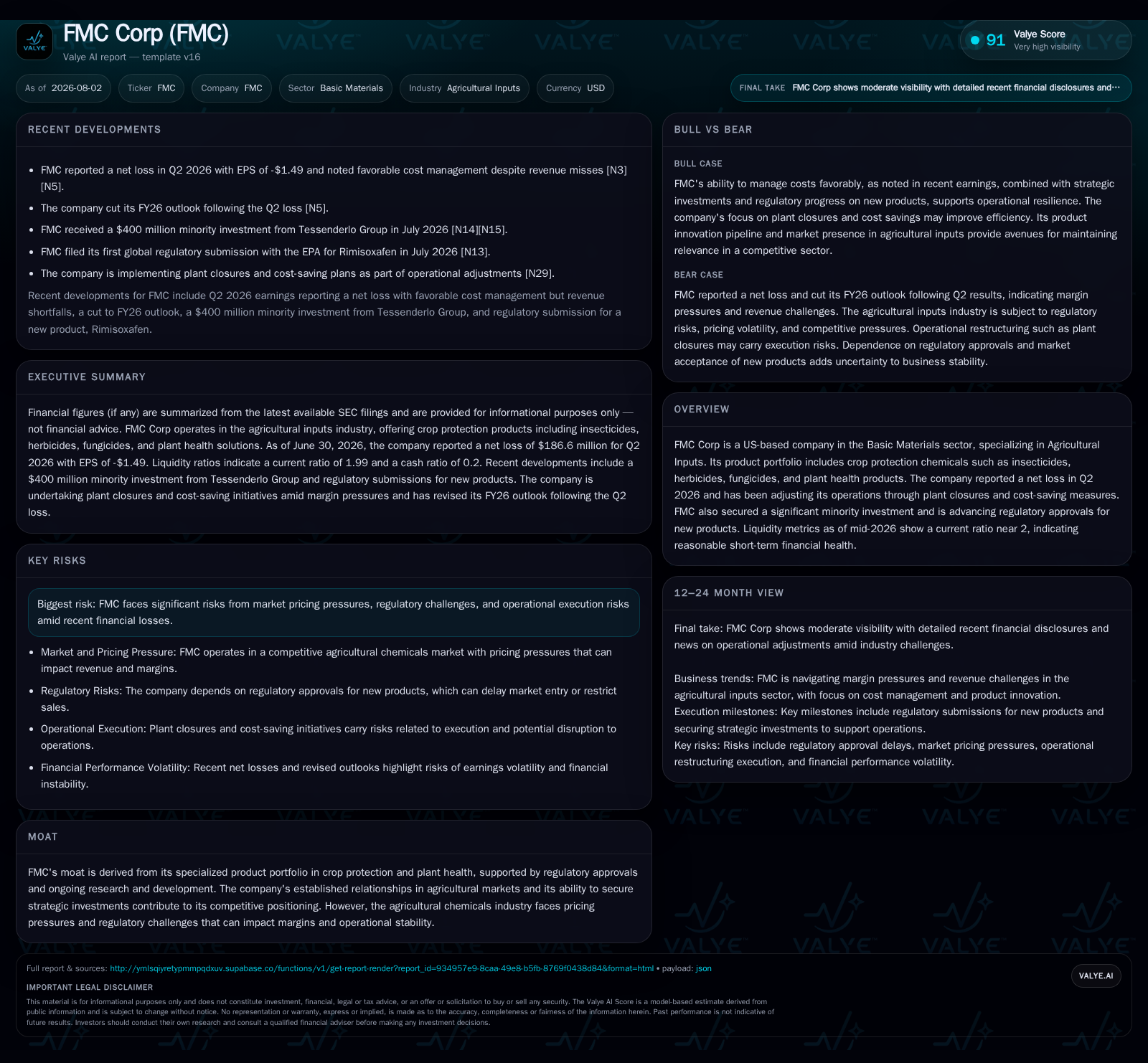
In Q2 2026, FMC Corp implemented the main actions of its previously announced Project Foundation cost optimization plan, including exiting certain high-cost manufacturing sites and transitioning production to lower-cost facilities. Concurrently, the company advanced regulatory approvals for new crop protection active ingredients, notably filing for EPA review of rimisoxafen. FMC also progressed with divesting its India commercial business as part of portfolio reshaping. On the financial front, FMC issued $1.2 billion of senior secured notes to refinance near-term maturities and reduce revolving credit facility borrowings, underpinning liquidity with a current ratio near 2. These moves collectively aim to restore margin growth amid ongoing net losses and industry pricing pressures.
Project Foundation Drives Next-Gen Manufacturing Leaning
FMC's Q2 2026 filings clarify advancement of Project Foundation, a comprehensive plan approved in December 2025 aimed at optimizing the company's cost structure through manufacturing footprint redesign. A core aspect is exiting higher-cost active ingredient and formulation plants and shifting production toward lower-cost sources [S2]. This operational recalibration is materializing with recognized non-cash asset write-offs and accelerated depreciation totaling approximately $128.3 million during H1 2026 linked principally to planned exit activities [S11]. Additionally, severance payments and contract exit costs added roughly $27.7 million in restructuring-related expenses during the quarter [S2]. These efforts aim to reduce cash costs over time—however, they add near-term financial drag evidenced by elevated restructuring charges of $222.3 million in Q2 compared to $36.7 million a year earlier [S5].
R&D Investment Fuels New Product Momentum Amid Regulatory Gains
FMC’s business model hinges heavily on proprietary active ingredients embedded within insecticides, herbicides, fungicides, and increasingly biological products that deliver differentiated crop protection effects [S1]. The company maintains robust investment in research and development; Q2 R&D expenses rose slightly to $60.4 million from prior period levels despite overall revenue softness [S5]. This investment supports the product pipeline’s strength—critical given ongoing resistance management challenges and regulatory hurdles defining industry competition.
Highlighting progress on this front is FMC’s recent global regulatory submission for rimisoxafen—a novel fungicide agent undergoing EPA review that represents a step towards expanding environmental compliance-compliant solutions [N14], [S14]. Such advances potentially open new market access opportunities amidst tightening regulations worldwide. Biological crop health solutions also feature prominently in FMC’s strategy as complements or alternatives to synthetic chemistries emphasizing sustainability traits like low use rates and shelf stability [S1]. Continued success in securing approvals for these pipeline products will underpin competitive differentiation.
Portfolio Adjustment Focuses on Core Crop Protection While Pruning Underperforming Lines
The divestiture of FMC’s India commercial business crystallizes an ongoing portfolio rationalization strategy aimed at concentrating resources on geographies with stronger growth and profitability profiles [S20]. Announced sale consideration stands at approximately $252 million subject to customary adjustments with closing anticipated within 2026 [S2], [S20]. This business has been classified as held for sale since Q3 2025 and carries an adjusted carrying value reduction reflected as a $43.6 million impairment charge during H1 2026 [S20].
Refocusing commercial engagement notably extends to Latin America where FMC is shifting toward direct grower relationships rather than distributor intermediaries—a move aligned with Project Foundation’s broader operational pivot [S11]. While this strategy deepens customer intimacy potentially boosting volume and pricing control in targeted markets like Brazil, it introduces receivables realignment risks exemplified by a non-cash write-off of $70.6 million long-term receivables associated with such transitions [S11]. Monitoring evolving customer concentration metrics alongside sales volume trends will illuminate commercial execution effectiveness.
Industry Context Frames Competitive Position Relative to Global Leaders
Within the global agrochemical industry landscape dominated by scale titans Bayer AG (post-Monsanto), Corteva Agriscience, Syngenta Group (ChemChina), BASF AG, and UPL Ltd., FMC occupies a nuanced position leveraging specialized active ingredient portfolios supplemented by enhanced formulation capabilities [S1]. The segment exhibits significant concentration with these six companies accounting for approximately three-quarters of global crop protection sales.
FMC distinguishes itself through its focused development of proprietary chemicals addressing resistance management and sustainability needs while integrating precision agriculture tools such as its Arc™ farm intelligence platform that combines real-time data analytics with pest modeling on over 20 million farmed acres globally [S1]. However, scale economics inherent to larger peers grant them pricing leverage challenging smaller players amid commoditization dynamics.
This tension manifests in gross margin volatility; FMC’s gross margin contraction despite cost initiatives reflects industry-wide pricing pressures exacerbated by input cost inflation and competitive oversupply conditions. Intellectual property protections underpin FMC's moat yet require sustained R&D output and swift regulatory approvals to prevent erosion.
Growth Drivers Emerging From New Chemistry Development & Precision Agriculture Integration
Looking forward, FMC's growth impetus lies heavily in introduction of novel chemistries such as rimisoxafen coupled with expansion of biologicals that align with increased farmer demand for sustainable solutions addressing environmental regulations [N14], [S1]. The integration of precision agriculture technologies exemplified by the Arc™ platform enhances product value by enabling targeted applications reducing chemical usage volume—a key differentiator fostering grower adoption.
Strategic investments channeled through FMC Ventures reinforce innovation pipelines spanning disruptive modalities such as molecule encapsulation and peptides designed to boost efficacy or address emerging pest resistance patterns [S1]. Adoption rates will be a critical KPI; given agricultural producers’ dependence on proven cost-benefit profiles before committing volumes, market penetration speed may face typical adoption curve delays common in agtech sectors.
These factors collectively suggest a structural driver supportive of FMC’s medium-to-long-term revenue growth potential contingent upon successful commercialization execution.
Risks From Margin Pressure And Execution Risks Remain Key Watchpoints
Despite strategic initiatives, FMC continues wrestling with considerable risks:
- Pricing pressures: Persistent competitive discounting limits ability to fully pass on raw material cost increases diminishing gross margins further.
- Regulatory complexity: Navigating global approval processes for novel chemistries involves uncertain timelines affecting pipeline monetization cadence.
- Operational execution: Large-scale manufacturing transitions involve capital-intensive asset write-offs plus workforce adjustments introducing potential disruption risks.
- Market demand cyclicality: Weather variability coupled with pest pressures drives fluctuations in product usage intensity impacting volume predictability.
- Receivables credit risk: Commercial model shifts toward direct grower exposure increase collection risk evidenced by recent receivables impairments [S11]. These vulnerabilities warrant close monitoring through quarterly KPIs such as price/mix trends, capacity utilization rates post-restructuring, regulatory approval counts achieved vs planned milestones, along with working capital efficiency metrics.
Upcoming Catalysts To Monitor: Pipeline Milestones & Financial Metrics
Key upcoming signposts for assessing FMC’s trajectory include:
- Progression on global approvals for rimisoxafen and other new active ingredients that demonstrate tangible pipeline commercialization capability.
- Reported benefits against Project Foundation targets quantified via margin improvement or reduced cash restructuring outflows.
- Completion timing of India business divestiture finalizing fiscal impact clarity.
- Sales volume progression within Latin American direct grower channels reflecting strategic pivot success. Consistent positive delta across these operational markers would substantiate claims of rebalancing towards sustainable profit recovery.
Financial Profile Discussion: Solid Liquidity Supports Transition While Profitability Lags in Near Term
On liquidity grounds, FMC bolstered financial flexibility by issuing $1.2 billion aggregate principal amount of 8% Senior Secured Notes due 2031 in June 2026 used primarily to redeem $500 million senior notes maturing later in October 2026 along with repayment under revolving credit facilities [S2]. As of June 30, 2026 the Company reported total debt approximating $3.96 billion against cash & equivalents nearing $477 million yielding net debt around $3.49 billion; current assets stood at roughly $4.73 billion versus current liabilities near $2.38 billion supporting a current ratio just shy of two (1.99) reflecting adequate short-term financial health [F1].
However, operating results remain challenged; Q2 showed net loss from continuing operations of approximately $193 million compared to profit a year earlier driven by margin decay compounded by restructuring charges totaling over $222 million during the quarter alone [S5]. Interest expense also climbed modestly reflecting incremental debt costs alongside prior borrowings pressure points. Capital expenditures moderated to about $22 million year-to-date signaling cautious deployment amid restructure [S22].
Looking ahead, free cash flow generation tied closely to realized cost savings from manufacturing consolidation plus stabilized price/mix conditions will determine sustainability of deleveraging efforts while safeguarding necessary investment for growth projects including R&D remains imperative. Debt maturities beyond current horizon benefit from secured note tenor extension mitigating immediate refinancing risk.
Disclaimer: This analysis is based solely on publicly available information as of the referenced filing dates without projecting future company performance or making investment research views.
Disclaimer: This is research-only, informational analysis and not investment advice. It may include AI-generated interpretation and general industry context. Always verify important details using primary sources.

Comments