
Hilton Grand Vacations Enhances Liquidity and Securitization to Support Integrated VOI Sales and Resort Management
HGV’s latest quarter highlights resilience in vacation ownership financing and steady resort operations amid disciplined capital management.
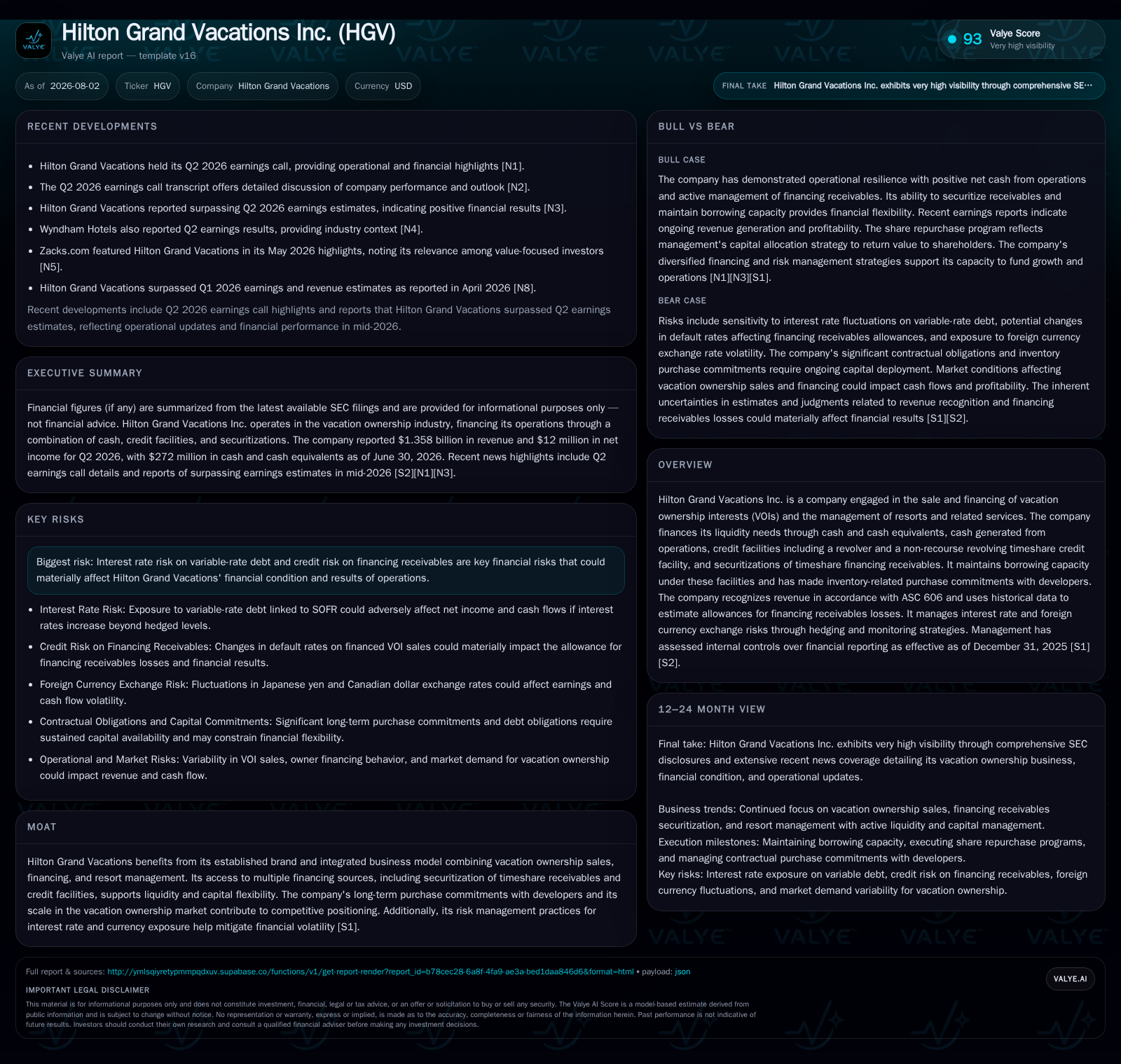
Hilton Grand Vacations Inc. recently reported continued operational stability in Q2 2026, maintaining its integrated approach combining vacation ownership interest (VOI) sales, financing, and resort management. The company’s liquidity remains supported by strong cash balances, available revolver capacity, and active securitization of timeshare financing receivables, crucial for funding inventory and growth. HGV’s risk management of interest rate and credit exposures remains prudent, balancing refinancing commitments with market uncertainties. Growth drivers include expanding ancillary services and leveraging brand strength, while watchpoints focus on credit risk from financing receivables and long-term purchase commitments with developers.
Q2 2026 Operational Snapshot and Why It Matters
Hilton Grand Vacations Inc. (HGV) reported its latest quarterly filing through July 30, 2026, reaffirming a stable operating environment with no material changes to known risk factors detailed in its prior annual report [S2]. The absence of new significant risks in the short term suggests management’s ongoing vigilance in navigating credit and market uncertainties within the vacation ownership sector.
Maintaining liquidity is critical given HGV’s capital-intensive business requiring continuous inventory investment and portfolio refinancing. As of June 30, 2026, the company held $272 million in cash and equivalents [F1], complementing a substantial $809 million borrowing capacity under the revolver credit facility reported at year-end 2025 [S4]. These resources underpin day-to-day operations and enable opportunistic securitizations of timeshare financing receivables — a cornerstone of HGV’s capital strategy.
Integrated Business Model: Sales, Financing, and Resort Operations
HGV operates through a tightly integrated model encompassing: (1) the marketing and sale of vacation ownership interests (VOIs); (2) provision of consumer financing secured by these VOIs; and (3) management of resort properties offering ancillary services such as rentals, club memberships, food & beverage outlets, and retail amenities [S6]. This integration allows HGV to internally source inventory while simultaneously capturing multiple revenue streams throughout the value chain.
Revenue recognition follows ASC 606 principles emphasizing distinct performance obligations: VOI sales transfer real estate rights to customers who pay upfront or finance their purchase; resort management fees stem from ongoing operations including member dues; ancillary revenues enhance profitability through hospitality services [S10][S20]
Crucially, financing receivables generated from consumer loans on VOI purchases represent both a revenue source via interest income and a liquidity asset often monetized via securitization programs [S13]. This dual role creates a complex interplay between sales volume growth, credit quality monitoring, allowance for expected losses based on static pool analysis, and liquidity management
Industry Structure and Competitive Positioning
The vacation ownership sector demands substantial upfront capital to acquire or commit to inventory from third-party developers or internal projects. HGV’s strategic purchase commitments totaling roughly $226 million over ten years provide long-term visibility on unit supply but embed obligations that require steady funding sources [S4]
In this capital-intense environment, access to diverse funding channels differentiates incumbent operators. HGV manages its short- and long-term liquidity through cash reserves, revolving credit facilities with maturity extensions (e.g., revolver extended to 2030), non-recourse revolving timeshare facilities that isolate collateral risk, and frequent securitizations of finance receivables aggregating hundreds of millions annually [S1][S4][S5]
Interest rate risk on variable-rate borrowings is carefully hedged using swaps converting SOFR-based floating rates to more predictable fixed rates over specific maturities [S14]. This mitigates volatility in interest expenses amid fluctuating US benchmark rates. Meanwhile, credit risk—representing potential defaults on financed VOI loans—is addressed through historical loss modeling factoring borrower FICO scores and equity positions at sale time [S13].
Comparable companies like Marriott Vacations Worldwide or Wyndham Destinations face similar dynamics yet vary in scale, geographic diversification, reliance on third-party developer partnerships versus owned inventory, and relative weightings between sales versus resort operations. HGV’s sizable secured credit lines combined with multiple successful securitizations highlight a well-established footing within this competitive peer set.
Growth Drivers Supporting Demand Resilience
Multiple structural growth vectors bolster Hilton Grand Vacations’ forward prospects:
- Consumer Shift Toward Vacation Ownership: Increasing valuation of cost-effective travel planning boosts appeal for VOIs that lock in lodging access.
- Expanding Resort Amenities: Enhancements in hospitality offerings elevate ancillary revenues beyond mere room nights.
- Evolving Club Programs: Activation fees, transaction fees from exchanges among club members add recurring revenue layers.
- Financing Availability Improvements: Streamlined credit terms facilitate more accessible customer acquisition compared to outright cash sales.
- Strategic Acquisitions: The Bluegreen acquisition enhances portfolio breadth diversifying regional exposure [S11].
- Brand Loyalty Effects: Hilton’s established brand assists retention rates critical given cyclical nature of vacation demand.
Operating KPIs like number of VOIs sold—a direct volume driver—and average selling price impact top-line trajectory distinctly. On the resort side, occupancy rates combined with utilization metrics reflect operational efficiency tied closely to customer satisfaction economics.
Risks and Watchpoints
Despite stable near-term reporting, several inherent risk factors demand ongoing attention:
- Interest Rate Fluctuations: Variable-rate debts expose margin volatility despite hedging; rising rates could increase interest costs unaffordably if swap coverage mismatches exposure durations [S14].
- Credit Risk Exposure: Financing receivable defaults may rise during economic downturns or travel disruptions impacting collections; conservative allowance levels may require adjustment reflecting evolving macro conditions [S13].
- Liquidity Constraints: Substantial long-term purchase obligations necessitate continuous capital access; any tightening in credit markets or deterioration in securitization appetite could strain flexibility [S4][S25].
- Regulatory Compliance: Surety bond availability linked to insurance carrier health influences state-specific regulatory requirements for VOI sales escrow deposits impinging on working capital needs [S16].
- Market Demand Cyclicality: Sector exposed to discretionary spending shifts; broader economic shocks might depress both sales velocity and resort utilization.
- Operational Risks: Service quality lapses could erode brand loyalty adversely affecting renewal rates critical for recurring fee streams.
Management’s risk disclosures have remained consistent indicating measured acknowledgment but emphasizing preparedness via hedging programs plus historical-based loss estimation frameworks that can adapt swiftly to trending portfolio behaviors [S2][S13][S16]
What to Watch Next
Indicators critical for monitoring HGV’s execution momentum include:
- Tracking sequential changes in net cash provided by operating activities which reflect integrated cash generation from sales-financing-resort operations nexus.
- Quarterly updates on inventory purchase commitments signaling pipeline replenishment status supporting future VOI supply
- Volume metrics around VOI units sold alongside average sales price trends providing insight into demand strength versus competitive pricing pressures.
- Developments in securitization volumes—the ability to efficiently monetize financing receivables remains pivotal for sustaining liquidity without excessive debt buildup.
- Allowance for loan losses evolution serving as an early warning barometer for potential credit deterioration within financing portfolios.
- Review of outstanding debt maturities alongside covenant compliance announcements confirming balance sheet health.
- Expansion or contraction signals from ancillary service lines such as rentals or club transactions illuminating operational diversification progress.
Closer scrutiny upon announcement date releases will also help identify any emerging regulatory or litigation matters which historically can influence market perception within this industry.
Financial Profile Discussion
Hilton Grand Vacations maintains a robust financial position supported by diversified liquidity sources integral to its business model. As per the most current snapshot ending June 30, 2026, cash plus equivalents stood at $272 million providing immediate resource availability [F1]. At year-end 2025, ample revolver borrowing capacity remained at $809 million coupled with an additional $235 million available under the non-recourse Timeshare Facility reflecting preserved room for operational flexibility without immediate debt refinancing pressure [S4].
The strategic use of periodic securitizations—totaling approximately $1.5 billion during calendar year 2025 across multiple tranches denominated also in foreign currencies such as Japanese yen—demonstrates deliberate liability management aimed at reducing gross debt burdens while optimizing overall cost structures through non-recourse financings backed by tangible collateral pools [S1][S9]. Interest rate swaps linked mainly to SOFR-based variable senior credit facilities further stabilize expense variability by converting exposures into average fixed rates near or below historical averages between roughly 1.55% per annum over maturities extending up to anticipated loan amortization periods ending around 2028-2030 windows [S14].
Maintaining compliance with all applicable covenants under revolving facilities plus unsecured senior notes provides evidentiary support that capital structure remains manageable under prevailing economic conditions though attentive monitoring remains crucial particularly amidst rising interest rate environments globally impacting funding cost trajectories unexpectedly.
Disclaimer: This analysis is based solely on publicly available SEC filings dated up to July 30, 2026 ([S1]-[S3]) supplemented by company facts data ([F1]) as well as sector contextual knowledge relevant to Hilton Grand Vacations Inc.’s operating environment. No investment advice or research view is provided herein.
Disclaimer: This is research-only, informational analysis and not investment advice. It may include AI-generated interpretation and general industry context. Always verify important details using primary sources.

Comments