
Viemed Healthcare Expands Home Respiratory Care with Technology-Enabled Model Amid Regulatory and Cost Pressures
Viemed Healthcare leverages a specialized clinical staffing and equipment rental model to drive growth in the expanding home medical equipment sector.
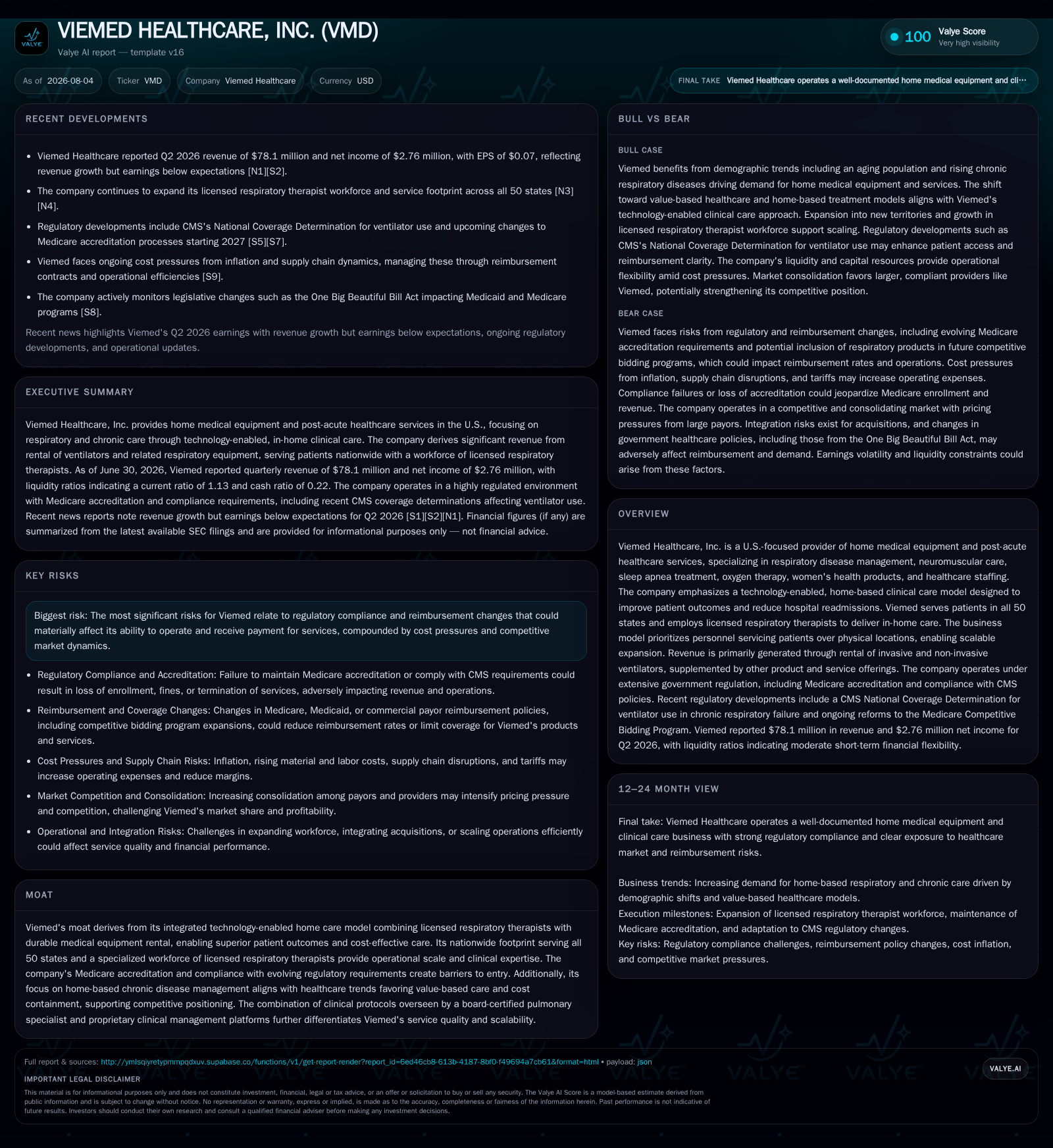
Viemed Healthcare, Inc. reported solid revenue growth driven by ventilator rental and expanded product sales, including women's health and sleep apnea supplies. The company’s technology-enabled home care model centers on licensed respiratory therapists delivering chronic disease management across all 50 U.S. states, enabling scalable expansion while focusing capital on personnel rather than physical infrastructure. Although regulatory compliance and reimbursement changes remain key risks, Viemed’s integrated approach aligns well with healthcare trends favoring value-based, cost-effective home care. Recent financials show stable liquidity and debt levels supporting ongoing investment in rental assets and clinical staffing expansion.
Latest Operating Update Highlights Growth Concentrated in Equipment Sales
Viemed Healthcare's Q2 2026 results reflect strong top-line momentum with total revenue rising due to a striking $19.4 million (114%) surge in equipment and supply sales over the first half of 2026 compared to prior periods. This growth was chiefly driven by expansion in women’s health product sales alongside increased positive airway pressure (PAP) resupply volumes tied to an expanding sleep therapy patient base [S2]. Despite being a smaller component than ventilator rentals, service revenues from healthcare staffing and in-home sleep testing also registered modest growth (~2.3%) signaling stability across ancillary offerings.
Notably, invasive and non-invasive ventilator rentals persist as Viemed’s largest revenue contributor, constituting over half of overall revenue streams (approximately 51% in latest periods) demonstrating continued demand for home-based respiratory therapy in complex chronic conditions [S1], [S2]. This mix underscores Viemed's core competency in durable medical equipment (DME) rental combined with specialized clinical care.
Business Model: Tech-Enabled Home Care Focused on Licensed Respiratory Therapists
Viemed operates at the nexus of home medical equipment provision and clinical service delivery by integrating ventilator rentals with an experienced cadre of licensed respiratory therapists (RTs). At year-end 2025, Viemed employed roughly 401 licensed RTs—representing about 29% of total employees—a foundational staff base deployed nationwide to provide direct patient support within their homes rather than through costly physical facilities [S1]
This personnel-focused operational strategy allows scalable geographic expansion beyond traditional brick-and-mortar constraints common among peers by minimizing location overhead in favor of extensive clinical staffing coverage. Licensed RTs not only facilitate equipment setup but actively manage chronic respiratory diseases with clinical protocols overseen by board-certified pulmonary specialists through proprietary technology platforms designed to improve patient adherence and reduce hospital readmissions, positioning Viemed's offering as differentiated among generic HME providers.
Revenue generation hinges primarily on long-term rental agreements for ventilators supplemented by sales of associated disposable supplies (PAP devices) and increasingly diversified product lines like women’s health solutions. Recurring service revenues from healthcare staffing placements contribute additional steady cash flow streams tailored for both internal operational efficiency and external partnerships within healthcare institutions seeking qualified clinicians.
Industry Structure: Regulated Landscape with Competitive Bidding Backdrop
The broader home healthcare services industry is characterized by substantial government regulation involving Medicare accreditation mandates and reimbursement policies heavily influencing provider economics. Viemed is subject to these frameworks including evolving CMS competitive bidding programs which have recently exempted certain product categories (e.g., non-invasive ventilators removed before full Round 2021 implementation), thus partially alleviating prior downward price pressures but preserving ongoing uncertainty requiring active compliance efforts [S1]
Competitive bidding dynamics also compel providers to optimize operating efficiencies through tech adoption and specialized clinical integration—areas where Viemed leverages its scale across all U.S. states facilitated by its personnel-centric model. Market competition spans regional home medical equipment suppliers, other national respiratory therapy providers like Lincare Holdings or AdaptHealth (not cited directly here), plus equipment manufacturers such as Philips Respironics supplying underlying devices.
Growth Drivers: Chronic Disease Trends & Service Expansion
Demand patterns driving Viemed’s growth align closely with demographic shifts including an aging population sustaining increased prevalence of chronic respiratory diseases requiring prolonged ventilation support alongside growing diagnosis rates for sleep apnea evolving via PAP therapies.
Additionally, healthcare cost containment initiatives promote shifting care away from inpatient settings towards cost-effective home-based therapies incentivized through value-based reimbursement models prioritizing hospital readmission avoidance—an area where Viemed professes measurable success through integrated clinical protocols employing licensed RTs supported by technology platforms.[S2]
Product portfolio diversification notably into women’s health offerings represents another catalyst contributing significant incremental revenue gains validated by recent double-digit increases—a strategic move tapping into an underpenetrated subset relative to core respiratory products.
Geographic expansion efforts leverage a relatively asset-light approach targeting under-served territories without the burden of physical locations but requiring scaled recruitment of licensed clinicians ensuring service quality standards are preserved alongside rising patient volumes.
The company also provides healthcare staffing services externally beyond internal operational needs representing a supplementary growth vector aligning with market-wide shortages in qualified clinical professionals.
Risks & Constraints: Regulatory Uncertainty & Cost Inflation Pressure Margins
Regulatory risk remains foremost; modifications in Medicare reimbursement structures or potential reinstatement/enlargement of competitive bidding programs could materially reduce pricing power affecting both revenue levels and gross margins. Compliance complexity with multiple federal/state regulations elevates operational risk requiring sustained investment in governance frameworks including cybersecurity oversight given sensitive patient data handled through digital clinical management systems [S23],.
Inflationary input costs spanning materials acquisition for durable medical equipment supplies, labor costs particularly for skilled RTs amid tight labor markets, transportation fees impacted by fuel prices, all pose margin pressures. While contractual mechanisms linking reimbursement adjustments to inflation provide partial mitigation [S22], residual cost exposure persists forcing ongoing scrutiny on operational efficiencies.
Competitive intensity from regional players able to undercut on pricing or local service presence introduces market share risks particularly if Viemed cannot maintain consistent quality or scale advantage potentially affecting payer contracting outcomes.
Moreover, successful scaling requires continual licensing compliance across jurisdictions alongside managing risks inherent to patient adherence variability influencing clinical outcomes that underpin reimbursement eligibility.
What to Watch Next: Execution on Scale & Clinical Outcomes Amid Financial Discipline
Upcoming operational milestones warrant close attention include effectiveness in ramping licensed RT headcount proportional to anticipated patient additions as geographic footprint broadens while maintaining high-quality care delivery standards evidenced by outcome metrics such as hospital readmission rate reductions.
Monitoring average rental duration per patient combined with utilization rates will provide clarity on sustainable recurring revenue streams critical for cash flow predictability.
Financially, tracking operating income margin stability amid inflationary pressures along with capital allocation discipline towards rental asset purchases versus acquisitions will indicate management’s ability to balance growth investments against profitability targets.
Given recent share repurchase activity totaling ~680 thousand shares canceled in H1 2026 aligned with approved programs reflects confidence but warrants observation regarding capital flexibility given existing debt levels [S17], [F1].
Any shifts or updates around Medicare policy or competitive bidding program modifications will be pivotal regulatory developments directly impacting future reimbursement dynamics.
Financial Profile Discussion
As of June 30, 2026, Viemed reported cash and cash equivalents of $10.7 million juxtaposed against a total debt load around $7.1 million yielding a net debt position of negative $3.6 million indicating modest net liquidity buffer supporting near-term obligations [F1], [S2].
Gross margin percentages have remained relatively stable near ~58%, balancing price pressures against cost inflation mitigations exercised via contract negotiations and scale efficiencies sustained through integration of technology-enabled care delivery platforms coupled with disciplined procurement practices [S16], [S22].
Overall financial positioning conveys viable runway to fund strategic initiatives contingent on maintaining operating performance trends amid an evolving reimbursement landscape that continues to pose execution risks common across the home healthcare services sector.
Conclusion
Viemed Healthcare exemplifies a modern home medical equipment provider combining specialized clinical expertise through licensed respiratory therapists with durable medical equipment rental anchored in respiratory care specialization. The company’s technological integration aimed at improving chronic disease management outcomes aligns well with broader healthcare system imperatives favoring cost containment via transition from institutional care towards scalable home-based solutions. Recent quarters evidence robust growth fueled by product line diversification into women's health supplies alongside sustained predominance of ventilator rentals bolstering recurring revenues.
Nonetheless, enduring challenges persist primarily stemming from variable reimbursement frameworks influenced by Medicare policy shifts alongside pervasive cost inflation affecting inputs and labor resources critical to delivery models reliant on skilled clinical staff. Viemed’s demonstrated compliance track record together with ample liquidity resources provides baseline financial resilience but requires prudent capital allocation strategies amidst regulatory uncertainties.
Investors monitoring Viemed should prioritize operational KPIs related to patient volumes served via RT deployments, utilization efficiencies for rented equipment assets, margin trajectory amid pricing reforms, as well as progress against geographic dispersion objectives leveraged through lean overhead structures emphasizing personnel rather than fixed locations.
While competition intensifies alongside macroeconomic headwinds affecting healthcare spending dynamics globally, Viemed’s integrated approach combining device provision with licensed clinician enablement coupled with focused population health management positions it favorably within an expanding home healthcare services industry largely catalyzed by demographic demand growth and permanent structural shifts away from inpatient-centric care models.
Disclaimer: This is research-only, informational analysis and not investment advice. It may include AI-generated interpretation and general industry context. Always verify important details using primary sources.

Comments