
Cheesecake Factory’s Strategic Strengths and Capital Constraints in Q2 2026
Q2 2026 marks Cheesecake Factory’s first billion-dollar quarterly revenue milestone amid ongoing cost pressures and capital allocation challenges.
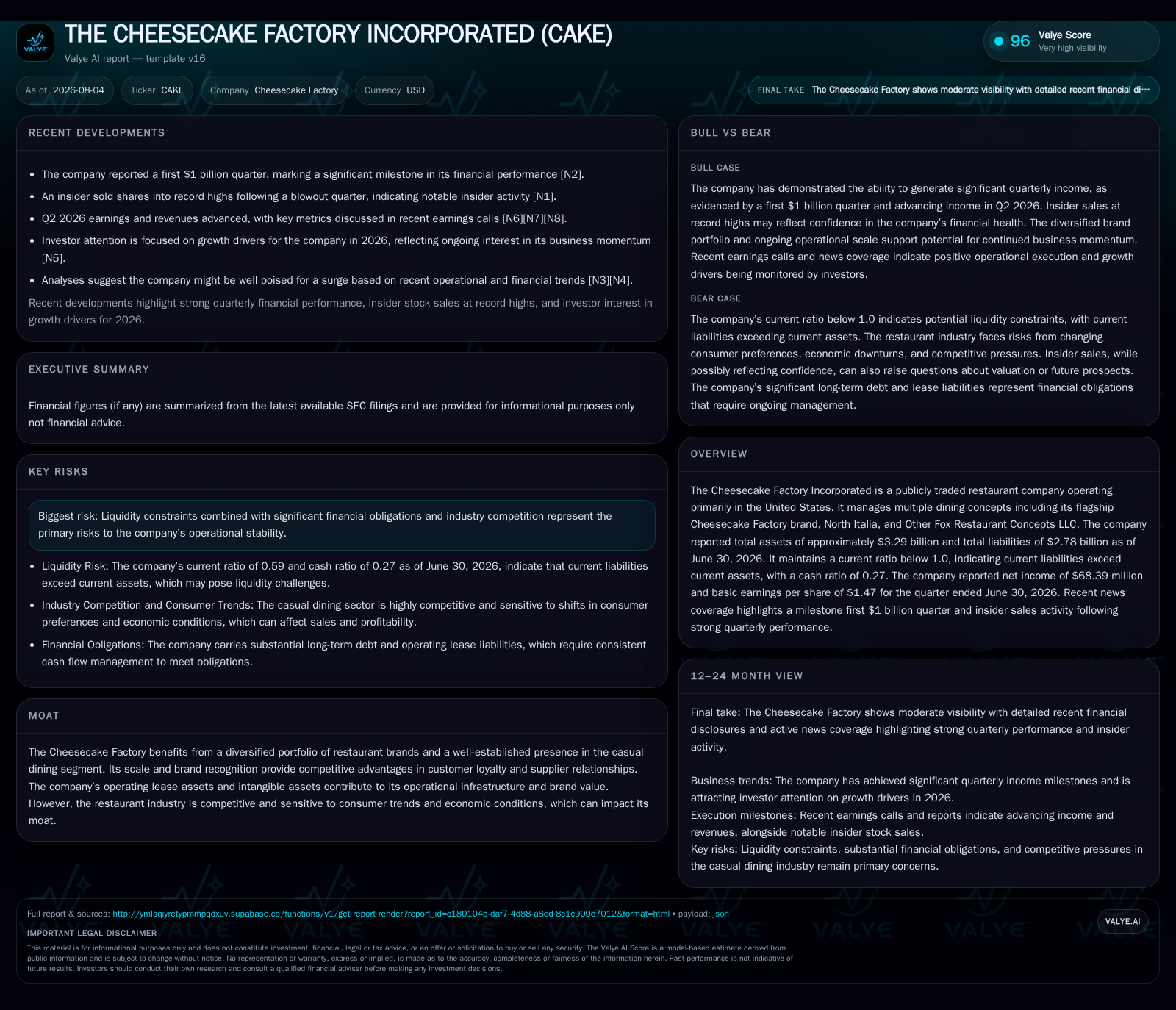
The Cheesecake Factory reported a landmark $1 billion quarter in Q2 2026, driven by solid same-store sales growth and strength across its multi-brand portfolio including North Italia and Other Fox concepts. While top-line momentum reflects effective management of guest traffic and average check gains, rising labor costs and ongoing litigation risks add pressure to operating margins. Meanwhile, the company balances aggressive share repurchases alongside significant financial leverage and constrained liquidity, a tension inherent to its capital-intensive casual dining business model. Near-term focus will remain on managing cost inflation, sustaining comparable sales, and navigating debt covenants under lease-heavy fixed costs.
Q2 Operating Milestone Highlights Amid Rising Cost Pressures
The Cheesecake Factory delivered its first-ever quarterly revenue exceeding $1 billion in Q2 2026—a milestone underscoring strong underlying demand traction in an industry sensitive to economic cycles [S2]. This figure marks a crucial inflection reflecting not only overall volume recovery but successful average check size improvements and guest traffic growth at core brands including the flagship Cheesecake Factory, North Italia, and Other Fox Restaurant Concepts [N1]. Same-store sales growth appears broadly positive in this quarter as the company leverages menu innovation alongside targeted pricing strategies that have preserved customer appeal despite inflationary headwinds [S2]. Insider selling activity noted post-quarter [N7][N8] does not appear to indicate concern but rather is interpreted as profit-taking at elevated price levels coinciding with operational success.
However, this topline accomplishment coexists with intensifying labor cost pressures. The company disclosed an active class action lawsuit filed in California alleging wage-and-hour violations from a former hourly employee [S2], highlighting potential incremental costs that could further compress already thin operating margins. Labor represents a significant expense line in casual dining where staff wage inflation stems from both minimum wage increases and tighter labor market supply [S1]. These factors necessitate judicious operational discipline particularly when combined with persistent food cost inflation. The net effect places added emphasis on efficiency levers such as menu engineering—adjusting offerings to optimize ingredient use—and controlling table turnover without sacrificing guest experience.
Multi-Concept Portfolio Drives Revenue but Requires Margin Discipline
Cheesecake Factory’s business model centers on ownership and operation of multiple restaurant brands catering primarily to the casual dining consumer segment in the United States [S1]. The flagship brand remains the largest contributor to revenue but is complemented by North Italia’s fast-casual style concept and Other Fox Restaurant Concepts which collectively diversify revenue streams. This multi-brand portfolio mitigates risk against cyclical fluctuations impacting any one concept and enhances cross-brand marketing efficiencies including customer loyalty programs designed to increase repeat visitation.
However, managing diverse menus across brands increases operational complexity. Coordinating supply chains for varied offerings presents challenges in food cost control requiring exacting vendor management and procurement strategies [S1]. Labor allocation similarly must be aligned efficiently across different service styles—full-service versus counter-order fast casual—adding staffing coordination intricacies. Peer companies such as Darden Restaurants demonstrate that multi-brand scale can generate operating leverage if balanced by rigorous cost controls; Cheesecake Factory’s recent results indicate progress but reveal ongoing margin pressures exacerbated by fixed lease costs [S1][S2].
Casual Dining Industry Dynamics Shape Competitive Positioning
The casual dining restaurant sector features moderate pricing in relaxed environments targeting broad consumer segments whose discretionary spending fluctuates with economic conditions. Competition extends beyond direct peers such as Brinker International or Bloomin’ Brands to fast casual players who attract value-conscious diners seeking speed or digital ordering convenience. Cheesecake Factory competes predominantly on differentiated menus, perceived quality, ambiance, and brand reputation.
Industry-wide inflationary impacts elevate food and labor costs industrywide while shifts toward delivery reduce dine-in table turnover rates—pressuring per-unit profitability. Cheesecake Factory's scale allows some purchasing power benefits but does not completely insulate it from input cost volatility. Current comparable restaurant sales growth points to resilient price elasticity suggesting modest pricing power; however, sustained margin expansion depends on ongoing efficiency improvements amid stiff competition [N2][F1]. Digital channels are growing as supplemental revenue sources but represent a smaller portion compared to peers more aggressively invested in third-party delivery partnerships.
Labor Inflation’s Impact on Profitability and Pricing Strategy
Labor costs continue to rise driven by wage rate escalation especially within California where significant litigation risk resides due to alleged labor code violations [S2]. Labor cost percentage thus remains a critical KPI affecting operating margins given it typically accounts for approximately one-third or more of total expenses in company-operated casual dining venues. Cheesecake Factory’s challenge involves balancing necessary wage increases against potential price escalations without eroding consumer demand or competitive positioning.
Menu engineering initiatives aim to introduce dishes leveraging lower-cost ingredients or recipes optimized for kitchen efficiency while maintaining premium quality expectations tied to the brand’s market positioning [S1]. However, such adjustments require careful consumer acceptance testing given brand loyalty dependence on signature dishes like its namesake cheesecakes that command pricing premiums. The interplay between guest traffic trends—reflective of frequency—and average check size growth will be determinative of sustainable profitability going forward.
Capital Structure Balancing Act: Repurchases Versus Liquidity Constraints
Financially, Cheesecake Factory presents a high fixed-cost structure accentuated by substantial lease obligations that underpin its restaurant footprint [S1][S2]. As of June 30, 2026, the company carried total debt estimated at approximately $632 million contrasted against cash reserves near $195 million yielding net debt around $437 million—a sizable leverage position relative to earnings capacity [F1][S2].
Notably, capital allocation has heavily favored share repurchases aimed at offsetting dilution from equity compensation grants and supporting earnings per share growth. Since inception through June 30, 2026, approximately 60.4 million shares were repurchased at a cumulative cost exceeding $2 billion—demonstrating management’s commitment to shareholders but raising questions about prioritization versus reinvestment or liquidity conservation amidst tightening margin pressures [S4]. Dividend policy remains consistent with quarterly payouts of $0.30 per share declared recently reflecting measured confidence tempered by balance sheet considerations [S3][S4]. Peers such as Darden Restaurants have similarly balanced share buybacks against capex demands but arguably maintain more conservative leverage profiles enabling greater operational reinvestment flexibility while navigating sector-wide labor inflation headwinds.
What Investors Should Track Next — Key Catalysts and Risks Ahead
Looking forward, critical operating indicators for Cheesecake Factory include:
- Sustaining positive same-store sales growth amid evolving consumer dining preferences within casual dining,
- Controlling labor cost escalation particularly related to California litigation outcomes,
- Managing food cost inflation via procurement strategies and menu optimization,
- Maintaining adequate guest traffic and average check size expansion through marketing effectiveness,
- Monitoring compliance with debt covenants given lease-heavy fixed expenses,
- Evaluating incremental impact from digital ordering channels on revenue mix,
- Observing capital allocation decisions balancing share repurchases with liquidity preservation,
- Assessing resolution or exposure from ongoing wage-and-hour lawsuits influencing future cash outflows.
These factors collectively shape whether Cheesecake Factory can convert its top-line momentum into durable profitability improvements while managing the liabilities inherent in its business model and capital structure.
Financial Profile Discussion
The latest financial snapshot underscores Cheesecake Factory’s leveraged position: total debt near $632 million against cash balances around $195 million generate net debt close to $437 million as of June 30, 2026 [F1]. This net leverage requires disciplined free cash flow generation from operations characterized by moderate EBITDAR margins under pressure from rising wages and commodity input costs [S2].
Share repurchase activity persists actively within board-approved limits totaling over 60 million shares retired costing upward of $2 billion cumulatively through Q2 2026 [S4], indicating prioritization of EPS accretion alongside a stable dividend payout consistently set at $0.30 per quarter per share [S3][S4]. While supporting shareholder returns aligns with historical precedent among casual dining public peers like Brinker International or Bloomin' Brands, the high fixed-cost base embodied primarily by leases requires careful navigation between operational investment needs versus cash returned externally.
In sum, the firm exhibits clear strengths in scaling multiple brands with growing consumer demand evident by record revenues yet faces tangible margin compression risk attributable largely to its labor-intensive model compounded by legal exposures—factors that mandate vigilant cost management combined with prudent financial stewardship going ahead.
Disclaimer: This is research-only, informational analysis and not investment advice. It may include AI-generated interpretation and general industry context. Always verify important details using primary sources.

Comments