
Crown Holdings’ Expansion and Margin Resilience Amid Raw Material Challenges
Crown Holdings delivered a Q2 earnings beat driven by higher beverage can volumes and specialty innovation, underpinned by sustainability initiatives and effective raw material cost management.
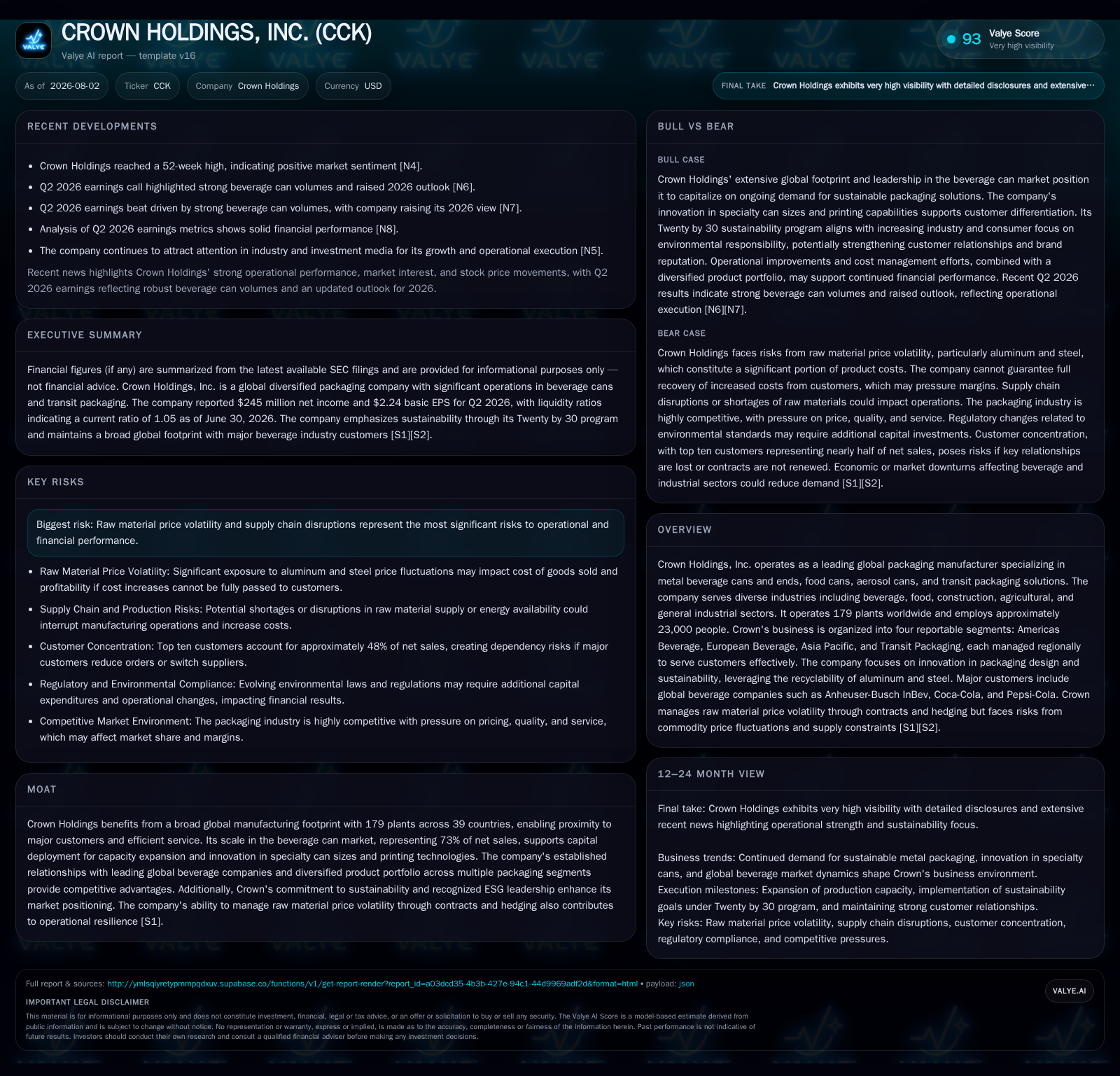
In its latest quarter ending June 30, 2026, Crown Holdings reported stronger-than-expected revenue growth fueled primarily by increased production volumes in its beverage can segment. Despite persistent raw material price volatility, the company leveraged commodity hedging and pricing strategies to protect margins. Its global footprint, emphasizing proximity to major beverage customers, combined with innovations in specialty can sizes and printing capabilities, reinforce competitive positioning. Capital investments focusing on capacity expansion align with growing demand in alcoholic and non-alcoholic beverage categories. However, risks from raw material supply fluctuations and customer concentration remain key watchpoints.
Volume Growth Fueling Q2 Beat despite Raw Material Pressures
Crown Holdings reported a notable second quarter performance for the period ending June 30, 2026, surpassing earnings estimates primarily due to stronger production volumes in its beverage can segment — responsible for roughly 73% of net sales. This volume increase offset ongoing raw material cost headwinds arising from volatile aluminum and steel prices that constitute a significant portion of the company's cost of goods sold (47% aluminum and 8% steel) [S2], [S1]. The company employs commodity hedging strategies to mitigate price swings but faces limits when passing through costs during competitive pricing pressures.
The average selling price per unit benefited from product mix shifts toward specialty cans with premium features such as slim or sleek shapes and advanced printing decorations. These innovations support pricing power that partially compensates for input costs without materially dampening volume demand [N6], [S1]. Notably, these specialty offerings help Crown differentiate itself during increasing commoditization risk common in the global metal packaging sector.
Product Innovation and Sustainability Programs Cement Market Leadership
Crown’s Twenty by 30™ sustainability initiative encapsulates its strategic focus on environmental stewardship alongside commercial growth. The program outlines twenty measurable goals aligned with reducing carbon footprint and advancing circular economy principles inherent in metal packaging. Aluminum beverage cans are infinitely recyclable and comprise a cornerstone of Crown's sustainability narrative — an advantage bolstered by cooperation with industry consortia to increase recycling rates and recycled content utilization across products [S1]
Product innovation extends beyond recyclability; it encompasses design efficiencies optimizing material usage while maintaining product integrity. Crown’s R&D investment supports evolving customer requirements such as new coating technologies improving barrier properties or decorating advancements delivering superior shelf impact. Such capabilities enhance customer retention among global beverage giants including Anheuser-Busch InBev, Coca-Cola, and Pepsi-Cola who increasingly seek sustainable yet visually differentiated containers [S1]
Global Footprint Provides Operational Flexibility during Supply Chain Challenges
Operating 179 plants across 39 countries positions Crown Holdings advantageously against supply chain disruptions that have challenged many global manufacturers. This footprint enables localized production close to major customers within each region — Americas Beverage, European Beverage, Asia Pacific, and Transit Packaging — thereby reducing transportation complexity and facilitating responsiveness to changing demand patterns [S1]
Compared to peers such as Ball Corporation who also maintain extensive manufacturing networks, Crown’s diversification across segments (beyond beverage cans into food cans and transit packaging) offers some revenue stability benefits during cyclical end-market softness. The trend toward innovative specialty cans supports incremental volume growth beyond traditional formats. These investments underscore management’s view of long-term secular growth opportunities despite near-term raw material inflation risks [S16], [S1].
Capital intensity is embedded within Crown’s operational model requiring ongoing maintenance capex alongside expansions. Efficiently timed capacity additions are critical given the risk of overcapacity if market demand evolves slower than expected or competitors accelerate their own expansions. The company’s flexible multi-regional footprint aids in mitigating this risk by allowing regional capital allocation adjustments aligned with localized demand signals.
Financial Profile Discussion: Managing Leverage in a Capital-Intensive Industry
As of June 30, 2026, Crown Holdings reported cash and equivalents of approximately $656 million against total debt near $6.06 billion resulting in net debt around $5.4 billion [F1]. Its current ratio stands at about 1.05 reflecting adequate near-term liquidity but highlighting limited cushion against unexpected working capital shocks.
Growth Drivers: Specialty Cans, Emerging Markets, ESG Momentum
Crown’s growth outlook rests on several convergent factors:
- The increasing global preference for metal beverage packaging driven by recyclability advantages supports volume growth worldwide.
- Expansion into emerging markets leverages localized manufacturing to capture rising consumption trends while mitigating currency fluctuation risks.
- Innovation in specialty can sizes caters to consumer trends demanding differentiated product experiences.
- Regulatory initiatives incentivizing recyclable materials align closely with Crown’s sustainability positioning enhancing customer loyalty. These drivers interplay favorably but must be weighed against competitive pressures from both metal packaging peers and alternative substrate providers such as plastic or paper-based producers who also pursue sustainable solutions.
Risks Watch: Raw Material Volatility, Customer Concentration, Regulatory Environment
Raw material price swings remain the foremost risk impacting margins despite hedging programs. Aluminum tariffs and steel supply constraints influenced by geopolitical developments add uncertainty to procurement costs that cannot always be passed through effectively without volume impact [S1], [S7].
Customer concentration presents another vulnerability since several major beverage producers represent substantial revenue sources; loss or material reduction in purchase levels could disproportionately affect financial results. Furthermore, litigation surrounding anti-trust investigations in Europe focused on metal packaging conduct adds regulatory risk exposure alongside ongoing asbestos-related claims accrued at $177 million as of year-end 2025 impacting cash flow predictability [S7], [S15].
What to Watch Next: Demand Trends, Pricing Pass-Through, Investment Outcomes
Upcoming quarterly results will be critical to confirm whether volume momentum persists amid macroeconomic oscillations affecting consumer spending on beverages. Monitoring the effectiveness of raw material cost pass-through will signal margin resilience or compression risk while tracking execution timelines for capacity expansion projects will inform future production scaling.
Comparative earnings reports from peers such as Ball Corporation and Avery Dennison will provide context regarding industry-wide raw material inflation management success and competitive dynamics influencing pricing power.
Investors should also observe any updates on regulatory developments or litigation outcomes that might influence operating flexibility or impose financial burdens over short-to-mid term horizons.
Disclaimer: This analysis is for informational purposes only based on publicly available data including recent SEC filings dated through July 30, 2026. It does not constitute investment advice or research views.
Disclaimer: This is research-only, informational analysis and not investment advice. It may include AI-generated interpretation and general industry context. Always verify important details using primary sources.

Comments