
CNX Resources Strengthens Midstream Edge and Navigates 2026 Commodity Volatility
In Q2 2026, CNX reported lower production but maintained strong earnings through capital discipline and integrated midstream operations in the Appalachian Basin.
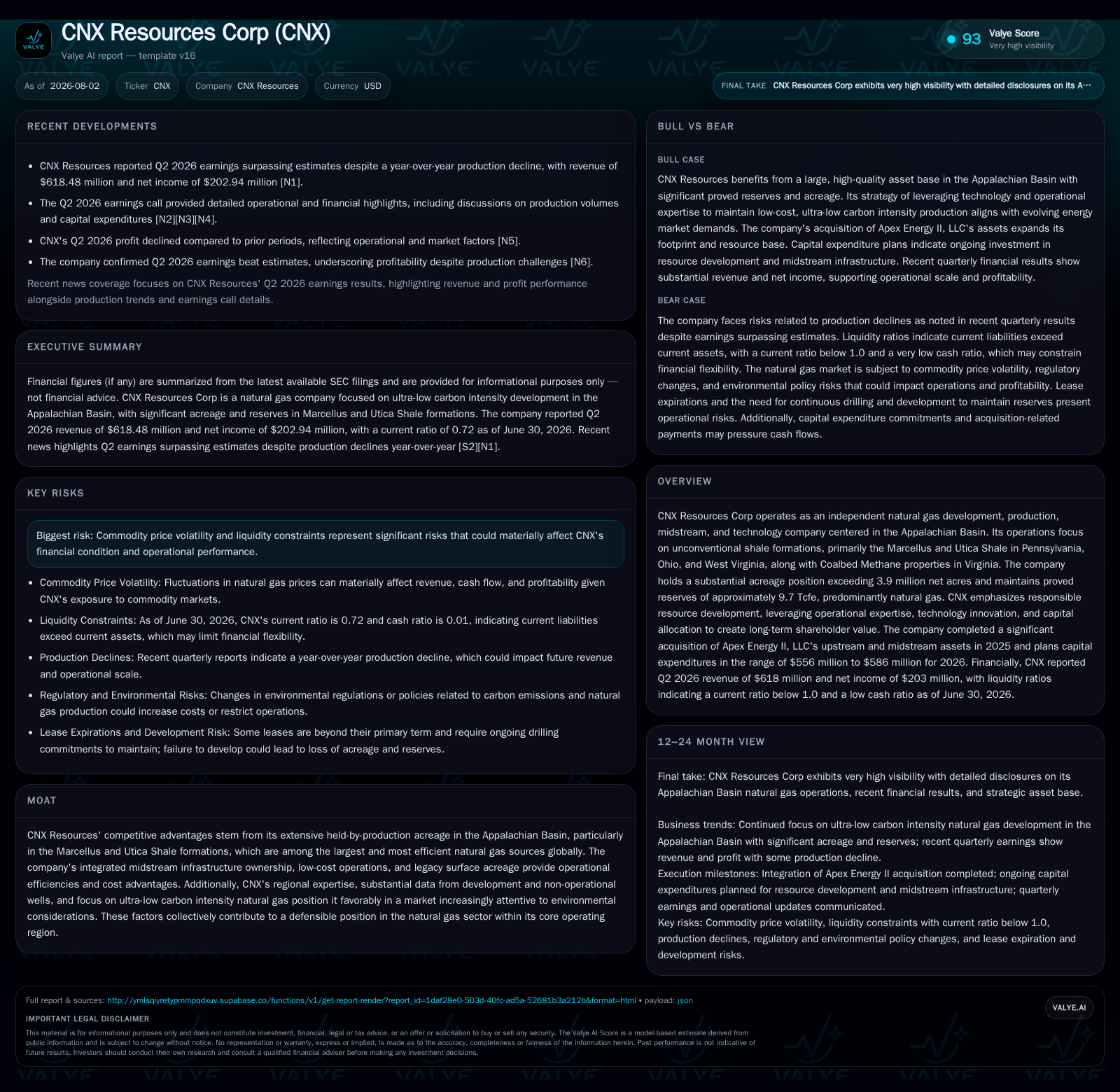
CNX Resources Corp’s latest quarterly results reveal a production volume decline amid persistent commodity price volatility. Despite this, the company upheld solid earnings performance through operational efficiency, strategic capital allocation between shale and coalbed methane assets, and ownership of midstream infrastructure that enhances margin capture. CNX’s large acreage and low carbon intensity position it well among Appalachian Basin independents, though market-sensitive risks in pricing and liquidity remain key watchpoints for near-term performance.
Q2 Operating Results Reflect Transitional Dynamics in Production and Pricing
Unlocking Value Through CNX's Integrated Upstream-Midstream Model in Appalachia
A defining strength for CNX lies in its vertically integrated asset base combining upstream unconventional shale (primarily Marcellus and Utica) and coalbed methane production with substantial midstream infrastructure ownership including gathering pipelines and compression facilities [S1][S2]. This integration provides CNX with distinct margin advantages over Appalachian peers who often rely on third-party transportation, exposing them to higher fees or capacity constraints. Midstream throughput volumes serve as an important operational KPI signaling the company's ability to control pipeline bottlenecks and optimize netbacks on sales volumes. Furthermore, CNX's expansive acreage position exceeding 3.9 million net acres, combined with proved reserves at approximately 9.7 Tcfe predominantly natural gas, establishes a defensible operational moat reinforced by legacy surface land holdings that mitigate leasing risk [S1][F1]. The firm's commitment to ultra-low carbon intensity operations further positions it favorably amid growing ESG scrutiny in energy markets.
Balancing Capital Allocation: Shale Versus Coalbed Methane Investments Under Cost Pressures
For fiscal 2026, CNX has delineated capital expenditures within the range of $556 million to $586 million focused on both unconventional shale plays and developing coalbed methane acreage [S2]. This balanced approach reflects the tradeoff between advancing high-return Marcellus/Utica drilling programs against capturing longer-term optionality in CBM assets located primarily in Virginia. Inflationary pressures affecting steel, diesel fuel, labor inputs, and other service costs have introduced operating cost headwinds typical across the natural gas sector [S1]. CNX reports ongoing initiatives aimed at enhancing operational efficiency to offset these upward cost trends, which notably influence lease operating expense per Mcfe—a key metric for evaluating unit-level profitability in the basin.
Managing Commodity Price Volatility with Hedging Strategies and Operational Efficiency
Given the inherent exposure to fluctuating natural gas prices which significantly impact top-line revenue and cash flows, CNX employs both physical supply contracts with marketers/end users and financial hedges to mitigate market risk [S1]. These instruments provide partial income stability during periods of price volatility except when market movements deviate materially from hedged levels. Current energy price environments remain uncertain with sustained volatility necessitating prudent risk management. Complementing hedging effectiveness are operational efforts aimed at cost containment that help buffer revenue shocks by lowering per-unit expenses, thereby preserving margins even when spot prices weaken.
Competitive Positioning Amid Appalachian Peers: Acreage Quality, Production Efficiency, and Cost Benchmarks
Compared qualitatively against regional Appalachia-focused independents such as EQT Corporation or Cabot Oil & Gas, CNX holds one of the larger acreage portfolios alongside deeply held-by-production positions that support extended reserve life. Its midstream asset ownership distinguishes it strategically relative to peers relying extensively on third-party systems subject to capacity bottlenecks or fee inflation. While exact production efficiency metrics are not publicly detailed for peer comparison here, CNX’s proactive operating cost management amidst inflation signals competitive discipline critical for sustaining returns in a cost-sensitive basin.
Growth Levers: Technology, Environmental Initiatives, and Midstream Capacity Expansion
CNX emphasizes technology development as foundational to improving recovery factors and lowering environmental impacts—key growth pathways as the industry gravitates toward sustainable energy solutions [S1]. Notably, their commitment to ultra-low carbon intensity natural gas aligns with broader market demand shifts favoring cleaner-burning fuels. Moreover, reserve replacement economics pose challenges given depletion rates and changing capital allocation dynamics. Counterparty risks inherent in commodity derivatives or midstream contracts also warrant vigilance given market instability. Liquidity tightness is underscored by a current ratio below unity (0.72), combined with cash balances of approximately $6 million against current liabilities exceeding $650 million at Q2-end [F1], signifying constrained short-term financial flexibility requiring careful working capital management.
Financial Profile Discussion: Capital Structure, Cash Flow Resilience, and Investment Outlook
At June 30, 2026 end-of-quarter reporting showed CNX carrying approximately $2.44 billion in total debt offset marginally by cash on hand leading to net debt approximating $2.43 billion [F1]. Though liquidity ratios suggest constraint (current ratio at 0.72), consistent capex guidance within moderate bounds coupled with earnings resilience indicate deliberate leverage management supportive of maintaining investment-grade credit profiles [S2]. Steady cash flow generation remains pivotal given large-scale capital-intensive nature of upstream/midstream operations; hedge programs play an ancillary role in smoothing cash conversion amid volatile commodity cycles.
This analysis integrates publicly available SEC filings from Q2 2026 alongside recent earnings call disclosures to evaluate CNX Resources’ operational posture amid commodity fluctuations and evolving Appalachian Basin dynamics. All financial figures reflect reported data without projection or unwarranted extrapolation.
Disclaimer: This is research-only, informational analysis and not investment advice. It may include AI-generated interpretation and general industry context. Always verify important details using primary sources.

Comments