
ClearPoint Neuro’s Mixed Growth Path: Neurological Device Sales and Capital-Intensive Preclinical CRO Expansion
ClearPoint Neuro advances its neurosurgical navigation business while investing heavily in a GLP-compliant preclinical CRO facility, posing execution and demand risks.
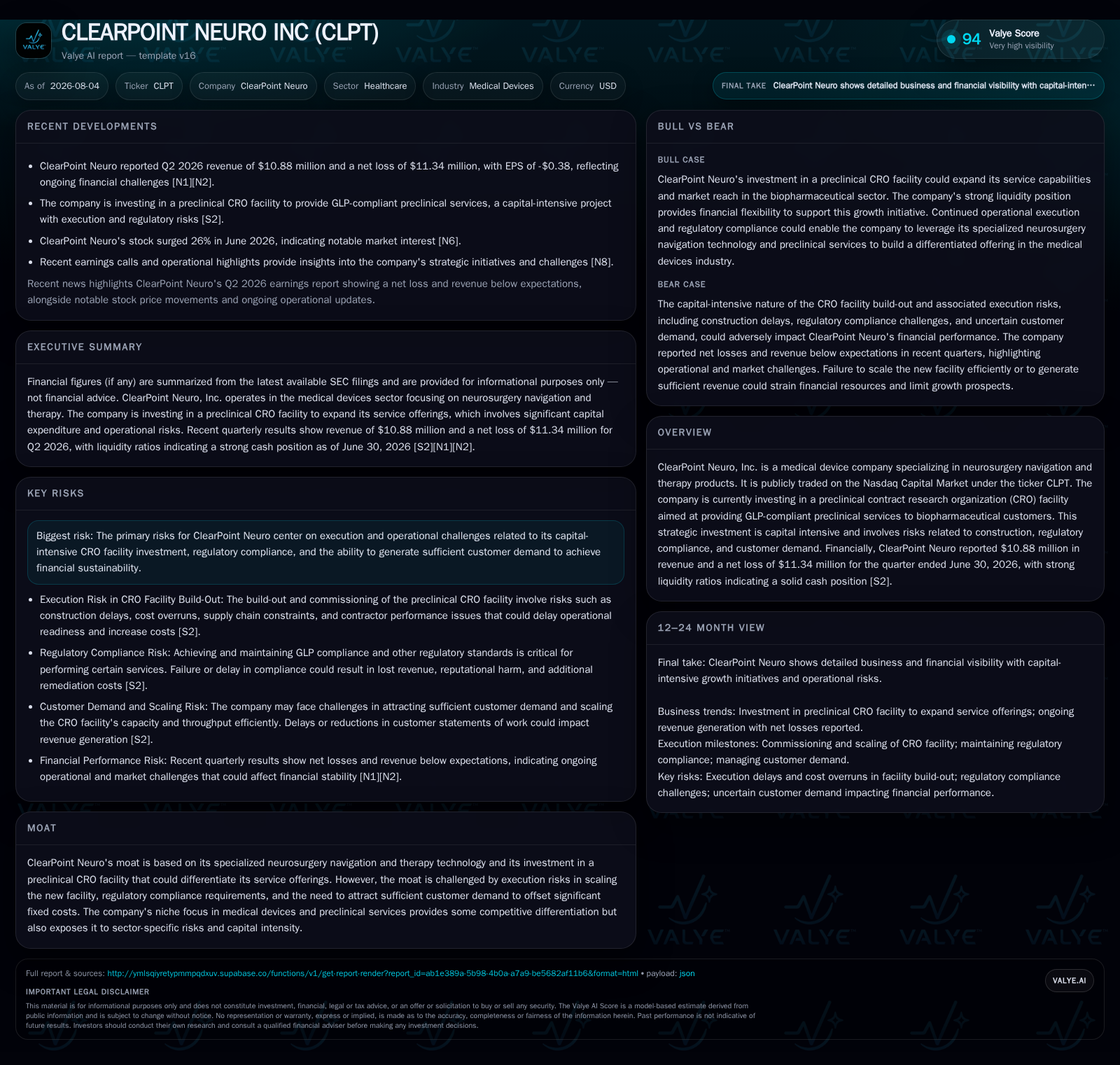
In Q2 2026, ClearPoint Neuro continued to generate revenue from its core neurosurgery navigation hardware and disposable components but faced significant net losses attributable to the capital-intensive build-out of a new preclinical CRO facility. This strategic pivot into providing GLP-compliant services to biopharma adds a new growth avenue but also heightens fixed costs and regulatory complexity. The company’s sales model balances upfront capital equipment installations with recurring disposable product revenue, a dynamic common among medical device firms, while incrementally expanding into facility-based contracted research services. Success hinges on scaling the CRO without compromising regulatory compliance or customer demand assumptions. ClearPoint maintains strong liquidity yet carries meaningful net debt, underscoring the financial strain of its expansion.
Recent Operating Update: Strategic Shift Embroiled in Execution Risk
ClearPoint Neuro’s Q2 2026 financial disclosure paints a picture of a company at an inflection point driven by dual operational themes. The latest quarterly filing reports revenue of approximately $10.88 million accompanied by a net loss of $11.34 million [S2]. While ongoing neurosurgery navigation sales drive top-line growth, the widening losses stem primarily from capital-intensive investments into a newly leased and outfitted preclinical contract research organization (CRO) facility. This facility aims to provide Good Laboratory Practice (GLP)-compliant study services targeting biopharmaceutical customers—a significant departure from the primarily capital-equipment-focused revenue stream historically characteristic of ClearPoint's business [S2].
This CRO initiative involves substantial upfront fixed costs encompassing leasehold improvements, specialized equipment installation, and recruitment of scientific personnel well ahead of assured operating income [S2]. Companion risk disclosures flag myriad possible challenges including construction setbacks, permitting delays, supply chain interruptions for critical machinery, and uncertainties around timely regulatory validation necessary for GLP compliance. The operational readiness and credentialing milestones for this lab directly impact ClearPoint’s ability to deliver contracted services and generate sustainable cash flow from this line [S2].
Business Model: Dual Revenue Drivers Across Devices and Services
ClearPoint operates at the intersection of medical devices centered on neurosurgery navigation systems and related disposable consumables alongside emerging biologics-focused preclinical services [S1], [S24]. Its flagship ClearPoint System integrates hardware—such as head fixation frames and control units—with complementary disposable components designed for single-patient use during surgical procedures. This bifurcated offering supports a monetization strategy common in medical devices: lower-margin reusable capital equipment installations cultivate an expanding installed base while higher-margin disposables create recurring revenue through per-procedure sold items [S1]. The software interfacing these components adds operational value but is not prominently featured as a direct subscription source.
The addition of the IRRA flow Active Fluid Exchange System via acquisition further diversifies product offerings toward neurocritical care applications, blending durable hardware with proprietary consumables [S18]. Instead of pure device sales reliance, ClearPoint's pivot toward operating its own preclinical CRO introduces contracted study protocols that monetize scientific expertise and facility capacity rather than standalone hardware sales [S2]. In essence, ClearPoint pursues an asset-heavy service model parallel to traditional device sales.
Revenue growth metrics thus depend heavily on two principal KPIs: the number of installed capital systems and disposable attach rates per installed system for legacy products; alongside ramping customer contracts fulfilled through the CRO platform manifesting as utilization rates for the facility [S1], [S2]. These multi-faceted streams mean variable margin profiles: typically higher gross margins on disposables versus capital equipment and lower initial margins on service contracts until scale economies emerge.
Industry Structure and Competitive Position
Operating within the specialized subsegment of neurosurgery combined with the nascent domain of GLP-compliant preclinical services places ClearPoint at a complex industry nexus. The established competitive landscape for neurosurgical navigation includes large-cap medtech companies such as Medtronic and Brainlab that offer integrated platforms combining hardware precision with software workflows. These peers possess materially greater marketing reach, R&D budgets, and installed base scale—raising barriers for mid-tier players like ClearPoint.
On the other hand, entry into full-service preclinical CRO work introduces competition from prominent firms such as Charles River Laboratories that have long-operating GLP facilities with scale advantages and entrenched customer relationships in pharma/biotech R&D service procurement. Thus, ClearPoint faces dual competitive pressures: sustaining niche differentiation on neurosurgical device innovation while simultaneously carving out market share in an intensely competitive outsourced research services sector where reliability, compliance reputation, and throughput capability are paramount.
Growth Drivers: Leveraging Device Installations While Scaling Service Footprint
The strategic blueprint rests on leveraging core neurosurgery system innovations to expand installed hospital bases globally which sets up disposables recurring revenue over procedural volumes—a classic growth mechanism in medical devices emphasized by durability in clinical adoption cycles and physician preference evolution [S1], [S24]. Technological innovations like improved laser ablation systems under ClearPoint Prism Neuro Laser Therapy extend clinical use cases potentially broadening addressable markets.
Concurrently, the investment in establishing the CAL preclinical CRO facility aims at penetrating high-growth biopharma outsourcing demand where neurological disorders fuel R&D expenditure increases. Successful commissioning and GLP certification would unlock stable contracts generating predictable service revenues beyond episodic device sales [S2]. Partnerships with over 60 pharma, biotech, academic institutions underpin growth opportunities but actualizing these depends heavily on facility readiness timelines and scaling operational throughput without protracted fixed cost absorption hampering margins.
Risks and Growth Constraints: Capital Intensity Meets Regulatory Complexity
Key risks cluster around the buildout phase execution for CAL—a multifactor challenge involving construction delays that can push revenue recognition timelines backward while inflating costs due to supply-chain issues or vendor performance problems beyond corporate control [S2]. Crucially, regulatory compliance demands maintaining exacting GLP standards; failure incurs delayed certification or costly remediation threatening contract retention chances or invitations to bid on future projects.
Customer demand uncertainty for new preclinical services compounds financial risk given upfront investments are largely fixed before volume ramps become visible. Delays or cancellations in statements-of-work could exacerbate poor capacity utilization elevating burn rates.
From a device standpoint, competitive pressure against global industry heavyweights limits pricing power particularly concerning capital equipment sales where purchase decisions involve budget cycles at hospitals or health systems often constrained by reimbursement evolutions [S22]. Customer concentration risk along with dependency on single-source suppliers—and vulnerabilities from cybersecurity or IP litigation exposure—create additional headwinds summarizing a high-risk return profile.
What to Watch Next: Milestones Anchoring Future Visibility
Investors should observe key operational milestones regarding CAL’s commissioning status including construction completion dates, FDA or relevant agency GLP certifications obtained or maintained without incident, plus early customer contract wins or backlog developments reflecting market acceptance.
On product frontiers, tracking incremental shipments or installations of ClearPoint system variants alongside disposable usage rates will yield insight into underlying adoption momentum across range expansion initiatives such as laser therapy platform penetration.
Financial Profile Discussion
ClearPoint Neuro exhibits a financing profile fitting an early-to-mid stage medtech company aggressively executing strategic expansion beyond core hardware sales. At June 30, 2026, it held approximately $29.4 million cash & equivalents supported by a robust current ratio near 4.74 reflecting solid short-term liquidity [F1]. This buffers operational runway amid net debt calculated near $22.6 million due mainly to prior borrowings funding both working capital needs and heavy capex associated with the new CRO facility build-out [F1].
Despite this liquidity cushion, persistent losses driven by elevated R&D spending dedicated to product development coupled with operating expenses tied directly to scaling the CAL weigh heavily on profitability metrics [F1], [S2]. This pattern reflects typical developmental-stage trajectory where significant upfront investments precede steady-state operating leverage benefits assuming execution milestones are met successfully.
Therefore, crucial finance KPIs moving forward will include controlled burn rate aligned with revenue progression from both device disposables attach rate improvements and progressive ramp-up of contracted service throughput at CAL ensuring alignment between cost structure evolution and incremental margin accretion.
Disclaimer: This analysis is based solely on publicly available filings dated through August 3, 2026, associated news sources up to August 4, 2026, and general industry context. It does not constitute investment advice or research views.
Disclaimer: This is research-only, informational analysis and not investment advice. It may include AI-generated interpretation and general industry context. Always verify important details using primary sources.

Comments