
Leggett & Platt Faces Merger Litigation Amid Manufacturing Restructuring and Customer Credit Challenges
The company’s latest quarter highlights operational strain from a pending merger lawsuit and evolving demand conditions affecting customer payments.
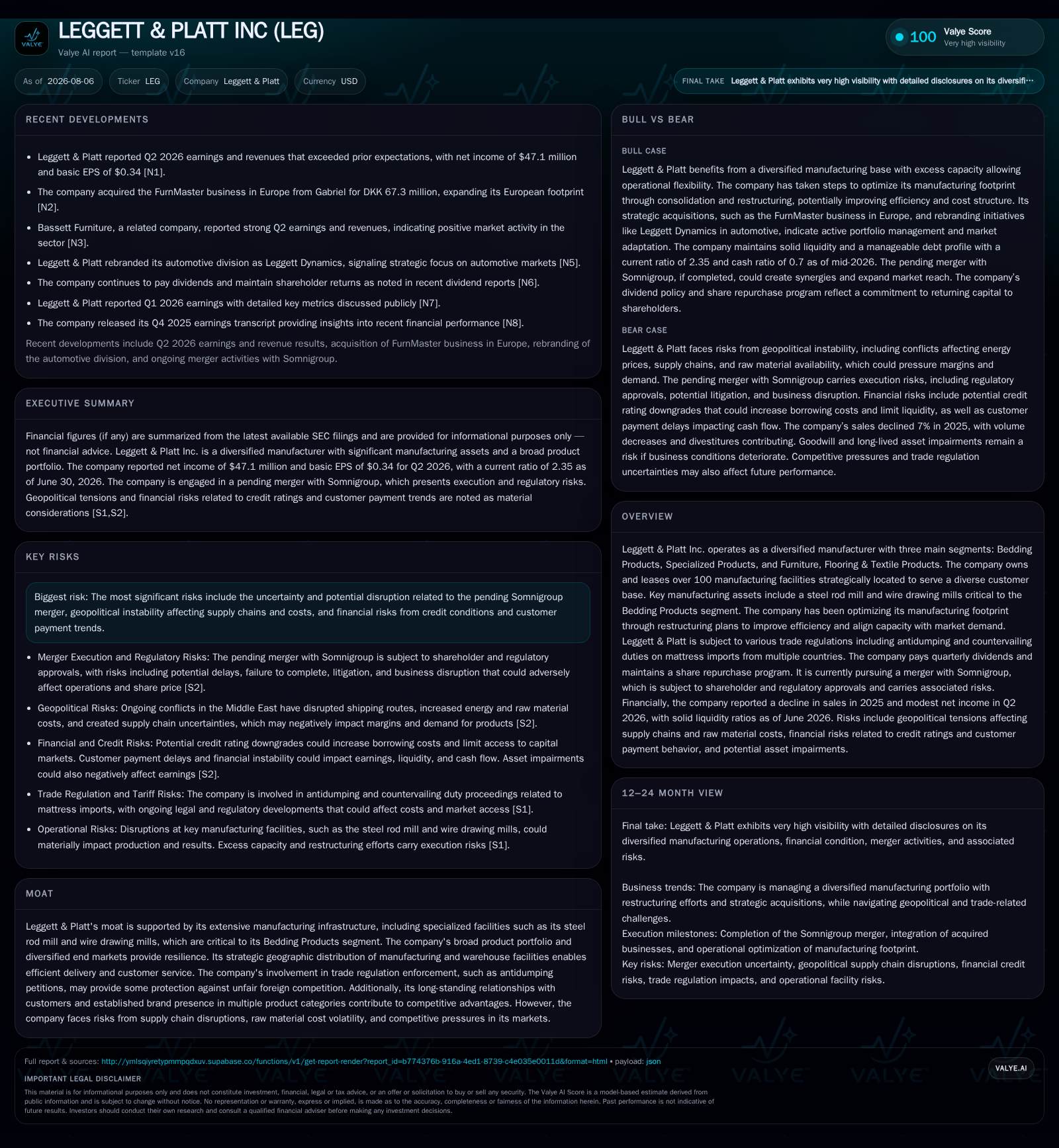
Leggett & Platt’s August 2026 quarterly update reveals increased management focus on a contested merger with Somnigroup alongside ongoing manufacturing footprint optimization. The bedding industry's exposure to tariffs and trade regulation remains significant, with the company dependent on its vertically integrated steel rod and wire operations. Customer financial stress causing slower receivables and inventory delays poses near-term risks. Leggett & Platt remains capital constrained by debt covenants limiting borrowing ahead of the merger closure. Monitoring litigation outcomes, capacity utilization trends, and trade duty developments will be critical for assessing the company’s operational trajectory.
Recent Operating Update: Litigation and Receivables Pressure
Simultaneously, the company reports signs of weakening end-market demand manifesting in slower customer payments and potential delays in order fulfillment. “We have seen slower payment trends among certain customers,” highlighting their exposure to changing market dynamics that could disrupt cash flow [S2]. The firm is actively managing receivables to mitigate earnings, liquidity, and cash flow impacts but acknowledges the risk attendant with customers' inability to take delivery of prior orders [S2]. Such payment trends are notable within diversified industrial manufacturers serving cyclical bedding and furniture sectors where OEM customers often face volatile retail demand.
Business Model: Vertical Integration Fuels Resilience during Footprint Optimization
Leggett & Platt operates across three principal segments: Bedding Products; Specialized Products; and Furniture, Flooring & Textile Products [S1]. Its business model leverages vertical integration—particularly through specialized production assets including a steel rod mill in Sterling, Illinois (~1 million sq ft, annual capacity ~500K tons) and complementary wire drawing mills in Missouri and Indiana—which supply key inputs for mattress innersprings predominantly sold within the Bedding segment [S1]. This stands as a strategic moat by securing control over raw material processing critical to product quality and cost competitiveness.
The company monetizes primarily via trade sales to OEMs, retailers, and distributors encompassing component assembly (springs, frames) as well as finished goods (innerspring mattresses, furniture components). Revenue growth depends on volume expansion driven by end-market residential furniture demand cycles and aftermarket component sales. Pricing mechanics incorporate raw material pass-throughs but remain sensitive to steel scrap market price volatility.
Leggett & Platt maintains ownership or leases over 100 manufacturing facilities strategically positioned for efficient delivery [S1]. In response to market shifts—including import tariff regimes affecting bedding components—the company has pursued production consolidation under its 2024 Restructuring Plan involving closure or consolidation of multiple domestic plants [S1]. Despite this rationalization drive, most facilities still operated below full capacity in 2025, implying lingering underutilization that depresses operating leverage.
Industry Structure and Competitive Position
Leggett & Platt operates within the diversified industrial manufacturing industry specializing in engineered components for residential bedding and furniture markets. It shares competitive space with peers such as Tempur Sealy International and Serta Simmons Bedding on the bedding side alongside furniture manufacturers like Flexsteel. Compared to typical industrial manufacturers lacking upstream steel capabilities, Leggett’s integrated steel rod mill uniquely anchors its Bedding segment [S1], offering cost advantage but also concentrated exposure to steel supply disruptions.
Trade regulatory dynamics significantly influence competitive positioning. The company actively participates in antidumping duty petitions targeting imports from multiple countries (e.g., China duties extended through 2030 at rates up to 1,732%) to offset unfair foreign competition prevalent in mattress components [S1]. Trade enforcement serves as both protective barrier for domestic producers like Leggett & Platt but invites counterparty litigation risks that could erode these benefits if determinations shift unfavorably.
Capacity utilization rates remain a key industry metric impacting profitability across peers. While Leggett has rationalized footprint post-2024 restructuring, excess capacity persists especially where import competition compresses pricing power. Peer comparisons suggest continuous pressure on margins unless offset by scale efficiencies or innovation-led product mix improvement.
Growth Drivers
Organic growth prospects are anchored in improving manufacturing efficiency through automation upgrades and ongoing strategic restructuring aimed at balancing capacity with demand fluctuations [S1]. As consumers increasingly favor higher-end mattress features and specialty furniture products, Leggett stands positioned to capitalize via expanded component offerings drawing upon its engineering expertise.
Non-organic growth levers include selective acquisitions complementing core segments; for instance, recent purchases such as the acquisition of FurnMaster business in Europe enhance geographic reach [N6]. Moreover, favorable trade policies underpin sustained protection for domestic production facilities amidst global supply chain volatility.
Aftermarket parts sales represent an incremental revenue stream less correlated with new home construction cycles. Leveraging distribution networks developed across segments may fuel margin expansion here. Finally, improving working capital management—critical given observed receivables aging challenges—could release cash flow supporting reinvestment or shareholder returns.
Risks and Watchpoints
Among most salient risks is ongoing uncertainty surrounding consummation of the Somnigroup merger given shareholder litigation alleging deficient disclosures [S2]. Delays or failure carry strategic consequences including management distraction and potential loss of market confidence.
Raw material cost volatility remains elevated given steel market dynamics coupled with trade policy evolutions. Disruptions at the proprietary steel rod mill or sourcing interruptions could force dependency on third-party suppliers at higher prices impacting Bedding segment margins materially [S1].
Customer credit risk exacerbated by weak end-market demand manifests as slower payments hindering liquidity visibility [S2]. Management states close oversight is being maintained but deteriorating receivables quality is a watchpoint especially if macroeconomic headwinds persist.
Excess production capacity presents structural pressure on operating leverage although ongoing restructuring efforts aim to curtail this overhang [S1]. Regulatory compliance costs related to international trade remedies also add complexity amid evolving geopolitical tensions.
Finally, financing flexibility is curtailed pre-merger by covenant limits restricting new indebtedness above $150 million without Somnigroup’s consent [S9], constraining balance sheet maneuverability amid potential cash flow pressures.
What to Watch Next
Investors should monitor developments regarding the shareholder lawsuits targeting merger approvals for insight into timeline clarity or prospective deal disruption risks [S2]. Timely resolution affects capital allocation strategy given management focus diversion.
Watch metrics reflecting manufacturing capacity utilization improvements post-restructuring as indicators of operational efficiency gains contributing to margin recovery. Also track receivables aging trends signaling customer credit health under current demand conditions.
Ongoing updates on trade enforcement rulings particularly antidumping duties’ duration or scope amendments will influence competitive pricing dynamics in core product categories.
Financially relevant catalysts include quarterly earnings releases detailing any incremental restructuring charges or impairment recognition linked to asset utilization shifts plus updates on net debt reduction progress leveraging operating cash flow generation capabilities [S3]
Financial Profile Discussion
As of June 30, 2026, Leggett & Platt held approximately $546 million in cash versus about $1.5 billion total debt resulting in a net debt position near $951 million [F1]. The current ratio stood robustly at 2.35 suggesting adequate short-term liquidity coverage of liabilities despite near-term working capital stressors highlighted by receivables concerns [F1].
This analysis provides an integrated view grounded in recent filings reflecting Leggett & Platt's operational developments, financial posture, industry context, and emerging risks without investment advice or forecasts. All data points are cited from official SEC filings or reputable news sources as indicated.
Disclaimer: This is research-only, informational analysis and not investment advice. It may include AI-generated interpretation and general industry context. Always verify important details using primary sources.

Comments