
How BlackRock’s Aladdin Platform and AUM Mix Shape Fee Revenue Sensitivity
BlackRock’s latest quarterly results highlight shifts in assets under management and technology integration that affect fee revenue resilience amid market volatility.
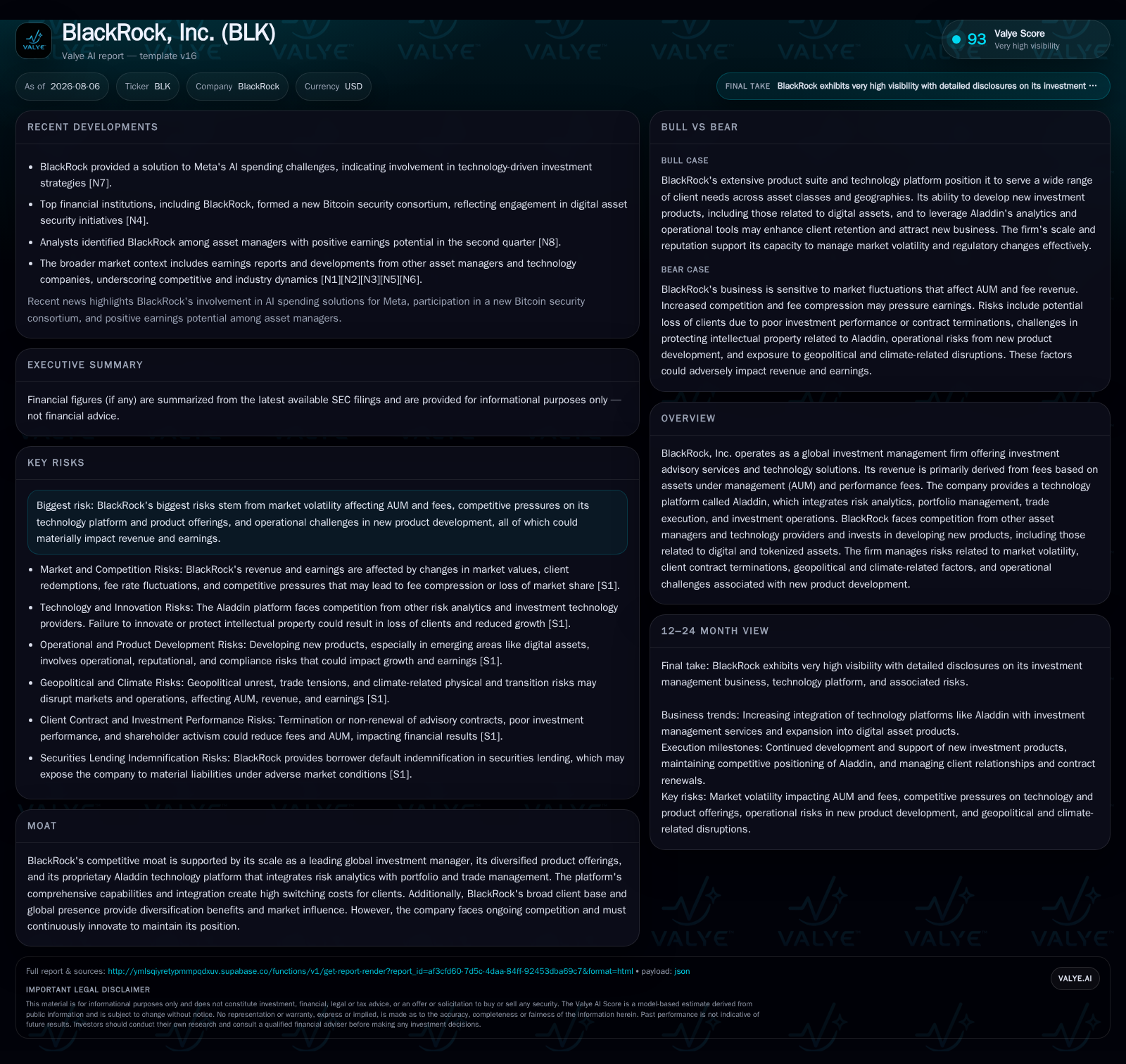
BlackRock's Q2 2026 10-Q reveals pressure on its assets under management (AUM) from market volatility, with a shift toward lower-fee asset classes dampening average fee rates. The Aladdin platform strengthens client retention by embedding risk analytics with portfolio management and trade execution, supporting revenue diversification through technology licensing. While management fees form the stable base of revenue, performance fees remain cyclical, reflecting market returns. Expansion into digital and tokenized assets offers growth potential but introduces operational and regulatory challenges. BlackRock's scale and integrated technology platform provide competitive differentiation, though execution risks persist amid evolving client preferences and fee compression trends.
Q2 Dynamics: AUM Composition and Fee Revenue Sensitivities Under Pressure
BlackRock’s Q2 2026 filing highlights how ongoing market volatility is influencing both the volume and the composition of its assets under management (AUM) [S2]. While total AUM remains sizeable given BlackRock’s global scale, there is a discernible shift toward asset classes—such as fixed income or passive strategies—that typically command lower management fees compared to equities or active mandates. This evolution dilutes the average effective fee rate even as gross AUM levels hold relatively steady [S2], [F1].
Because management fees are calculated as a percentage of AUM weighted by each asset category’s fee structure, these compositional shifts translate directly into variability in fee revenue. Client-driven reallocations or redemptions into lower-fee products further exacerbate this dynamic. Monitoring net inflow/outflow trends becomes critical for anticipating revenue stability; sustained inflows into higher-fee products would support margin resilience whereas accelerating outflows or migration to lower-fee segments would likely pressure earnings.
Aladdin’s Role: Driving Client Retention and Operational Integration
BlackRock’s proprietary Aladdin platform is central to its competitive moat by integrating risk analytics with portfolio management, trade execution, and investment operations into a cohesive system used both internally and licensed externally to clients [S1], [S2]. This deep integration raises switching costs for clients who embed Aladdin within their investment workflows, thereby enhancing retention rates.
Recent disclosures indicate ongoing enhancements aimed at broadening analytics capabilities and improving user experience. These investments underpin cross-selling opportunities beyond traditional asset management fees by generating incremental technology licensing revenues. In contrast to fintech competitors offering narrower point solutions, Aladdin’s comprehensive platform strengthens BlackRock’s position at the intersection of asset management and financial technology.
Fee Structure Nuances: Management versus Performance Fees in Shifting Markets
BlackRock balances stable base management fees derived from AUM with variable performance fees tied to investment returns exceeding benchmarks [S1], [S2]. Performance fees amplify total revenue during periods of strong market performance but are inherently volatile when markets soften.
The Q2 results reflected modest fluctuations in performance fees consistent with broader equity market softness. Management fees provide a reliable revenue foundation anchored by contractual relationships based on fund sizes, while performance fees serve as an earnings lever sensitive to alpha generation. Sustained ability to capture performance fees via differentiated active or alternative strategies would signal robust pricing power despite headwinds from asset mix shifts.
Innovating Beyond Traditional Assets: Digital and Tokenized Product Expansion Potential
BlackRock is actively advancing digital asset investing capabilities including tokenized assets—a growing segment within asset management that aligns with increasing investor interest in crypto-linked products [S1], [S2]. This strategic direction complements broader industry trends emphasizing digital transformation.
However, regulatory ambiguity around digital assets creates monetization timing uncertainty. Operational complexity also remains high as integrating tokenized offerings requires enhanced compliance frameworks and technological infrastructure upgrades. Execution risk persists as BlackRock invests significantly to scale these products; key milestones such as launching new digital ETFs or expanding blockchain-enabled custody services will be critical indicators of progress.
Competitive Landscape: Balancing Scale, Technology, and Fee Discipline
BlackRock’s global scale across active/passive ETFs, alternatives, mutual funds combined with its integrated technology platform differentiates it from mid-sized managers or fintech disruptors focused narrowly on advisory services or standalone technology solutions [N8]. This breadth provides resilience amid fee compression pressures common in large global managers.
Nonetheless, competition intensifies from low-cost passive providers compressing average fees and innovative fintech firms developing advanced portfolio analytics tools that attract emerging client segments. Inflationary cost pressures challenge margin maintenance without passing higher fees to clients who increasingly demand pricing transparency.
Maintaining competitive equilibrium demands continuous innovation coupled with disciplined pricing strategies that safeguard profitability while preserving client relationships.
Watchpoints Ahead: Market Conditions, Product Pipeline Milestones, Contract Renewals
Key indicators to monitor include:
- Quarterly net inflows/outflows revealing client confidence amid volatile equity/debt markets.
- Adoption rates of Aladdin platform enhancements signaling cross-selling momentum.
- Commercial rollout progress for digital asset products indicating diversification success beyond traditional assets.
- Annual fund contract renewals which may present renegotiation risks affecting revenue visibility.
Tracking these metrics will clarify if BlackRock can sustain its blend of traditional asset management strength alongside fintech-driven growth while mitigating margin erosion risks.
Financial Profile Discussion: Liquidity Cushion and Debt Positioning Support Strategic Flexibility
As of June 30, 2026, BlackRock reported approximately $10.5 billion in cash and equivalents against $12.7 billion in total debt, yielding net debt near $2.25 billion [F1]. This liquidity position provides a solid buffer enabling continued investment in technology initiatives like Aladdin enhancements or strategic ventures into digital assets without compromising operational cash flow stability.
This moderate leverage relative to enterprise scale reflects prudent financial stewardship supporting capital allocation flexibility even during episodic market disruptions that can depress earnings due to AUM fluctuations or performance fee variability. Consequently, BlackRock's financial health underpins confidence in its capacity to fund innovation cycles while absorbing inherent sector volatility [F1]
This analysis synthesizes BlackRock’s recent quarterly disclosures with sector dynamics illustrating how its integrated business model leveraging large-scale managed assets coupled with advanced technology platforms creates structural advantages. Yet it also faces ongoing challenges balancing innovation demands against shifting client preferences and competitive pressures. Monitoring KPIs such as net flows, average fee rate evolution linked to asset mix changes, proprietary platform adoption progress, digital product commercialization milestones alongside disciplined financial management will be essential to gauge whether BlackRock can maintain its industry leadership over the medium term.
Disclaimer: This is research-only, informational analysis and not investment advice. It may include AI-generated interpretation and general industry context. Always verify important details using primary sources.

Comments