
ITT Inc. Harnesses Operational Stability Amid Heightened Geopolitical Risks
ITT delivers solid Q2 results with $1.473 billion revenue and navigates inflationary pressures linked to Middle East tensions.
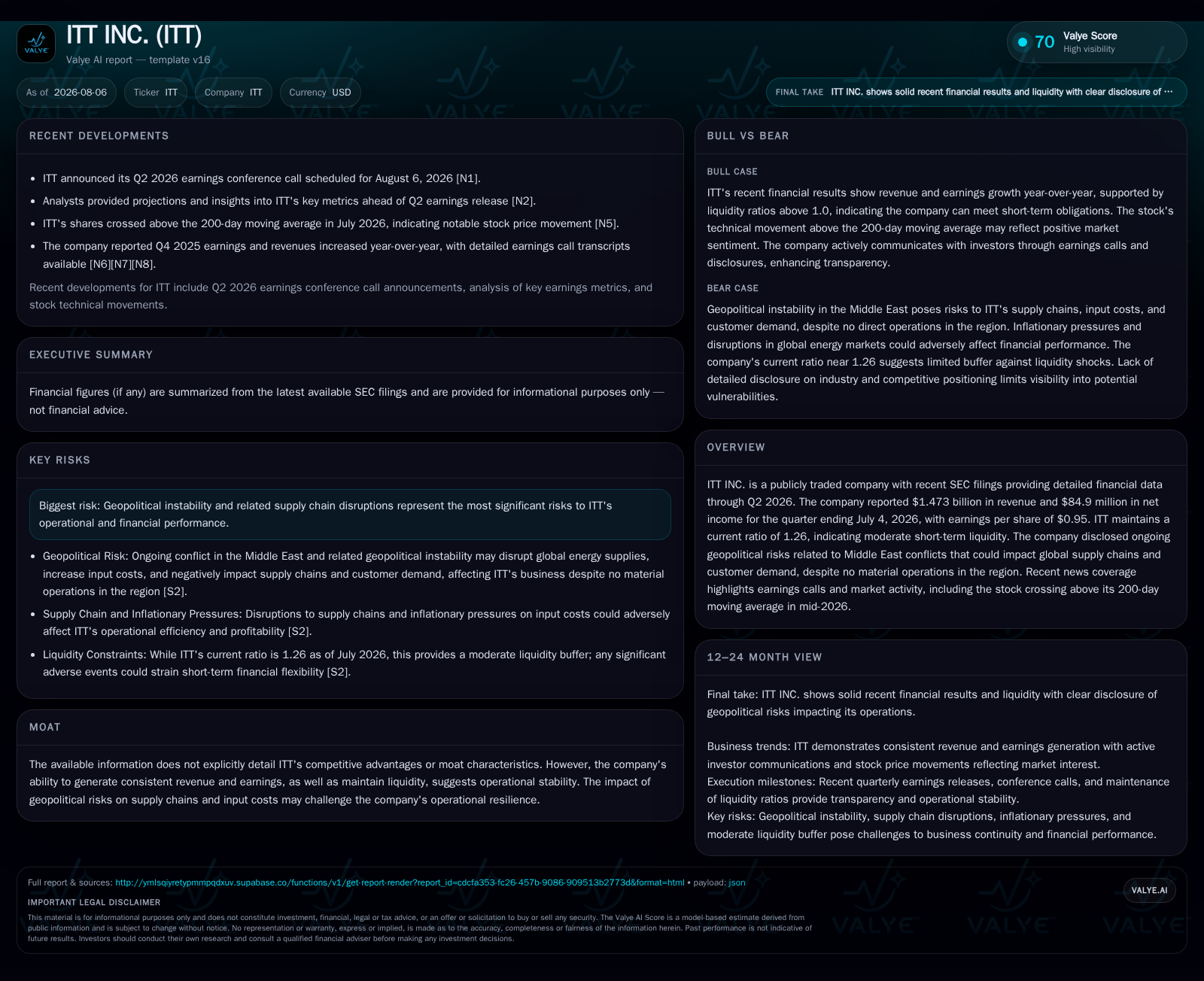
In Q2 2026, ITT Inc. maintained operational resilience by generating $1.473 billion in revenue and $84.9 million in net income despite elevated geopolitical risks stemming from Middle East conflicts that disrupted global energy supplies and increased input costs [S2],[F1]. Its diverse industrial equipment portfolio primarily serves OEM customers across aerospace, transportation, and energy sectors, benefiting from stable aftermarket parts demand even amid cyclical capital spending fluctuations [S1]. However, rising commodity prices and supply chain disruptions continue to pressure margins, offset partially by operational leverage as utilization improves [S2],[S1]. The company exhibits a moderate liquidity position with a current ratio of 1.26 and substantial net debt, necessitating prudent capital allocation amid industry cyclicality [F1]. Moving forward, key indicators such as order backlog trends and supply chain recovery will be critical to validate growth prospects under ongoing macroeconomic uncertainty [S3].
Q2 Results Reveal Operational Resilience Despite Geopolitical Tensions
ITT Inc.’s second quarter ending July 4, 2026 demonstrated notable operational resilience with reported revenue of $1.473 billion and net income of $84.9 million translating to earnings per share of $0.95 [S2],[F1]. These figures are significant given the backdrop of escalating geopolitical risk from ongoing Middle East conflicts since early 2026 involving the United States, Israel, and Iran resulting in heightened energy prices and disruption across global supply chains [S2],[S18]. Notably, while ITT does not operate materially within the Middle East region itself, these external factors have indirectly elevated input costs via inflationary pressure on commodities and energy-related expenses. This inflation has adverse downstream effects on macroeconomic conditions impacting customer demand within ITT’s served markets globally [S2]. The company’s ability to sustain strong top-line growth despite these headwinds underscores a degree of operational stability unusual for an industrial equipment manufacturer facing such widespread market turbulence.
ITT’s Industrial Model: Revenue Driven by Diversified OEM Demand and Aftermarket Stability
Based on the latest annual disclosures [S1], ITT’s business model leverages a diversified portfolio focused on designing and manufacturing engineered electromechanical components primarily sold to original equipment manufacturers (OEMs) across aerospace, transportation, and energy sectors. This positions ITT midstream in the complex industrial value chain where its products integrate into larger systems or machinery produced by end customers. A crucial aspect is its significant aftermarket parts and service offering which provides recurring revenue streams that help mitigate typical cyclical volatility seen in capital expenditure-driven markets. The relevance of well-managed product lifecycle offerings contributes to sustaining customer loyalty amidst fluctuations in new equipment orders tied to macroeconomic cycles.
Supply Chain Risks and Commodity Inflation Pinch Margins but Operational Leverage Provides Cushion
Consistent with industry-wide challenges reflected in recent risk disclosures [S2], commodity price inflation alongside persistent supply chain disruptions have exerted downward pressure on gross margins during Q2 2026. Increased energy prices elevate manufacturing costs both directly through utilities consumption and indirectly via freight/logistics expenses worldwide. ITT’s exposure to raw materials subject to commodity volatility further complicates margin management. However, the company demonstrates operational leverage benefits wherein improved capacity utilization during higher demand periods partially offsets margin compression by spreading fixed overheads more efficiently [S1],[S2]. Nevertheless, given the capital-intensive nature of industrial equipment production, sensitivity to supply bottlenecks remains a watchpoint for future profitability.
Peer Benchmarking: Efficiency and Capital Intensity Compared with Diversified Industrial Players
Comparatively analyzing ITT alongside broadly similar diversified industrial conglomerates such as Honeywell International and Carlisle Companies (used here for contextual benchmarking rather than precise peer matching) reveals shared sector dynamics around balancing operational efficiency with capital intensity requirements [N6],[N7],[S1]. These peers likewise confront challenges related to sustaining innovation-led product development while navigating raw material inflation and long supply chains vulnerable to geopolitical tensions or trade policies. Their balance sheet management strategies commonly emphasize maintaining liquidity buffers amidst cyclicality coupled with targeted CapEx investments aimed at productivity enhancement or expanding service-based offerings. Such benchmarking amplifies understanding of where ITT stands regarding margin profiles or structural resiliency within this competitive landscape without assuming direct market share implications.
Growth Outlook Anchored in Aerospace CapEx, Industrial Automation, and Aftermarket Expansion
Industry consensus suggests that growth drivers for companies like ITT include anticipated rebounds in aerospace capital expenditure fueled by commercial fleet upgrades alongside expanding adoption of industrial automation technologies aimed at enhancing production efficiency. Additionally, growing prominence of aftermarket parts sales supports more stable revenues less sensitive to short-term cyclical swings — a key advantage for suppliers integrated into product lifecycle support ecosystems rather than purely new equipment sales. While specific backlog or book-to-bill metrics were not disclosed in detail for Q2 2026 ([S3]), monitoring these KPIs provides insights into demand durability as aerospace suppliers gear up for modernization cycles alongside increasing regulatory emphasis on sustainability prompting new product development initiatives.
Risks to Watch: Geopolitics, Cyclical Demand Fluctuations, and Raw Material Costs
Principal risks outlined in recent SEC risk factor updates emphasize how ongoing Middle East conflict continues casting uncertainty over global trade logistics along with widening energy price volatility which cascades through input cost structures affecting profitability margins at ITT [S18]. Cyclical softening in end markets tied to global economic slowdowns might curtail OEM investment cycles reducing order inflows — a key revenue driver given dependence on capital-intensive projects across aerospace/transportation sectors. Raw material price swings remain another substantial risk vector requiring effective procurement strategies or pricing adjustments to safeguard margin integrity over time [S2]. Tracking actual input cost trajectories along with order backlog changes will be vital indicators signaling risk materialization or relief.
What Comes Next: Monitoring Backlog Trends, Margin Trajectory, and Supply Chain Recovery
Looking ahead, forward-looking markers include updates on third quarter guidance expected through forthcoming earnings calls or regulatory filings ([S3]). Key areas warrant surveillance encompass backlog evolution indicating strengthening or weakening OEM demand signals coupled with margin progression reflecting success in cost pass-through actions or productivity gains despite inflation pressures. Supply chain lead time normalization amid lingering disruptions also represents a pivotal variable influencing delivery performance hence customer satisfaction levels critical for repeat business continuity [N8]. External macroeconomic data interplaying with trade policy developments will further color outlook assessments.
Financial Profile Discussion: Balancing Liquidity Against Capital Needs in a Capital-Intensive Space
From a financial stance at quarter-end July 4, 2026, ITT held cash plus equivalents around $591 million against current liabilities near $2.25 billion yielding a current ratio approximately equal to 1.26 — suggestive of moderate short-term liquidity coverage though reflective of working capital demands typical for industrial manufacturers operating complex inventories across global supply chains [F1]. Total debt levels are substantial relative to cash on hand; approximated net debt hovers near $2.55 billion underscoring leverage considerations amidst cyclical capex requirements prevalent throughout the sector especially as companies invest aggressively in automation or new product lines aimed at long-term competitive positioning [F1]. Managing this debt load prudently while balancing free cash flow generation will remain important for sustaining financial flexibility needed under uncertain macroeconomic conditions.
Disclaimer: This analysis is based solely on publicly available data as cited from SEC filings, news reports, company facts snapshots [F1], and general industry knowledge as background context without access to nonpublic information. It does not constitute investment advice or research views.
Disclaimer: This is research-only, informational analysis and not investment advice. It may include AI-generated interpretation and general industry context. Always verify important details using primary sources.

Comments