
Goldman Sachs' Q2 2026: Shifts in Consumer Strategy and Market Making Amid Capital Management
Goldman Sachs reported second-quarter results highlighting evolving consumer finance positioning and stable market making while navigating regulatory and capital structure adjustments.
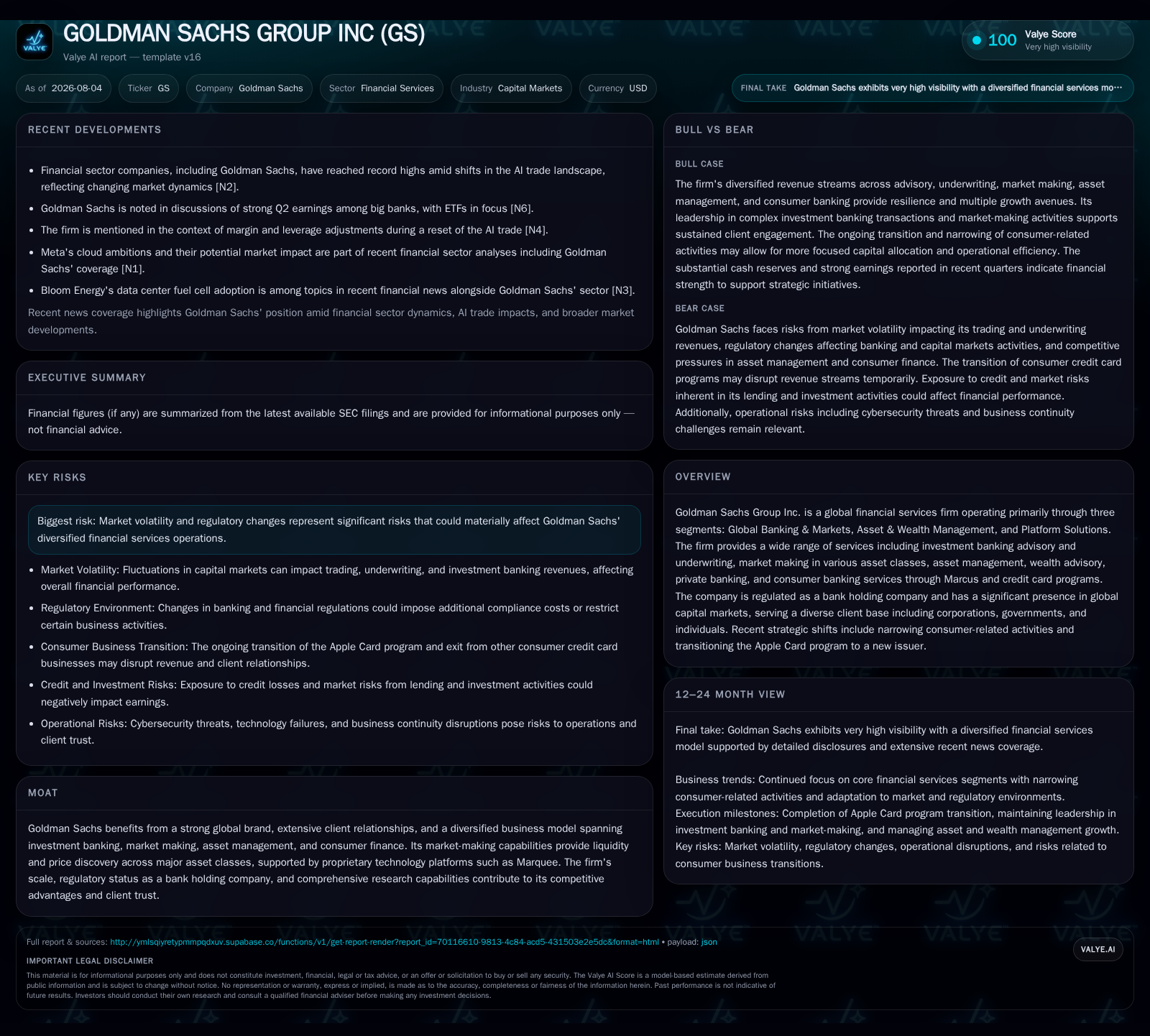
Goldman Sachs' latest quarterly filing reveals strategic narrowing of its consumer-facing Platform Solutions while reinforcing its core Global Banking & Markets activities, including an expanded transaction banking footprint. The firm continues to navigate the regulatory and capital environment prudently, demonstrated by the issuance of new preferred stock with protective rights impacting dividend policies. Market making remains a significant revenue contributor amid mixed macroeconomic signals, and asset management growth persists thanks to rising global wealth trends. Key risks include market volatility, regulatory pressures, and credit quality uncertainties as Goldman manages its diversified business lines across global markets.
Recent Operating Update
Goldman Sachs’ Q2 2026 10-Q filing presents targeted strategic actions emphasizing a narrowing of consumer finance exposures within its Platform Solutions segment while enhancing Global Banking & Markets offerings [S2]. Notably, the firm is transitioning the Apple Card program’s issuer role away from Goldman Sachs to a third-party partner, signaling a deliberate retreat from direct consumer credit risk [S1]. This move aligns with broader efforts to refine Platform Solutions toward less capital-intensive activities. Concurrently, transaction banking results are now consolidated within Global Banking & Markets rather than Other or Platform Solutions reporting groups, evidencing integration aimed at harnessing synergies in institutional client financing and servicing [S1]. This segment realignment reflects both a response to competitive dynamics in consumer finance and an emphasis on scalable institutional revenue streams.
Market making continues to serve as a cornerstone for Goldman’s revenue base. Despite fluctuating market volatility, fixed income, currency, commodities (FICC), and equities intermediation deliver stable net trading income supported by the firm's proprietary technology infrastructure such as its Marquee platform [S2]. This ecosystem facilitates price discovery and liquidity provision essential to client intermediation functions. The integration of structured letters of credit facilitation into FICC financing underscores diversification within core trading operations [S1]. The firm's ability to leverage technology-enhanced platforms enables it to compete effectively against both traditional market makers and emerging electronic trading firms.
In the Asset & Wealth Management division, ongoing growth is supported by rising assets under management (AUM) driven by global wealth accumulation trends. Revenue streams predominantly derive from management fees tied to AUM levels alongside performance incentives reflective of fund profitability [S1]. Private banking services complement these offerings with bespoke lending solutions that deepen client relationships and foster cross-selling opportunities. This diversification mitigates concentration risk inherent in advisory-only models.
On the capital structure front, Goldman issued Series AA Preferred Stock as part of its enhanced capital securities program during the quarter [S3]. This issuance incorporates dividend payment restrictions that constrain common stock dividend declarations or repurchases should the firm fail in paying preferred dividends. The move signals proactive management of regulatory capital buffers aligned with evolving Basel III/IV requirements and broader Federal Reserve oversight [S3]. Such financial instruments provide additional loss-absorbing capacity but place nuanced limitations on shareholder returns under stress scenarios.
Liquidity remains exceptionally strong with cash and equivalents totaling approximately $187 billion as of June 30, 2026 [F1]. This ample liquidity cushion provides resilience against potential funding shocks or rapid market dislocations typical in capital markets cycles. It also supports continued participation in primary markets for debt underwriting or syndication activities, vital given Goldman’s role as a global financial intermediary.
Business Model Analysis
Goldman Sachs monetizes value across three principal segments: Global Banking & Markets, Asset & Wealth Management, and Platform Solutions [S1]. The first chiefly generates income from investment banking advisory fees (M&A advisory, restructuring), equity and debt underwriting fees from public offerings or private placements, as well as trading revenue encompassing market making across fixed income, equity products, derivatives, foreign exchange and commodities. These flows depend sensitively on deal activity cadence and risk appetite among institutional clients.
Revenue mechanics factor volume-driven underwriting fees linked to completed capital raising transactions plus spread capture via principal trading books held for market making or proprietary purposes [S1]. Margin profile nuances arise from differentiated pricing power in advisory versus underwriting businesses—the former usually commanding higher relative fees but lower volume compared with highly competitive underwriting mandates.
Asset & Wealth Management leverages recurring management fees proportionate to AUM alongside incentive fees aligned with generating alpha above benchmarks. Client stickiness and retention hinge on fund performance credibility and shifting regional wealth patterns that drive inflows into diversified investment products [S1]. Private banking adds lending yield alongside fee-based advice.
Platform Solutions historically included consumer-oriented businesses like Marcus loans and the Apple Card credit card business earning net interest margin plus certain fee revenues [S1]. However, strategic repositioning marks this area for contraction or transformation given capital allocation considerations and competitive pressures. Monetization here relies more heavily on retail customer acquisition costs balanced against credit losses.
Across segments, Goldman’s position as a bank holding company subjects it to regulatory capital requirements affecting risk-weighted assets (RWA) impacts on loan generation capacity and balance sheet usage efficiency. Sophisticated risk management governs credit underwriting standards particularly in corporate lending or consumer credit extensions while operational resiliency investments underpin infrastructural robustness amidst cyber-threat landscapes.
Industry Structure and Competitive Position
Goldman Sachs operates within the global investment bank peer set alongside JPMorgan Chase, Morgan Stanley, Bank of America Merrill Lynch, Citigroup, Credit Suisse, and Barclays. Its strengths lie in scale economies allowing extensive client coverage across corporates, governments, financial institutions, asset managers and high-net-worth individuals [S1]. Its capabilities span integrated banking advisory through liquid market-making desks coupled with comprehensive asset management.
The firm faces competition both at the high-end advisory boutique level where specialized advisory firms challenge fee structures as well as at the electronic execution arena where pure-market-making entities push technological efficiencies. Scaling transaction banking within Global Banking & Markets differentiates Goldman versus peers more concentrated on traditional lending or advisory-heavy models.
Regulatory frameworks globally impose compliance burdens that influence geographic presence decisions and product mix optimization. Large banks benefit from diversified revenue streams buffering cyclical fluctuations yet must constantly optimize capital cost given Basel-imposed leverage caps. Goldman’s brand equity supports significant client loyalty but sustaining above-peer returns requires continuous innovation particularly integrating sustainability-linked products given ESG finance growth trajectories.
Growth Drivers
Key growth drivers include expanding transaction banking services which tap into increasing demand for corporate cash management solutions facilitated by digital platforms embedded in institutional workflows [S1]. This area promises stable relationship-driven revenue with relatively predictable volumes enhancing funding sources besides wholesale funding mechanisms.
M&A advisory growth correlates strongly with economic cycle inflections fostering deal activity while underwriting benefits from sporadic but lucrative primary issuance seasons worldwide. Asset & Wealth Management’s growth leverages cross-border wealth migration combined with demographic tailwinds boosting investable assets.
Technological advancements underpin trading advancements: proprietary platforms like Marquee enhance algorithmic execution quality improving spreads captured on client trades improving market share versus less technologically equipped rivals. Sustainability-linked financing products reflect emerging niche specialties aligned with client decarbonization objectives providing consultative differentiation.
Consumer finance contraction releases capital enabling redeployment toward institutionally oriented growth segments potentially augmenting return-on-equity metrics long-term.
Risks and Watchpoints
Market volatility remains a double-edged sword—while it may lift trading revenues via widened bid-ask spreads or increased positioning opportunities it also raises exposure to mark-to-market losses especially under stressed conditions impacting pre-tax income variability [S23]. Exposure to systemic shocks such as geopolitical tensions can curtail deal pipelines hurting fee-based businesses abruptly.
Regulatory changes pose ongoing uncertainty including enhancements in capital adequacy rules possibly inflating RWA calculations constraining balance-sheet expansion with direct profit impacts. Anti-money laundering (AML), Know Your Customer (KYC), and data privacy regulations increment operational complexity raising compliance costs while reputational damage from violations can be material.
Credit quality concerns arise mainly within corporate lending exposures amid potential deteriorations in macroeconomic fundamentals affecting default rates plus residual consumer lending risk despite strategic pullbacks [S23]. Counterparty concentration warrants monitoring especially where derivative contracts or collateralized transactions are concerned.
Operational risks incorporating technology failures or cyber intrusions threaten business continuity given Goldman’s reliance on system integrity across market operations globally.
Competitive pressure compresses fee margins requiring continuous investment in service excellence plus product innovation to defend mandate wins amid boutique insurgency targeting niche sectors.
What to Watch Next
Upcoming quarterly updates should reveal progress post-Apple Card transition clarifying ultimate impact on consumer-related revenues within Platform Solutions while delineating redeployment outcomes of freed capital resources [S1,S2]. Monitoring investment banking fee trajectory offers insight into deal activity recovery or weakness informing near-term earnings predictability.
Regulatory disclosures concerning risk-weighted asset composition changes will indicate how prudently Goldman is managing evolving Basel standards possibly signaling capacity for loan book expansion or contraction [S3]. Technology platform deployments enhancing market-making profits warrant further detail to assess sustainable competitive advantages relative to peers relying on legacy infrastructures.
Macro developments such as interest rate directional shifts could materially affect net interest income profiles especially under managed balance-sheet strategies balancing loan yields against wholesale funding costs. Watch indications of credit impairment trends confirm underlying portfolio health ahead of broader economic uncertainties.
Financial Profile Discussion
As of June 30, 2026, Goldman Sachs exhibits robust liquidity reserves standing at approximately $187 billion in cash and equivalents underpinning solid funding reliability amid volatile markets [F1]. Although total debt data not current beyond 2019 is less informative for present analysis, the firm’s recent issuance of Series AA Preferred Stock introduces dividend-related conditions impacting common stockholder return policies hinting at cautious capital deployment approaches aligned with regulatory expectations [S3].
Profitability remains contingent upon balancing cyclical revenue swings across volatile investment banking markets versus steadier asset management fees emphasizing recurring sources [S1]. Cost-to-income optimization will remain critical given rising regulatory cost pressures. Maintaining strong tier 1 capital ratios is foundational given bank holding company designation subjecting Goldman Sachs to Federal Reserve scrutiny ensuring adequate capitalization against risk exposures
Overall financial positioning reflects prudent conservatism supporting sustainable franchise operations even as macro uncertainty persists requiring dynamic response capabilities across diversified segments.
This analysis synthesizes disclosures filed through August 3rd, 2026 alongside broader industry context relevant to understanding Goldman Sachs Group Inc.'s evolving strategy amid regulatory constraints and competitive pressures. It refrains from specific forecasts or research views but underscores key operational shifts likely defining near-term trajectory within complex global financial services markets.
Disclaimer: This is research-only, informational analysis and not investment advice. It may include AI-generated interpretation and general industry context. Always verify important details using primary sources.

Comments