
Digital Asset Acquisition’s Path to Completing Business Combination with Old Glory Bank
DAAQ advances its de-SPAC process targeting a public listing through merger with Old Glory Bank, maintaining strong liquidity and governance amid typical SPAC risks.
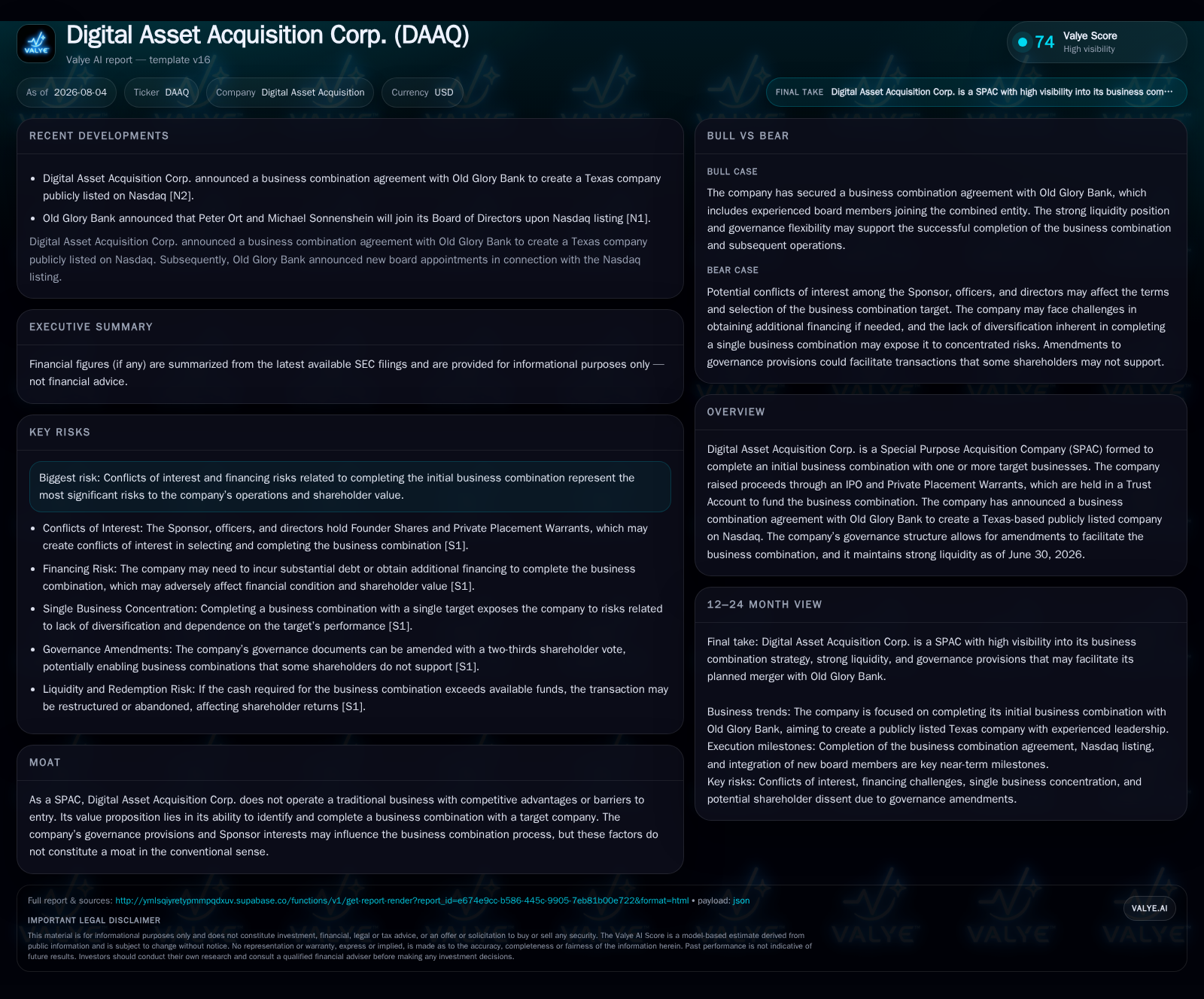
Digital Asset Acquisition Corp. (DAAQ) remains on track to consummate a business combination with Old Glory Bank, aiming to create a publicly traded company on Nasdaq. The SPAC retains robust liquidity as of mid-2026, with a current ratio exceeding 12, supporting the upcoming shareholder vote scheduled for August 14, 2026. Governance provisions allow the sponsor substantial influence over the business combination approval, illustrating common SPAC conflict dynamics. The success of this transaction will hinge on shareholder redemption rates and regulatory approvals within the defined timeframe.
Recent Operating Update
Digital Asset Acquisition Corp. filed its latest quarterly Form 10-Q on August 3, 2026, reaffirming its commitment towards completing an initial business combination with Old Glory Bank. While no significant operating income or revenue engines exist at this pre-combination stage—as expected for SPACs—the update confirms no material changes in risk factors or liquidity status since prior reports [S2]. Crucially, a scheduled shareholder vote on approving the proposed merger was postponed from July 31 to August 14, 2026, increasing time for proxy solicitation and shareholder engagement amid an important redemption deadline that passed on July 29 [S3], [S18].
Currently, DAAQ holds approximately $455 thousand in cash and cash equivalents within its trust account as of June 30, supporting a robust current ratio of about 12.8—reflecting very low liabilities relative to short-term assets [F1]. This liquidity profile aligns with the preservation mandate typical for SPACs during their acquisition search phase.
Business Model Overview
As a Special Purpose Acquisition Company (SPAC), Digital Asset Acquisition Corp. operates as a shell entity created solely to raise capital through an initial public offering (IPO) and private placement warrants to fund a future acquisition or merger (business combination). The funds raised are held in a trust account earning minimal interest but otherwise protected from usage until a qualified transaction is completed or liquidation occurs.
DAAQ's business model focuses entirely on sourcing and negotiating a target private company—here Old Glory Bank—to merge into the publicly listed vehicle in lieu of traditional IPO listing procedures. Revenue mechanics for DAAQ currently derive only from interest earned or warrant exercises post-combination; pre-business combination operating results typically reflect administrative and legal expenses related to compliance and transaction diligence [S1], [F1].
Governance provisions embedded in DAAQ’s structure allow founders and sponsors holding "Founder Shares" considerable voting power: they can approve the initial business combination even if most public shareholders dissent. Public shareholders possess redemption rights enabling them to cash out at IPO price before completion but excessive redemptions reduce available deal capital and can threaten transaction viability [S1]. This dual dynamic underscores inherent conflicts of interest between management incentives and minority shareholder protections common across SPAC constructs
Industry Structure and Competitive Position
DAAQ competes within the SPAC intermediary niche bridging public investor capital with private companies seeking expedited access to public equity markets. While not competing in traditional banking or asset sectors directly, it functions alongside peer SPAC vehicles like Pershing Square Tontine Holdings or Churchill Capital—entities known for sponsoring transformative transactions facilitating rapid public listings.
In targeting Old Glory Bank, a Delaware-based regional bank holding company intending to become publicly listed via this de-SPAC process, DAAQ leverages market trends where private banks prefer alternative listing routes due to faster timelines and relative cost efficiencies compared to conventional IPOs.
The competitive environment for such transactions involves complex negotiations balancing valuation expectations, regulatory hurdles specific to financial institutions, and investor appetite for exposure to banking sector equities post-combination. The outcome's durability depends on successful integration execution post-merger and sustained institutional investor confidence.
Growth Drivers
Growth prospects primarily hinge on DAAQ’s ability to close the pending business combination within regulatory deadlines—typically set by the SPAC’s IPO date plus an agreed window (usually around two years). Successful completion unlocks public market access for Old Glory Bank’s operations and potentially grants DAAQ shareholders exposure to an operating financial institution’s future earnings stream.
Other growth-related factors include:
- Favorable conditions in capital markets encouraging private financial institutions’ willingness to pursue de-SPAC listings,
- Improved regulatory clarity around SPAC transactions particularly involving banking entities,
- Sponsor effectiveness in negotiating accretive deal terms and managing shareholder relations,
- Investor appetite for speculative vehicles combined with regionally focused bank equities,
- Increasing sophistication among target candidates seeking quicker go-public pathways than traditional underwritten IPOs.
Milestones to watch include shareholder vote outcomes on August 14, actual redemption levels disclosed thereafter which impact net proceeds available for closing, final SEC clearance of registration statements tied to proxy materials, and timely announcement of closing dates post-vote.
Risks and Constraints
DAAQ faces quintessential SPAC risks accentuated by banking-sector specific challenges:
Monitoring these risk buckets is crucial as each directly influences whether the transaction advances successfully or encounters cancellation scenarios requiring liquidation distributions.
What To Watch Next
Investors and analysts should track the following near term indicators:
- Results from the August 14th extraordinary general meeting including shareholder vote tallies on approval proposals;
- Redemption statistics following the redemption deadline passed on July 29 that reveal investor willingness or opposition;
- Updates or amendments filed via SEC Form 8-K disclosing substantive changes in deal terms or timelines;
- Releases confirming receipt of required regulatory approvals particularly from banking regulators;
- Sponsor communications detailing progress toward closing milestones and expected timelines;
- Warrant exercise activity post-combination which can influence capital structure dilution dynamics.
These metrics collectively will clarify DAAQ’s progress toward delivering value via successful de-SPAC transition versus dissolution risk.
Financial Profile Discussion
At quarter-end June 30, 2026, DAAQ exhibited a healthy financial position consistent with typical late-stage pre-combination SPAC profiles. Cash and cash equivalents totaled approximately $455 thousand held largely in trust accounts ensuring principal protection reserved exclusively for transaction purposes [F1]. Current assets stood near $510 thousand against nominal current liabilities around $40 thousand yielding an ample current ratio roughly equal to 12.8—underscoring negligible liquidity stress [F1].
Net income figures are not meaningful given absence of operational activity; reported net income reflects accounting adjustments unrelated to continuing operations pre-combination [F1]. Operating expenses mainly encompass administrative overhead including legal compliance related costs anticipating eventual transaction closure [S2]. There is no recorded debt or financing beyond founder equity interests specific to sponsor investment in founder shares and warrants purchased privately at nominal prices during IPO formation phases [S1].
Importantly, this conservative financial posture enables shielding shareholder funds from operational depletion risks typical among earlier life-cycle SPACs while facilitating readiness for drawing upon cash proceeds upon meeting requisite closing conditions.
This analysis utilizes all publicly available filings through August 2026 reflecting Digital Asset Acquisition Corp.’s corporate status as primarily an investment vehicle formed explicitly for completing a transformational acquisition. Readers should consider these unique factors when evaluating developmental progress toward successful completion of the initial business combination with Old Glory Bank.
Disclaimer: This is research-only, informational analysis and not investment advice. It may include AI-generated interpretation and general industry context. Always verify important details using primary sources.

Comments