
Invitation Homes Advances Scale and Integration to Strengthen Single-Family Rental Position
The latest quarterly filing highlights Invitation Homes’ operational gains from scale, expanded homebuilding integration, and portfolio concentration that support steady rental demand amid market uncertainties.
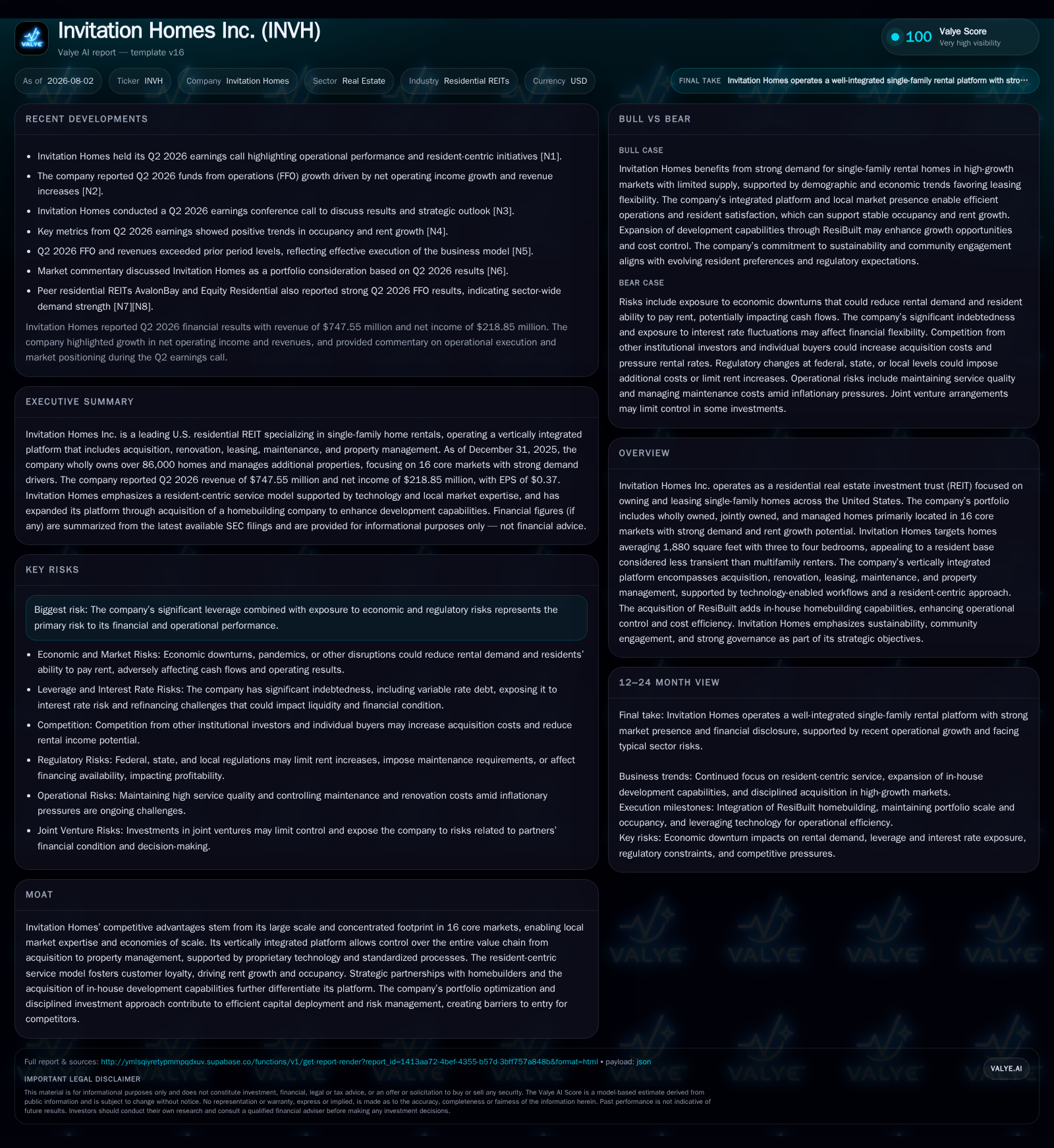
Invitation Homes recently reported Q2 2026 results showcasing resilient occupancy and same-store rent growth supported by its vertically integrated platform and strategic geographic concentration. The addition of in-house homebuilding capabilities through ResiBuilt enhances capital deployment efficiency and renovation cost control. While the company faces regulatory and leverage risks typical for large residential REITs, its resident-centric model and technology-driven property management underpin stable lease renewal rates and sustained rental income. Financially, Invitation Homes maintains significant gross debt around $8.6 billion with modest cash reserves, demanding prudent capital management to balance growth and leverage.
Q2 Operating Momentum Anchored by Scale and Efficiency Gains
Invitation Homes’ Q2 2026 10-Q reveals steady operational performance underpinned by its large-scale portfolio spanning approximately 110,000 homes across 16 concentrated U.S. markets [S2], [S1]. Occupancy rates have remained stable in this period despite macroeconomic pressures affecting many residential landlords, a sign of sustained demand for single-family rentals. The company's ability to maintain occupancy reflects its resident-centric leasing approach combined with strategic market selection emphasizing areas with durable employment bases and housing shortages. This concentration supports economies of scale that translate into margin benefits as fixed operating costs are spread over a dense asset base.
Additionally, same-store rent growth continues positively quarter-over-quarter, a key driver of net operating income (NOI) expansion. Invitation Homes leverages data-driven pricing tools deployed at the national level alongside local market expertise to capture prevailing demand dynamics effectively. Renovation capital expenditures remain directed towards targeted upgrades that enhance resident appeal while controlling ongoing maintenance expenses — an approach sharpened by long-standing vendor relationships negotiated centrally but executed locally to optimize costs and quality [S1], [N1].
Resident-Centric Platform Drives High Occupancy and Renewals Amid Market Challenges
Invitation Homes’ vertically integrated property management platform emphasizes a high-touch resident experience branded as ProCare, focusing on responsiveness through technology-enabled communications including mobile apps for maintenance requests and scheduling [S1]. This resident-centric model fosters loyalty reflected in lease renewal rates notably higher than typical turnover seen in broader residential REIT segments. High lease renewal reduces vacancy downtime and turnover-related expenditures, supporting more stable cash flows.
The company’s tech investments also improve operational transparency and streamline workflows across leasing, maintenance, and payment collection—a competitive advantage compared to less integrated single-family rental operators. Whereas multifamily REIT peers like Equity Residential rely on large apartment complexes for scale, Invitation Homes applies similar technology scalability principles adapted to detached housing units across distributed neighborhoods, tailoring service channels accordingly [S1], [N1]. Continued resident satisfaction is critical given the shorter average lease terms common in single-family rentals relative to commercial real estate.
Vertical Integration Advances Through Homebuilding Addition Enhance Cost Controls
A strategic evolution for Invitation Homes is the integration of homebuilding capabilities through acquiring ResiBuilt, adding in-house development alongside its traditional acquisition-renovation-leasing cycle [S1]. This move allows tighter control over the supply pipeline, mitigating external market volatility in construction prices and acquisition competition prevalent among institutional buyers.
Homebuilding integration helps streamline cost structures by reducing reliance on third-party general contractors for renovations or new supply enhancements. It also facilitates more disciplined portfolio expansion by sequencing new developments in line with target market demand profiles rather than opportunistic acquisitions subject to bidding wars. Investors often compare such vertical integration approaches with traditional homebuilders that juggle land acquisition risks; Invitation Homes’ platform offsets such risks by combining leasing revenue visibility with controlled capital deployment.
Tracking maintenance cost per home post-integration will be an important KPI over coming quarters to confirm the anticipated efficiencies from this expanded vertical scope genuinely materialize without disrupting existing property management service standards.
Market Concentration Supports Portfolio Optimization and Same-Store Rent Gains
Invitation Homes concentrates its assets primarily in select high-growth Western U.S., Florida, and Southeastern markets known for population inflows and barriers limiting new housing supply [S1]. This geographic focus enables localized operational expertise—field teams familiar with neighborhood-level nuances—and facilitates portfolio optimization practices whereby non-core or underperforming homes are selectively divested.
Portfolio optimization enhances returns by recycling capital into assets better aligned with long-term strategy while maintaining local density sufficient to realize vendor discounts and shared overhead benefits. The scale of roughly 5,000 homes per core market as of year-end 2025 underscores this strategy’s success in anchoring market presence against smaller operators who lack similar bulk incentives or local knowledge.
Stable occupancy coupled with steady rent appreciation reflects these barriers constraining supply against strong renter demand fundamentals—a dynamic supported by demographic trends favoring renting amid affordability challenges. However, geographical concentration does expose Invitation Homes to regulatory shifts specific to states or municipalities where institutional ownership norms might tighten.
Balancing Growth Opportunities Against Leverage and Regulatory Risks
Invitation Homes operates with significant financial leverage typical for large residential REITs; as of June 30, 2026, total debt stands near $8.6 billion offset by roughly $76 million cash on hand yielding net debt approximating $8.5 billion [F1], [S2]. Sustaining profitable cash flow generation sufficient to cover interest payments—especially under rising rate environments—is essential for balancing growth ambitions with financial prudence.
Debt covenants potentially constrain flexibility around refinancing or incremental acquisitions if economic conditions deteriorate or credit markets tighten unexpectedly. Regulatory risk compounds complexity; federal and state legislative initiatives scrutinizing institutional ownership of single-family homes could instigate acquisition limits or rent increase mandates negatively impacting revenue streams.
Proactive engagement with policymakers remains crucial as these risks may vary sharply by jurisdiction. Operational discipline in portfolio selection combined with careful capital allocation will determine how effectively Invitation Homes navigates this evolving landscape while preserving its REIT qualification status.
What to Watch: Execution Milestones and Market Signals into H2 2026
Monitoring key operating KPIs such as lease renewal rate progression will help gauge whether resident retention advantages sustain under shifting economic pressures. Similarly, observing same-store rent trajectory alongside NOI margin trends post-integration of homebuilding activities will indicate successful translation of vertical expansion into financial outcomes.
Development project milestones under ResiBuilt’s direction represent new execution risks but also opportunities to demonstrate enhanced supply control. Market signals including regional regulatory developments impacting rent control or tenant protections must be assessed continuously for potential disruptions or compliance costs affecting profitability.
Financially, tracking quarterly interest coverage ratios and available liquidity buffers will inform on resilience amid any broader macro-financial volatility that could constrain future capital access or impose higher borrowing costs.
Financial Profile Discussion: Leverage Positioning Supports Strategic Flexibility
Invitation Homes’ June 30 balance sheet shows cash reserves near $75.8 million against gross debt close to $8.6 billion resulting in net debt around $8.5 billion—levels characteristic of highly leveraged residential REITs focused on asset accumulation through acquisition plus development financing [F1], [S2]. While leverage increases exposure to refinancing risk amid volatile credit markets or interest rate hikes, the company’s sizable portfolio generates predictable rental income streams supporting pro forma interest coverage metrics described in prior filings.
Maintaining access to securitization markets or alternative credit facilities will be pivotal for funding continued acquisitions or supporting development pipelines without dilutive equity raises. The narrow cash buffer indicates disciplined working capital management is required alongside prudent renovation capex budgeting to sustain dividend distributions imperative for REIT status maintenance [S5], [S6].
Overall, Invitation Homes’ financial structure underscores a trade-off common within residential REITs: scale-driven margin improvements versus sensitivity to economic cycles impacting tenant payment capacity and cost of capital increases.
This analysis is based solely on publicly available documents filed with the SEC as of July 30, 2026, related news reports through August 2, 2026, and general industry context without providing investment advice.
Disclaimer: This is research-only, informational analysis and not investment advice. It may include AI-generated interpretation and general industry context. Always verify important details using primary sources.

Comments