
LKQ CORP Faces ERP-Driven Operational Pressure While Bolstering Specialty Segment Growth
LKQ's Q2 2026 results highlight ERP implementation challenges in Europe amid sustained specialty aftermarket expansion and stable North American operations.
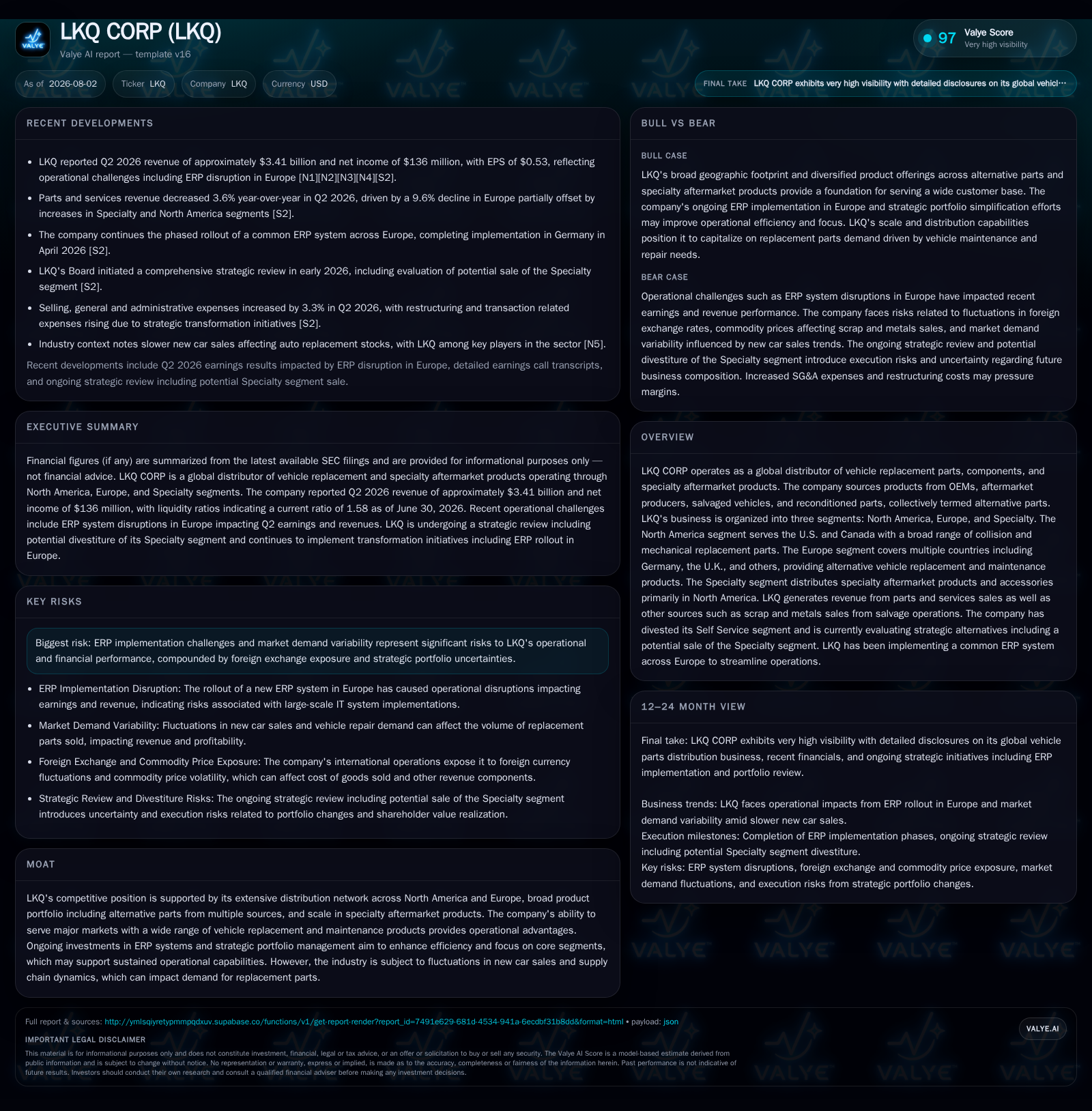
LKQ Corporation's latest quarterly filing reveals that the company continues to navigate operational disruptions stemming from its phased European ERP rollout, notably impacting its Europe segment’s near-term performance. Despite this, the Specialty segment delivered solid organic revenue growth supported by marine and recreational vehicle product lines, while North America showed modest improvement. LKQ’s broad distribution network and diversified alternative parts sourcing underpin its market position, but ERP execution risks and foreign exchange volatility remain key watchpoints. Liquidity remains adequate with close to $2 billion available, though leverage increased slightly as debt repayments were temporarily replaced with revolver borrowings.
Recent Operating Update: ERP Challenges Temper Europe's Performance
LKQ Corporation’s Q2 2026 Form 10-Q [S2] details a continued phased rollout of a common Enterprise Resource Planning (ERP) system across its European operations, with Germany's implementation finalized in April 2026. This transition disrupted supply chain efficiency and revenue recognition timing in the Europe segment, contributing to a shortfall against expectations cited in earnings calls [N1][N3]. The complexity of migrating legacy systems while maintaining service levels has manifested in higher selling, general & administrative (SG&A) expenses within the affected regions.
Business Model: Diversified Alternative Parts Distribution Across Geographies
LKQ operates principally as a distributor of vehicle replacement parts sourced from four defined categories: OEM new products; aftermarket new products not manufactured by OEMs; salvaged parts extracted from total loss vehicles; and refurbished or remanufactured components [S1]. Collectively, the latter three comprise the company's "alternative parts" offering—a category constituting the core value proposition due to lower costs relative to OEM counterparts
Revenue is generated primarily through wholesale distribution channels serving repair shops, dealerships, fleets, and specialty retailers. The North America segment services a broad market spanning collision parts (e.g., bumpers, fenders), mechanical replacement components (e.g., alternators, brakes), major mechanical assemblies like engines and transmissions, alongside paint products crucial for body shop operations [S2]. The Europe segment covers multiple countries with similar product profiles but faces greater variability driven by regional regulatory frameworks governing salvage part reuse and fleet composition.
The Specialty segment targets aftermarket vehicle products such as accessories intended to improve functionality or appearance outside traditional replacement needs—a sector witnessing growth due to consumer preference shifts toward personalization and recreational vehicle usage.
Industry Structure and Competitive Position
The automotive parts distribution industry comprises various players spanning OEM manufacturers supplying new parts directly, aftermarket producers crafting non-OEM new components, salvage operators reclaiming usable parts from total losses, and distributors managing complex inventories geographically aligned with end customers. LKQ positions itself as one of the leading global entities capable of integrated offerings across these segments through expansive distribution networks in North America and Europe.
Peers such as AutoZone focus heavily on retail-driven aftermarket parts sales predominantly in North America; Genuine Parts Company delivers broader industrial product diversification; while European distributors face heightened regulatory complexity influencing alternative part acceptance rates. LKQ’s scale enables leveraging synergies across sourcing channels, yet it must continuously manage pricing pressures amid OEM competition and volatile commodity costs affecting salvaged material inputs.
The ongoing ERP system rollout represents a typical structural challenge for large distributors striving for process standardization but risks short-term efficiency erosion affecting margins and customer fulfillment metrics.
Growth Drivers Amid Market Uncertainties
Several factors underpin LKQ’s growth outlook despite recent execution setbacks:
- Increasing Vehicle Parc Age: An aging global vehicle fleet expands demand for replacement parts versus new car sales which can depress OEM part penetration.
- Specialty Aftermarket Expansion: Rising consumer spending on vehicle personalization supports Specialty segment revenue gains.
- Geographic Footprint: Cross-border presence offers diversification benefits as regional economic cycles may differ.
- Acquisitions & Integration: Historically focused tuck-in acquisitions enhance product breadth albeit integration execution remains critical.
- Alternative Parts Adoption: Cost-sensitive repair shops increasingly opt for salvaged or remanufactured components boosting volumes.
Organic revenue growth measures indicate successful customer retention combined with new account additions across segments despite macroeconomic headwinds [S2][S9]. Moreover, investment in logistics infrastructure aims to improve order fulfillment time—a competitive advantage in this sector where downtime for repair shops directly correlates to customer satisfaction.
Risks and Watchpoints: Execution Complexity & Financial Sensitivities
LKQ faces several notable risks:
- ERP Implementation Disruptions: The Germany rollout demonstrated tangible impacts on operational efficiency which if prolonged or replicated elsewhere could depress margins further [S2].
- Foreign Exchange Exposure: Multinational activities introduce FX volatility risk particularly across the Eurozone operations affecting reported financials.
- Supply Chain Volatility: Salvage materials pricing fluctuations tied to commodity markets impact cost of goods sold variability.
- Competitive Pricing Pressure: OEMs’ proprietary advances or direct-to-customer strategies could erode alternative part market share.
- Regulatory Environment: Changes affecting salvage part acceptance or environmental regulations around recycling can alter available inventory or operational cost structure.
Close monitoring of Segment EBITDA margins—particularly within Europe—and SG&A expense controls will signal LKQ’s ability to contain transformation costs while preserving profitability.
What to Watch Next
Near-term developments important for assessing LKQ include:
- Progress updates on European ERP implementations beyond Germany—potentially France or Benelux—and associated impact on operational KPIs such as warehouse throughput or delivery lead times.
- Stabilization or improvement trajectories in Specialty segment volumes indicating sustainable growth beyond cyclical shifts.
- Foreign exchange hedging effectiveness given ongoing multinational deliveries.
- Debt maturity management outcomes including any announcements regarding refinancing structures or covenant compliance beyond reported current ratios (~1.58) [F1][S2].
- Management commentary during upcoming earnings conference calls spotlighting supply chain resilience strategies amid global disruptions.
- Acquisition activities focusing on tuck-in targets enabling product portfolio expansion rather than large-scale transformational deals.
Financial Profile Discussion
Liquidity remains robust with $301 million cash on hand at June 30, 2026 plus $1.63 billion undrawn capacity under revolving credit facilities totaling roughly $1.93 billion available funding [S2][F1]. The decrease from December 31, 2025 liquidity primarily reflects incrementally drawn revolver borrowings replacing term loan principal repayments prepaid mid-2026 [S2]. The current ratio stood near 1.58 at June 30, 2026, supported by current assets of $5.35 billion and current liabilities of $3.39 billion [F1].
The balance sheet profile suggests prudent capitalization supporting ongoing acquisition strategy focused on highly synergistic smaller-scale deals aimed at incremental revenue growth rather than transformative expansions. It integrates industry knowledge on aftermarket sourcing models and operational KPIs germane to platform transformations characteristic of large distributors expanding automation capabilities while addressing diverse geographic regulatory landscapes. Readers should consider risks highlighted herein alongside observable execution milestones when forming perspectives on LKQ’s trajectory going forward.
Disclaimer: This is research-only, informational analysis and not investment advice. It may include AI-generated interpretation and general industry context. Always verify important details using primary sources.

Comments