
KBR Strengthens Capability Integrator Role Amid Defense Budget Volatility and Energy Transition Growth
KBR's latest quarterly results highlight operational resilience supported by acquisitive growth in defense technology and a strategic pivot toward sustainability solutions.
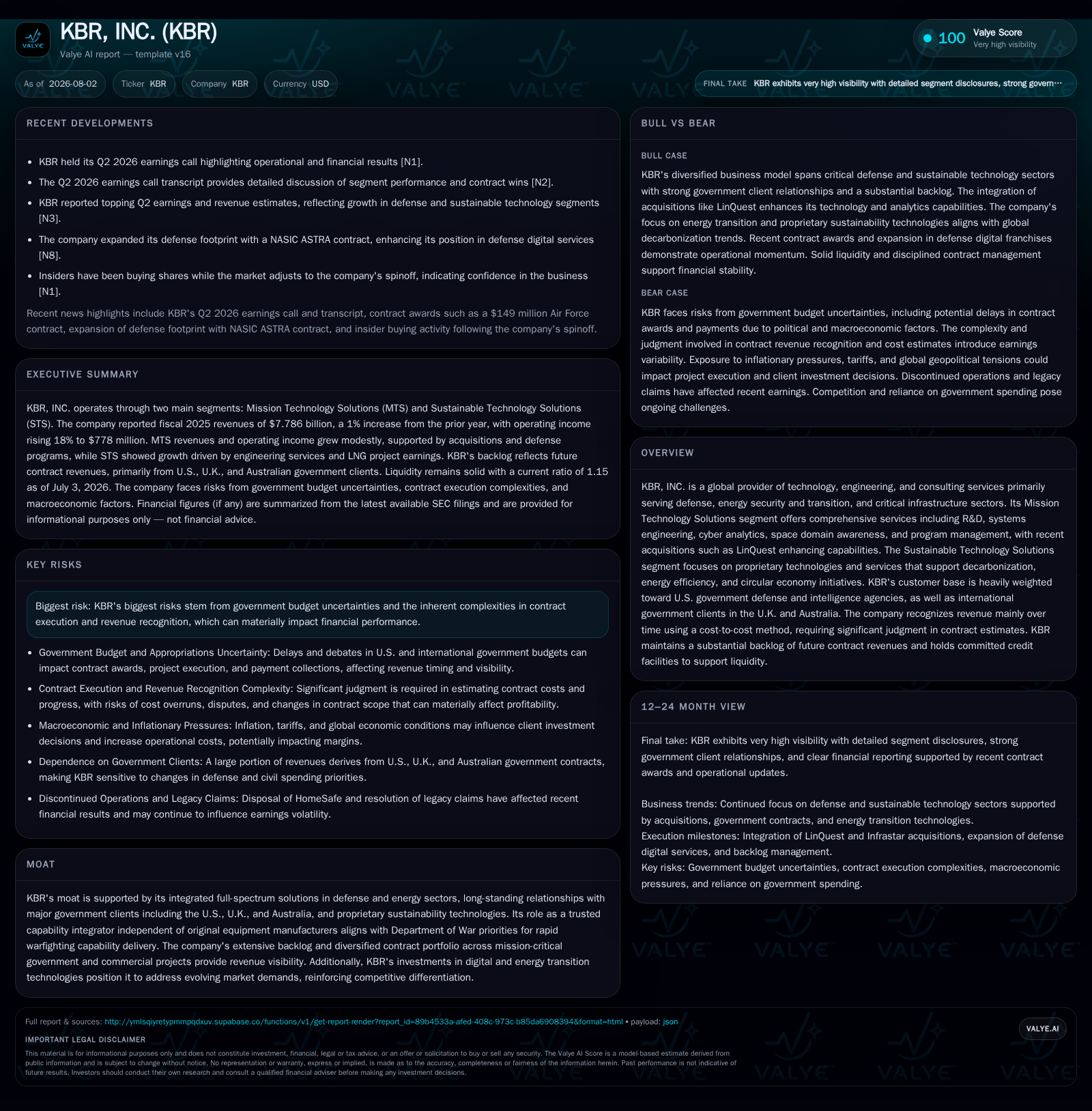
In Q2 2026, KBR reported solid operating income gains despite government contracting headwinds related to prior fiscal year shutdown delays. The company’s Mission Technology Solutions segment benefits from enhanced capabilities following the LinQuest acquisition, fueling defense and intelligence program revenue growth. Meanwhile, Sustainable Technology Solutions advances proprietary decarbonization technologies, reflecting KBR’s dual focus within aerospace and defense services. Success depends on navigating government budget timing, complex contract cost estimates under cost-to-cost revenue recognition, and scaling sustainability offerings in energy transition markets.
Recent Operating Update
Business Model Detail
KBR operates predominantly as a technology integrator and engineering services company serving primarily government defense agencies across the U.S., U.K., and Australia. The business is structured into two core segments:
Mission Technology Solutions (MTS): Provides comprehensive lifecycle support including systems engineering, R&D, acquisition support, cyber analytics, space domain awareness, C5ISR integration, and program management for defense and intelligence clients. The acquisition of LinQuest in August 2024 enhances these offerings with advanced data analytics and digital systems integration capabilities [S4], [S9]. Revenue in this segment is highly weighted towards U.S. government defense contracts but also includes international government projects tied to NATO partners.
Sustainable Technology Solutions (STS): Focuses on proprietary process technologies addressing industrial decarbonization across ammonia/syngas production, chemical refining, circular economy processes, and clean refining [S4]. This segment couples high-end engineering with advisory consulting on energy security and emission reduction strategies to support commercial clients targeting ESG goals
Revenue recognition predominantly uses the cost-to-cost method under ASC 606 due to the nature of long-term multi-phase contracts that transfer control continuously over time [S1]. This requires management judgment around contract costs estimates including materials prices, labor productivity variances, change orders, claims exposure, and contract disputes. Such estimates are reviewed regularly through project-level disciplined assessments; however significant revisions have material impacts due to catch-up adjustments affecting both revenue and profitability recognition within single reporting periods.
KBR’s monetization derives largely from long-term contracts with milestone deliverables or time-based service provisions which generate recurring but variable cash flows dependent on execution progress. These contracts often incorporate fixed-price components exposing margins to estimation risk. The firm also participates through joint ventures for certain projects, enhancing capability but adding partnership execution risk.
Industry Structure and Competitive Positioning
The aerospace, defense, and engineering services industry features firms that operate as integrators bridging OEMs’ hardware platforms with government operators’ evolving warfighting needs. KBR distinguishes itself as an independent capability integrator rather than an equipment manufacturer—an alignment reinforced by recent U.S. Department of War Acquisition Transformation Strategy emphasizing speed through flexible trade-off authority among speed/cost/performance triads for rapid operational capability delivery [S1].
Peers include larger government defense contractors such as Lockheed Martin or Raytheon Technologies focused more on manufacturing alongside technology integration; Leidos Holdings or Booz Allen Hamilton represent competitors with overlapping digital integration or consulting expertise respectively; Jacobs Engineering Group plays more in infrastructure modernization largely at commercial scale. KBR’s niche is providing integrated technology-enablement services especially tailored for defense customers requiring adaptable warfighting support systems combined with emerging energy transition solutions.
Geopolitically driven spending commitments by NATO members like the U.K.’s Strategic Defence Review increase potential demand internationally while Australian defense investment continues to grow. However, the bulk of revenues remain U.S.-centric with approximately 57% derived from U.S. government agencies including DoD intelligence entities [S9].
Growth Drivers
Government Defense Spending Increases: Despite recent appropriations delays during the late 2025 U.S. government shutdown impacting contract awards timing and cash collections temporarily [S1], KBR benefits from sizable annual baseline spending: FY26 discretionary DoD funding stands at $839 billion* with prospects for increases towards $1.5 trillion reflected in Administration advocacy for FY27 defense budgets [S1]. Acceleration of space and cyber defense initiatives further expands addressable market segments.
Acquisition Strategy: LinQuest expanded MTS’s digital engineering footprint substantially post-2024 acquisition offering differentiated data analytics synergies within high-value programs [S4]. Ongoing capability augmentations through targeted acquisitions remain a pillar of growth.
Energy Transition Demand: STS leverages over 85 proprietary sustainability technologies targeting emissions reduction and circular economy implementations within industrial process sectors experiencing regulatory pressure and ESG adoption trends globally. Advisory consulting cross-sells premium engineering services spurring margin expansion opportunities via lifecycle optimization engagements.
Geographic Diversification: International government contracts from the U.K., Australia account for close to a fifth of revenues diversifying dependency beyond U.S. federal budgets [S9]. Expansion aligned with NATO GDP-based spending targets towards 5% by 2035 should sustain longer horizon demand.
Policy & Procurement Reforms: The Department of War’s Acquisition Transformation Strategy prioritizes agility favoring trusted vendors like KBR able to integrate capabilities independently from OEMs creating competitive advantage over hardware-centric providers [S1].
Risks and Growth Constraints
Government Budget Uncertainty: Ongoing debates around federal budget size amid macroeconomic pressures introduce volatility in contract flow timing impacting order intake rates critical to backlog replenishment.
Contract Cost Estimation Complexity: Use of the cost-to-cost revenue recognition method subjects reported profitability heavily to forecast revisions that can lead to catch-up adjustments compressing margins unexpectedly; fixed-price contracts amplify this risk profile [S1]
Joint Venture Execution Risks: Collaboration through partnerships introduces dependency risks related to partner financial health or performance issues impacting overall program delivery.
Regulatory Compliance & Audits: Extensive audits by government agencies such as DCAA increase compliance costs; potential disallowances or disputes could result in penalties or contract suspensions affecting cash flows [S18]
Technology Obsolescence: Rapid evolution in cyber security or space domain awareness technologies requires continuous investment; failure to innovate may erode competitive positioning.
International Geopolitical Instability: Rising global tensions could disrupt international contract execution timelines or client funding priorities.
What To Watch Next
- Progression of contract awards post-U.S. government shut-down impact period will be key demand markers along with booking rates in MTS segment.
- Accuracy trends in contract cost forecasts assessed via quarterly operating margins highlighting estimation quality improvements or shortfalls.
- Integration signals from acquisitions such as recent shifts within STS units moving from MTS reporting boundaries planned for fiscal 2026 reporting cycles.
- Adoption velocity of proprietary sustainability technologies within industrial clients especially LNG-related equity earnings contributions signaling STS margin scalability.
- Impact of evolving geopolitical environments on revenue bursts from U.K./Australia governments aligned with NATO expenditure targets.
- Capital allocation decisions indicated via share repurchase activity versus debt repayment relating to liquidity utilization patterns.
Financial Profile Discussion
As of July 3, 2026, KBR maintained $312 million in cash and equivalents against total debt approximating $2.55 billion resulting in net debt near $2.24 billion with a modest current ratio around 1.15 indicating manageable near-term liquidity coverage given its working capital base [F1]. Interest expenses rose marginally reflective of higher average debt balances employed mainly for acquisitions like LinQuest [S16], [S6]. Management actions during fiscal 2025 included meaningful share repurchases ($323 million spent) underscoring confidence in cash generation capacity though leverage metrics remain elevated relative to other peers focused purely on service contracting rather than aerospace manufacturing operators [S10], [F1].
Contract backlog remains a critical financial anchor providing revenue visibility though subject to fluctuations due to customer phase releases inherent in multi-year complex contracts common in aerospace/defense sector value chains [S11]. Close monitoring of backlog quality alongside order intake rate will serve as essential confirming KPIs for organic growth prospects amid external funding uncertainties.
This analysis incorporates information available as of early August 2026 including SEC filings through July 30, 2026, supplemented by contemporaneous news reports without prescriptive investment research views or forward-looking projections beyond documented evidentiary support.
Disclaimer: This is research-only, informational analysis and not investment advice. It may include AI-generated interpretation and general industry context. Always verify important details using primary sources.

Comments