
ArcBest Consolidates Brands and Restructures Operations to Strengthen Integrated Logistics Platform
ArcBest's Q2 2026 update highlights strategic cost realignment alongside revenue growth driven by pricing gains amid operational challenges.
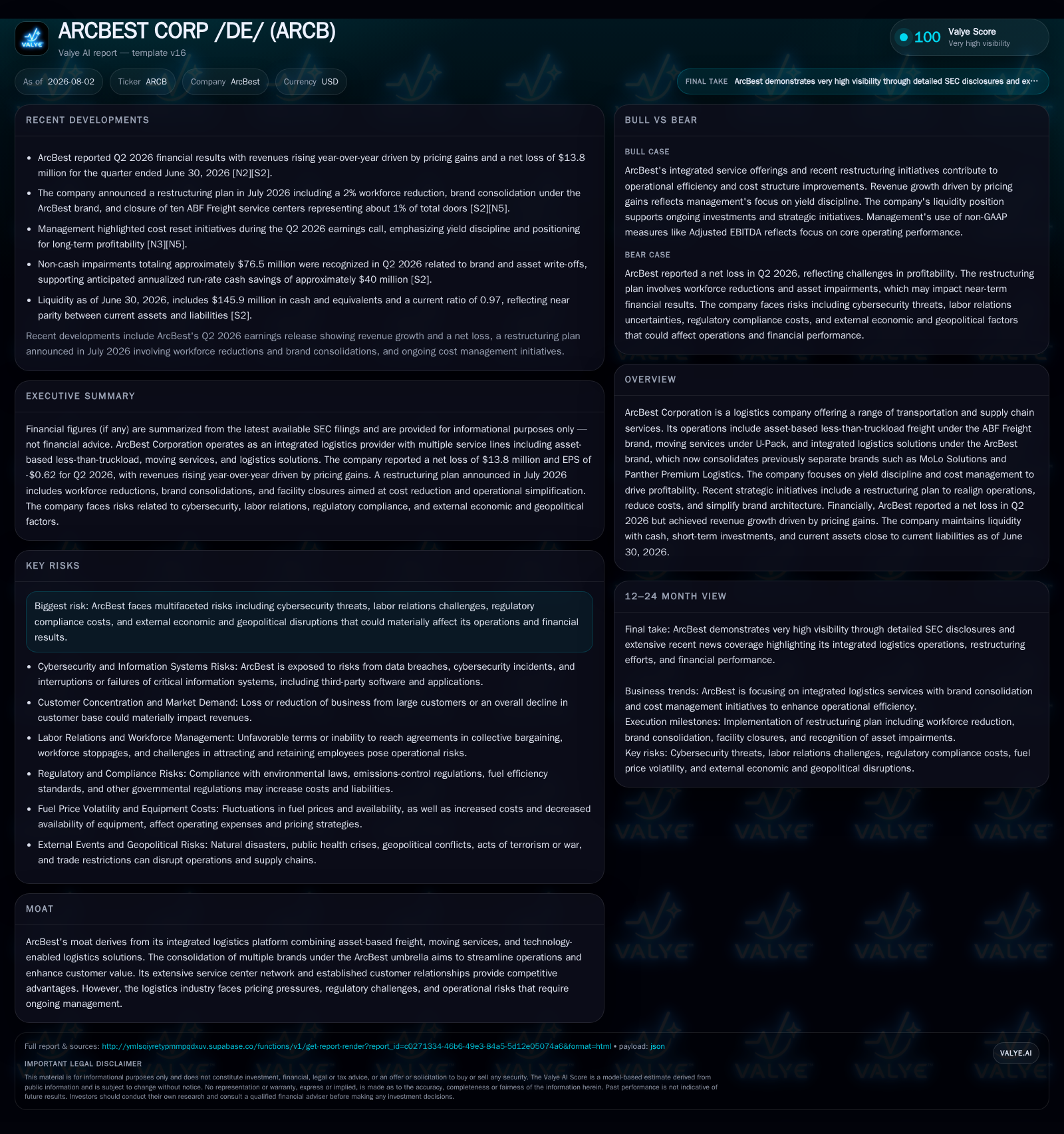
ArcBest reported second-quarter 2026 results showing revenue growth primarily from pricing discipline, offset by a net loss reflecting ongoing restructuring charges. The company is executing a multi-pronged operational restructuring plan to reduce costs, streamline its brand portfolio, and consolidate service centers. Positioned as an integrated logistics provider blending asset-based freight and technology-enabled services, ArcBest faces industry pressures including labor dynamics and regulatory complexity but leverages its diverse service offerings and network scale. The near-term focus on yield management, simplification, and cost control aims to restore profitability while maintaining service capacity amid a challenging macro environment.
Recent Operating Update
Concretely, the July 16 restructuring Plan aims to reshape ArcBest’s cost structure through targeted workforce reductions approximating 2% of total positions across geographies and functions. Complementary actions include consolidation of brand architecture — retiring MoLo Solutions and Panther Premium Logistics brands into the ArcBest umbrella — which reflects a shift toward broader integration of formerly siloed trucking brokerage and expedited ground services. Notably, ABF Freight continues independently as the company’s flagship asset-based less-than-truckload (LTL) carrier brand alongside U-Pack in moving services. Additionally, ten smaller ABF Freight service centers are scheduled for closure representing roughly 1% of its network doors; this rationalization effort balances efficiency gains without materially curtailing overall capacity given an 8% net increase in doors compared to 2021 levels [S23][N3]
Business Model Overview
ArcBest operates primarily as an integrated logistics service provider with multiple business lines spanning asset-based freight movement, third-party logistics (3PL), freight brokerage, and technology-enabled supply chain solutions. Its largest segment is the asset-based less-than-truckload (LTL) operation conducted under ABF Freight which owns trucks and terminals delivering regional to national freight shipments that do not require full truckloads.
Revenue streams comprise base freight charges weighted by volume (revenue per hundredweight), with additive yields from fuel surcharges and specialized handling fees. Moving services via U-Pack monetize customer moves through rental trailers or containers enabling do-it-yourself relocations. Brokerage arms historically under MoLo Solutions facilitate truckload transactions by matching shippers with carrier capacity without owning assets directly.
This mix enables ArcBest to capture a broader share of shipper spend combining physical freight movement with value-added services such as integrated supply chain management technology offered under the revitalized ArcBest brand. This platform orientation seeks differentiation versus pure LTL carriers like Saia Inc. or Old Dominion Freight Line by layering data analytics-driven routing optimization over traditional transportation capacity.
Profitability is influenced significantly by operating ratio (operating expenses relative to operating revenue), load factor (capacity utilization), length-of-haul profiles, and revenue per shipment unit. Yield management encompasses negotiating freight rate increases responsive to inflationary cost pressures (fuel, wages) balanced against volume impacts from shipper demand shifts.
Industry Structure and Competitive Position
The North American logistics sector where ArcBest operates is marked by capital-intensive asset-based carriers alongside asset-light brokers and integrators. The LTL subsector requires dense service center networks for linehaul consolidation combined with strong driver availability given the specialized handling required versus truckload carriers who often compete on long-haul efficiency.
ArcBest’s blend of asset-heavy operations via ABF Freight with an expanding tech-enabled brokerage offering aligns it alongside peers such as J.B. Hunt Transport Services who have invested heavily in intermodal integration and digital freight matching platforms. Meanwhile, standalone LTL peers like Saia or Old Dominion emphasize scale density and premium service reliability as defensive moats.
A critical competitive advantage for ArcBest lies in its ability to offer omnichannel transportation solutions encompassing full truckload brokerage (formerly MoLo) folded into a single brand alongside premium expedite ground services previously provided by Panther Premium Logistics. This rebranding intends to streamline customer engagement while reducing overhead complexity. However, sustaining differentiated pricing power depends on consistently executing reliable delivery performance amid persistent industry-wide driver shortages that impact capacity utilization metrics across all carriers [S1][S15]
Growth Drivers
Pricing improvements enabled by strict yield management are central near-term growth levers evident in Q2 results where higher revenues were primarily price-driven rather than volume expansion. The growing demand for integrated supply chain visibility tools supports ArcBest Technologies’ solutions assimilation into customers’ logistics workflows.
Shifts toward outsourced logistics provider relationships benefit firms like ArcBest tapping into rising demand for end-to-end fulfillment capabilities including warehousing plus multi-modal distribution enhancement. Moreover, e-commerce penetration continues contributing incremental parcel-like volumes often cross-leveraged through less-than-truckload route structures.
Infrastructure investments at both federal and commercial levels improve domestic transportation efficiency indirectly supporting capacity optimization efforts which translate into better load factors when matched effectively with fleet utilization strategies.
Operational synergies from brand consolidation could also unlock incremental cost savings enhancing adjusted EBITDA margins once restructuring effects normalize beyond transitional charges.
Risks and Watchpoints
Labor market tightness poses a significant risk highlighted by collective bargaining complexities within ABF Freight’s unionized workforce governed under the National Master Freight Agreement. Any negotiation standoff or work stoppage could severely impair operational throughput given the reliance on experienced drivers familiar with LTL-specific unloading/reloading routines.
Additionally, exposure to fuel price volatility presents earnings pressure despite fuel surcharges designed as pass-through mechanisms; these surcharges may lag sudden market spikes affecting cash conversion cycles temporarily.
Cybersecurity vulnerabilities remain pertinent given dependence on software platforms for routing optimization and shipment tracking; any disruption could impact customer satisfaction metrics critical in retention-focused selling motions.
On the regulatory front, compliance costs related to safety standards emissions regulations can escalate fixed operating expenses further compressing operating ratios unless offset via technology investments improving equipment efficiency.
Economic cyclicality drives freight volume swings underpinning tonnage moved—a fundamental top-line growth component—making diversification across industries a partial hedge against sector-specific slowdowns.
What to Watch Next
Key milestones include monitoring execution progress against the July restructuring Plan during upcoming quarters—particularly confirmation of realized annualized run-rate savings offsetting incurred charges detailed mid-year [S23]. Evidence of sustained margin expansion driven by pricing power rather than solely cost cutting would signal healing profitability trends.
Operational KPIs such as fleet utilization rates post-consolidation closures will offer insight into network efficiency improvements without sacrificing service coverage or on-time delivery performance.
Further updates regarding labor negotiations under the NMFA agreement will provide clarity on potential disruption risks.
Surveillance of liquidity position remains prudent although current cash balances near $146 million alongside manageable net debt provides cushion against operational setbacks or opportunistic investments [F1]
Financial Profile Discussion
As of June 30, 2026, ArcBest held cash & equivalents of approximately $146 million against current liabilities totaling about $730 million resulting in a current ratio slightly below parity at 0.97—indicative of tight working capital equilibrium but adequate liquidity considering the business model's short cash conversion cycle primarily driven by prompt billing in freight operations [F1]. Total debt was recorded at roughly $186 million as of March 31, 2023, with net debt around $40 million after adjusting for cash balances; this modest leverage level aligns with moderate capital expenditure requirements largely associated with vehicle fleets rather than heavy fixed facility investments [F1].
The Q2 net loss outcome contrasts with full-year prior periods' profitability highlighting temporary disruption from restructuring-related expenses combined with normalizing cost pressures despite top-line gains [S2]. Adjusted EBITDA measures excluding extraordinary items provide a clearer view of operating trends emphasizing continuous efforts on cost control balanced against sustaining essential capacity amid volatile input prices.
In summary, financial flexibility appears sufficient to support ongoing integration activities while balancing shareholder returns evidenced by maintained quarterly dividends declared mid-2026 [S20][S29]
Disclaimer: This analysis is based solely on publicly available information as of July–August 2026 including SEC filings and news reports. It does not constitute investment advice or reflect non-public material information.
Disclaimer: This is research-only, informational analysis and not investment advice. It may include AI-generated interpretation and general industry context. Always verify important details using primary sources.

Comments