
Stoke Therapeutics Advances Zorevunersen Phase 3 Enrollment with Strong Financial Position
Completion of Phase 3 enrollment for Stoke's lead RNA therapy in Dravet Syndrome marks a key milestone, supported by robust liquidity and ongoing regulatory dialogue.
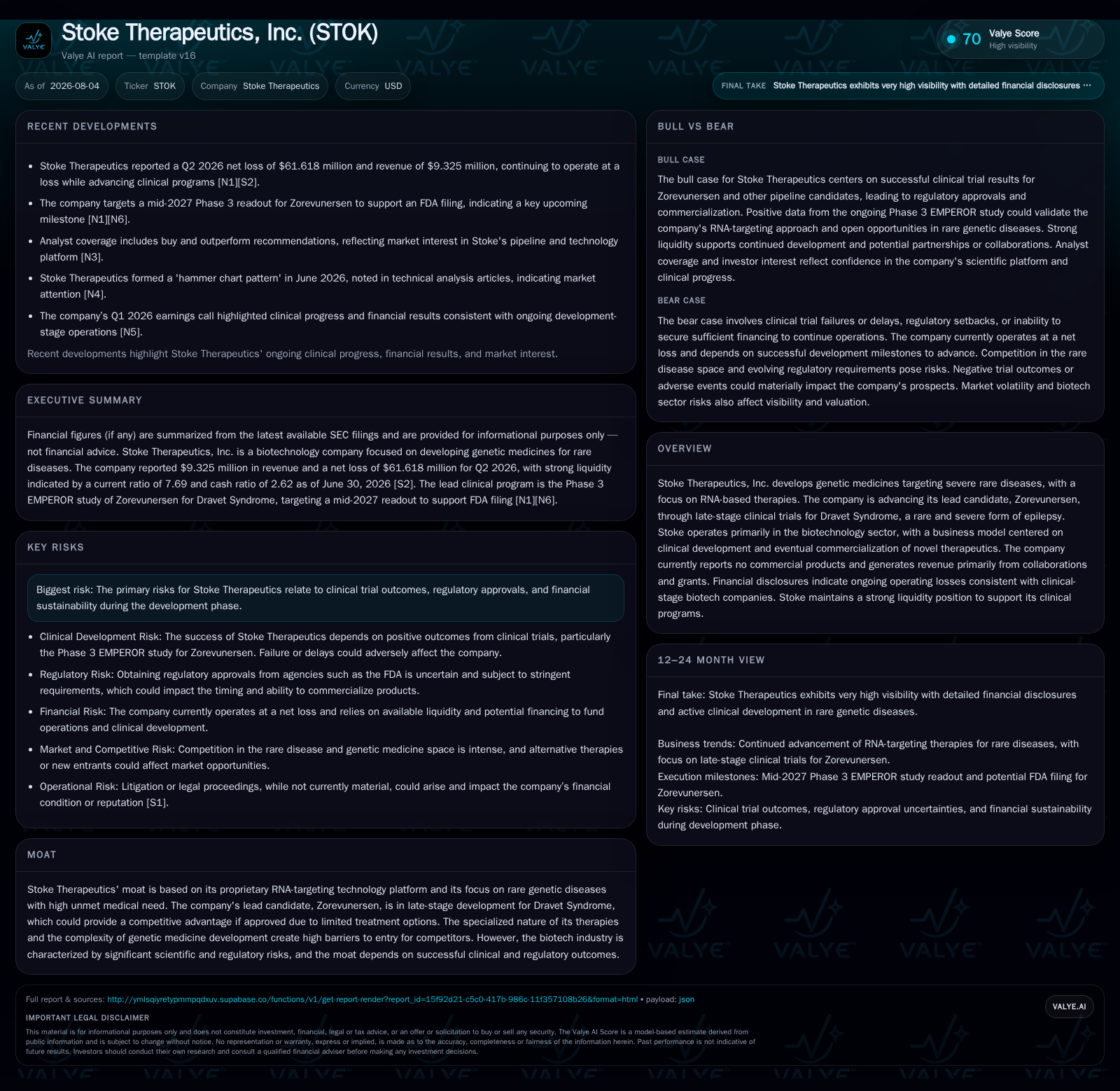
Stoke Therapeutics reported the completion of patient enrollment in its Phase 3 EMPEROR study for zorevunersen, targeting Dravet Syndrome, with data readout expected in Q3 2027 [S2][S27]. The company is engaging the FDA on potential expedited review pathways while preparing a rolling NDA submission beginning in early 2027 [S12][S27]. Stoke currently holds approximately $110 million in cash with a strong current ratio of 7.69, reflecting solid financial resources to fund operations through anticipated data milestones [F1]. As a clinical-stage biotech focused on rare genetic diseases, Stoke's operating model depends heavily on successful late-stage clinical outcomes and collaborations to sustain long development cycles [S1]. Ongoing risks include trial execution, regulatory approval uncertainties, and capital needs amid development expenses.
Recent Operating Update
Stoke Therapeutics reached an important developmental milestone by completing enrollment of 162 patients in the Phase 3 EMPEROR study evaluating zorevunersen for Dravet Syndrome, a rare and severe genetic epilepsy disorder. This surpasses the initial enrollment target of 150 patients outlined earlier in January 2026, indicating steady patient recruitment across key geographies including the U.S., U.K., and Japan [S27]. Approximately one-third of enrolled patients have progressed through the critical 28-week treatment period—aligned with the primary endpoint assessment measuring change in major motor seizure frequency.
The company plans to initiate a rolling New Drug Application (NDA) submission to the U.S. Food and Drug Administration (FDA) during the first quarter of 2027 with an expected completion in the latter half of that year. This near-term regulatory activity aligns with their timeline to potentially bring the first RNA-based modulator therapy for Dravet Syndrome to market [S12][S27]. Notably, Stoke continues to engage with the FDA on options to expedite this process through discussions centered around leveraging existing clinical data and regulatory pathways for rare diseases. Although no immediate changes were made to study design or regulatory strategy at recent meetings, the ongoing dialogue reflects Stoke's proactive effort to minimize time-to-market post-clinical readout [S12].
Business Model
Stoke Therapeutics operates as a pure-play clinical-stage biotechnology firm pioneering RNA upregulation therapies designed for rare genetic diseases where conventional treatment options are limited or nonexistent. The company's scientific focus centers on increasing the expression of naturally occurring genes disrupted by mutations using antisense oligonucleotides—a modality distinct from RNA interference or gene replacement therapies employed by some peers. This technical differentiation underpins their lead program zorevunersen.
Currently, Stoke does not generate revenue from commercial sales but relies principally on collaboration agreements and grant funding common among pre-commercial biotechs conducting expensive late-stage trials. As shown by their latest annual filings, operating losses are driven primarily by research and development expenditures required to progress drug candidates through clinical phases. Revenue recognized relates largely to milestone payments from partners such as Biogen and Acadia Pharmaceuticals, which also supply strategic validation and potential commercialization support once approved [S1][F1]. This business funding structure is typical among rare-disease biotech developers who must balance costly clinical investment against extended timelines before product launch.
Industry Structure and Competitive Position
Within the biotechnology value chain, Stoke occupies an upstream discovery and clinical development role focused on rare genetic neurological conditions—a niche characterized by small but highly specialized patient populations. Unlike broad-spectrum pharmaceuticals, success hinges heavily on generating compelling efficacy/safety data that justify regulatory approval under orphan drug pathways with potential accelerated reviews.
Peers in RNA therapeutics such as Ionis Pharmaceuticals or Alnylam Pharmaceuticals work on related modalities but often target different diseases or employ RNA interference versus upregulation strategies. Larger pharma incumbents like Biogen provide collaboration channels that can amplify distribution reach post-approval.
The complex biology underpinning Dravet Syndrome and challenges around selective CNS delivery contribute substantial barriers to entry; hence Stoke’s proprietary antisense technology gives it a differentiated technological moat when combined with focused pipeline assets. Nonetheless, susceptibility remains for competitive threats given advancing RNA platforms elsewhere and evolving regulatory standards around gene therapies.
Growth Drivers
Principal growth catalysts are tied directly to successful clinical execution culminating in regulatory approvals. Completion of patient enrollment validates ongoing trial momentum while mid-2027 data readout will serve as a crucial binary event determining future commercial viability.
Regulatory engagement aimed at expedited review pathways could materially shorten time-to-market relative to standard FDA procedures—a significant value inflection if realized given the urgency for effective Dravet treatments.
Pipeline expansion into additional rare genetic diseases leveraging their RNA-targeting platform could generate multiple shots on goal beyond zorevunersen. Moreover, sustained collaborations offering milestone-based funding enhance financial flexibility amid capital-intensive R&D.
A rising awareness and diagnosis rate of rare neurological disorders also incrementally expands the addressable population over time—augmenting longer-term commercial potential.
Risks and Constraints
Stoke’s future prospects remain tightly linked to several high-impact risk factors inherent to clinical-stage biotechnology:
- Clinical trial results might fail to demonstrate statistically significant benefit or meet safety thresholds during pivotal studies.
- Regulatory bodies can impose delayed review timelines or request additional data that protract approval horizons.
- Continuous high R&D costs necessitate external financing which dilutes shareholder value or constrains operational flexibility if capital markets tighten.
- Manufacturing complexities related to oligonucleotide scale-up may pose logistical bottlenecks as commercialization approaches.
- Intellectual property challenges could arise given competitive RNA technology innovation landscape.
- Market adoption post-launch might encounter reimbursement hurdles given gene therapies’ historically high price points amid payer scrutiny.
Monitoring these risk dimensions via clinical event updates, FDA feedback disclosures, financing activities, and intellectual property filings is critical for assessing Stoke’s progress trajectory.
What To Watch Next
Key upcoming milestones include:
- Q3 2027: Primary endpoint data readout from EMPEROR Phase 3 trial—a definitive efficacy/safety inflection point [S27]
- First half of 2027: Progression through rolling NDA submission stages—monitor FDA feedback signaling acceptance timelines [S12]
- Ongoing FDA interactions concerning potential expedited regulatory pathways—any shifts here may accelerate or complicate approval prospects [S12]
- Updates on partnership collaborations especially milestone payments affecting cash inflows and liquidity runway
- Any new clinical programs advancing into registration-enabling studies indicating platform expansion
- Quarterly financial disclosures illustrating burn rate trends relative to cash availability
Financial Profile Discussion
As of June 30, 2026, Stoke held $110 million in cash and equivalents complemented by current assets totaling approximately $323 million against current liabilities near $42 million—yielding a robust current ratio of approximately 7.69 which signals ample immediate liquidity coverage [F1]
Revenues stem predominantly from collaboration agreements rather than product sales consistent with its clinical-stage profile; reported annual top-line revenue was $184 million as of year-end 2025 [F1]. Operating losses remain present due to heavy investment in R&D activities including clinical trial execution costs—operating income registered negative $20.6 million while net income reflected a loss of about $6.9 million for the same period
This financial disposition is typical within rare disease biotechs approaching pivotal readouts where capital deployment peaks prior to commercial launch financing ramp-ups or royalty streams following drug approval [S3][S29]. Ongoing equity offerings via controlled sales agreements with agents like Cantor Fitzgerald provide flexible funding mechanisms to further extend runway if needed without fixed debt burdens
Overall liquidity appears sufficient at present to support operational objectives into late-stage milestones barring unanticipated setbacks or rapid scaling demands.
This analysis synthesizes recent SEC filings alongside industry context without providing investment advice or speculative forecasts. It reflects company-specific information validated against official disclosures as of August 2026.
Disclaimer: This is research-only, informational analysis and not investment advice. It may include AI-generated interpretation and general industry context. Always verify important details using primary sources.

Comments