
Koppers Strengthens Specialty Chemical Leadership Despite Seasonal and Pricing Pressures
Q2 2026 results reflect volume-driven growth in chemicals and poles offset by pricing headwinds and divestitures in railroad products.
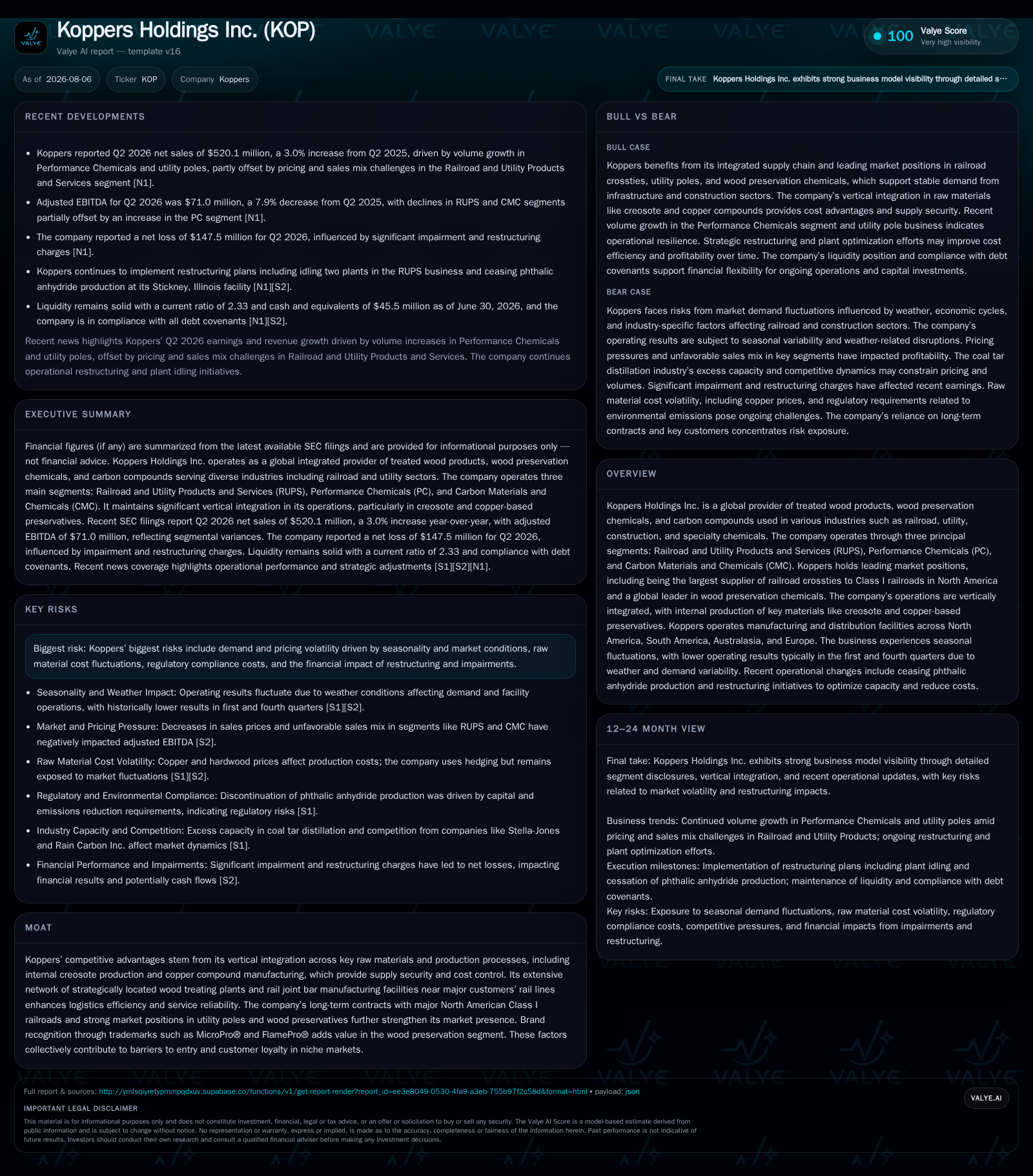
In the second quarter of 2026, Koppers Holdings Inc. returned to modest revenue growth driven by improved volumes in its Performance Chemicals segment and utility poles within its Railroad and Utility Products and Services division. However, the company faced persistent pricing pressure and an unfavorable sales mix in treated wood products, exacerbated by the mid-2025 sale of its railroad bridge services business. Its vertically integrated model continues to provide supply security for creosote and copper-based preservatives, though seasonal fluctuations and regulatory obligations remain key challenges. Koppers’ broad geographic footprint and niche market leadership underpin resilience amid industry cyclicality and raw material cost variability.
Recent Operating Update: Q2 2026 Performance Highlights
for an $11.9 million sales reduction relative to the prior year period [S2]. Carbon Materials and Chemicals (CMC) revenues edged up modestly by 2.3%, driven by volumes for carbon black feedstock despite ongoing challenges following phthalic anhydride production cessation in mid-2025 [S2],[S1].
This quarterly rebound occurs against a backdrop of pronounced seasonality that has traditionally depressed results in Q1 and Q4 due to weather-related operational constraints and demand softness, especially impacting wood treatment schedules linked to outdoor infrastructure projects [S2],[S1]. Q2 typically marks a recovery phase as customers ramp maintenance activities in more favorable conditions.
Business Model Overview: Integrated Specialty Chemicals and Treated Wood Products
Koppers operates through three synergistic segments: RUPS focuses on pressure-treated railroad crossties primarily sold under long-term contracts to North American Class I railroads, alongside utility poles serving electric utilities; PC develops proprietary wood preservation chemicals crucial for pressure treating lumber used in residential, industrial, and agricultural applications; CMC processes coal tar into creosote—essential for preserving treated wood—and produces specialty carbon compounds including carbon black feedstock.
The company's vertically integrated structure is pivotal: it internally produces critical raw materials such as creosote within CMC that are predominantly utilized internally by RUPS plants for wood treatment operations. Similarly, PC produces copper-based preservatives like chromated copper arsenate (CCA) and dichloro-octyl-isothiazolinone (DCOI), supplying RUPS’s treating processes across North America and Australia [S1]. This vertical integration ensures supply chain control—mitigating exposure to commodity volatility typical in coal tar derivatives while improving cost management.
Revenue mechanics revolve around selling treated wood products with customers primarily being large industrial players such as Class I railroads subject to renewal cycles governed by infrastructure maintenance budgets which can be lumpy or deferred depending on capital expenditure trends. Pricing power varies across segments: PC’s differentiated chemical formulations support stronger pricing resilience compared to commoditized treated wood products where contract renegotiations drive pricing fluctuations.
Margins benefit from scale manufacturing spread over fixed costs at strategically located treatment plants, particularly those proximate to major rail corridors reducing logistics costs—a significant factor given freight expense sensitivity in bulky wood products distribution.
Industry Structure and Competitive Position
The specialty chemicals and wood preservation industry features high entry barriers rooted in regulatory complexity, customer specification rigor, environmental compliance costs, and capital-intensive manufacturing infrastructure coupled with technical know-how.
Koppers holds leading positions as the largest supplier of railroad crossties for North American Class I railroads and a global leader in wood preservation chemicals production [S1]. This dominance arises from its blend of vertical integration ensuring raw-material security, proprietary preservative technology brands such as MicroPro® enhancing market differentiation, extensive distribution networks spanning North America, South America, Australasia, and Europe, plus longstanding contractual relationships often multi-year in nature enhancing customer retention.
Notably, the company faces competition from other integrated wood preservation manufacturers and specialty chemical suppliers focusing on biocides or alternate preservatives like chromated copper borate (CCB). Nonetheless, Koppers’ expansive footprint combined with its capability to supply treated railroad ties alongside complementary products like utility poles creates bundled value offers difficult for smaller or less integrated peers to replicate.
Environmental regulation imposes ongoing compliance burdens unique to this sector where legacy chemicals’ toxicological profiles invite scrutiny; thus firms must maintain sophisticated environmental controls adding cost but also creating another entry barrier versus new entrants lacking these capabilities.[S1]
Growth Drivers
Koppers’ growth momentum hinges on several interrelated factors:
- Infrastructure spending trends on railroads underpinning steady replacement demand for crossties amid aging networks requiring continuous maintenance-of-way activity.
- Expansion of utility pole volumes leveraged via acquisitions such as the recent western U.S. procurement business enabling broader geographic reach within utility sectors experiencing grid modernization investments.
- Advances in preservative chemistries under PC fostering new product adoption across residential construction segments sensitive to durability standards.
- Geographic diversification mitigates exposure to localized economic weakness or regulatory changes bolstering overall resilience.
- Strategic acquisitions like Brown Wood (completed earlier) add capacity specifically targeting niche end-markets augmenting existing offerings.[S1],[S2]
Risks / Watchpoints / Constraints
Despite strengths, several risks temper outlook:
- Demand volatility driven by seasonality accentuates quarterly earnings swings making short-term forecasts challenging.
- Price pressure persists especially in commoditized RUPS product lines limiting margin expansion potential.
- Raw material cost volatility—for example coal tar or copper compounds—can compress gross margins amid pass-through limitations.
- Environmental liabilities related to legacy chemical usage pose litigation risks necessitating provisions that impact earnings unpredictably.[S1]
- Operational disruptions from plant shutdowns during winter months or unexpected maintenance events can affect timely deliveries given tight customer schedules.
- Sales concentration among a handful of large industrial customers raises counterparty risk should infrastructure budgets tighten abruptly.[S1],[S2]
- Restructuring charges related to phthalic anhydride plant closure completed last year exemplify transitional cost burdens linked to portfolio rationalization.[S1]
Monitoring order backlogs particularly from key railroad contracts plus pricing trends will be critical indicators on revenue trajectory; analogous scrutiny applies to volumes shipped post seasonal troughs signaling recovery strength.
What To Watch Next
Upcoming milestones include:
- Early fiscal third-quarter operating updates revealing whether volume gains sustain beyond spring maintenance season.
- Pricing negotiations outcomes particularly within railroad tie contracts influencing H2 revenue mix.
- Environmental regulatory developments potentially driving incremental compliance expenditures or capex requirements.
- Integration progress on recent acquisitions notably if they translate into cross-selling opportunities expanding pole market share.[N1],[N4]
- Management commentary on capital expenditure pacing against stated $55 million budget guidance beyond non-acquisition growth investments highlighted last year.[S1]
Tracking adjusted EBITDA margin trends segmented by RUPS vs PC/CMC will illuminate margin pressure points versus operational leverage achievements given shifting product mix dynamics.
Financial Profile Discussion
As of June 30, 2026, Koppers maintains robust liquidity with current assets totaling approximately $680 million against current liabilities near $291 million yielding a healthy current ratio of about 2.33 indicative of solid short-term financial flexibility [F1]
At December 31, 2025, total debt stood near $936 million while net debt after subtracting cash approximates $891 million reflecting consistent leverage management aligned with covenant thresholds outlined under the credit facility agreement [F1]
Capital expenditures excluding acquisitions forecast around $55 million for 2026 are expected to be funded from cash flows generated through operations underscoring self-sustaining investment capacity without reliance on external financing [S1]
Overall financial positioning suggests sufficient liquidity buffers alongside manageable leverage enabling continued strategic investments while absorbing cyclical earnings oscillations typical for this capital-intensive specialty chemical segment.
This analysis is based exclusively on publicly available SEC filings dated through August 6, 2026 ([S1], [S2], [S3]), leading news sources ([N1], [N4]), and company facts data ([F1]). No forward-looking projections or investment research views are offered here.
Disclaimer: This is research-only, informational analysis and not investment advice. It may include AI-generated interpretation and general industry context. Always verify important details using primary sources.

Comments