
Primerica’s Network-Driven Growth Sustains Middle-Income Life Insurance Focus Amid Market Nuances
Primerica leverages its independent agent network and risk-aware model to capitalize on life insurance demand in the middle-income segment, supported by robust cybersecurity governance.
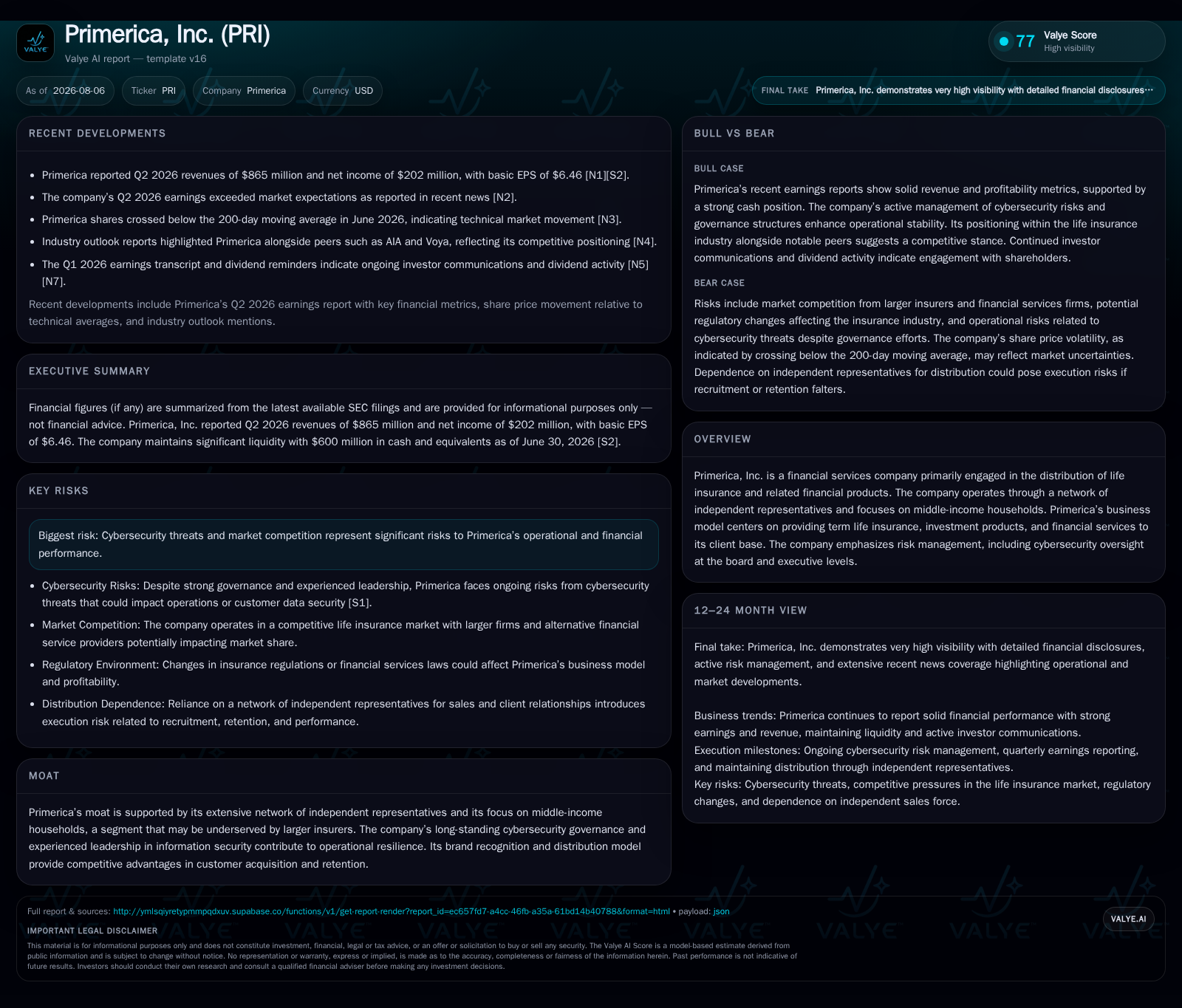
Primerica’s latest quarterly update reaffirms steady operating momentum driven by its large network of independent representatives focusing on term life insurance and complementary financial products for middle-income households. The company’s business model centers on risk-managed premium flows, commissions, and ongoing policy persistency, with adjusted metrics excluding investment volatility highlighting core profitability. Primerica’s competitive edge rests on deep distribution, brand recognition, and disciplined cybersecurity oversight amid rising digital competition and regulatory complexities. Key growth vectors include agent network expansion and cross-selling opportunities, while risks cluster around cybersecurity threats and evolving market preferences. Near-term performance should be tracked via active representative counts, policy issuance volumes, persistency rates, and adjusted operating income.
Recent Operating Update: Second Quarter 2026 Results
Primerica’s Q2 2026 disclosures indicate continued operational stability with adjusted operating revenues reflecting sustained direct premiums net of coinsurance cessions. The company maintains a clear emphasis on non-GAAP metrics—adjusted premiums, operating income before taxes, and net operating income—that exclude investment gains/losses to provide consistent comparability across periods affected by market volatility [S2][S3][S4]. Notably, adjusted operating income before taxes showed improvement relative to prior quarters, signaling healthy underlying growth despite broader market uncertainty. This refined view isolates core insurance distribution activities from asset valuation swings which have historically obscured performance analysis.
Business Model Analysis: Independent Agent Network and Middle-Income Focus
Primerica operates predominantly as a distribution-focused financial services firm specializing in term life insurance policies sold through a broad network of independent representatives. Its primary clients are middle-income households—a segment often underserved by traditional insurers offering more complex or whole life policies [S1]. Revenue is generated primarily as commissions derived from premiums collected on term life insurance policies alongside ancillary financial products including investments and advisory services
The company effectively manages risk exposure by engaging in coinsurance transactions initiated at its IPO stage that offload portions of underwriting risk to reinsurers. These agreements continue to wind down as legacy policies expire, steadily increasing the proportion of premiums fully earned by Primerica without cession [S4]. This enhances the predictability of net premiums earned over time.
Agent recruitment, training, and retention are core strategic pillars as they drive new premium generation. Agents receive commissions on new sales as well as renewal streams conditioned on policy persistency. Persistency rates — the fraction of policies that remain active over time — directly impact future commission revenue visibility, making it a key performance indicator for Primerica's longer-term earnings quality [S1]. The model also leverages scalable customer acquisition cost dynamics due to low fixed selling expense relative to revenues.
Industry Structure and Competitive Position
Primerica sits in the insurance distribution layer between upstream carriers (life insurers underwriting risk) and end customers seeking affordable life protection. It resembles peer categories including firms like Aflac and direct-to-consumer platforms such as Haven Life but differentiates by targeting middle-income families with an extensive face-to-face independent agent network rather than relying solely on digital channels or captive agents. This approach provides personalized financial advisory coupled with policy sales that build trust within communities.
The company's competitive moat draws from its established brand recognition in this demographic segment combined with a proven network effect across thousands of independent agents who contribute to customer acquisition at relatively low marginal cost. Cybersecurity governance is highly institutionalized—integrated at board level with quarterly reporting from a veteran Chief Information Security Officer—and represents a critical element safeguarding sensitive policyholder data amid intensifying cyber threats targeting the financial sector [S1]. Maintaining this operational resilience is crucial given increasing digital integrations.
Growth Drivers
Key growth avenues include expanding the number of active independent representatives who serve as sales and advisory conduits into untapped middle-income markets. Strengthening agent productivity through technology enhancements also supports rising policy issuance volumes per representative. Simultaneously, Primerica captures incremental revenue by cross-selling complementary financial products alongside life insurance policies—such synergies improve client retention and broaden wallet share per household.
Demographic factors such as growing awareness of life insurance importance among aging middle-class consumers underpin structural demand growth. Moreover, macro trends favoring term life insurance—due to its affordability relative to whole life alternatives—align well with Primerica’s product focus. Enhancements in underwriting tools may further streamline policy approval processes boosting conversion rates.
Risks and Constraints
Despite these positives, Primerica faces risks typical for distribution-centric insurers: cybersecurity threats pose material operational risks despite strong governance frameworks; failure to attract or retain qualified agents could constrain new business generation; regulatory changes impacting financial advisory or insurance sales practices could alter permissible product offerings or compensation models; and shifting consumer preferences driven by digital-native competitors threaten traditional agent-driven sales models.
Additionally, dependence on third-party insurer partners exposes Primerica indirectly to carrier capacity constraints or unfavorable pricing terms [S1]. Persistency risks represent another watchpoint—as lapses reduce renewal commission inflows impacting revenues long-term. Lastly, volatile capital markets affect investment product attractiveness bundled within Primerica’s offerings potentially affecting cross-sell efficacy
What to Watch Next
Investors should track upcoming quarterly filings closely for trends in adjusted operating income excluding investment gains/losses—a cleaner signal of core insurance distribution performance. Monitoring the number of active representatives provides insight into channel health and new business pipeline potential. Policy persistency changes will signal customer satisfaction and future renewal revenue flows.
Additionally, incremental disclosures regarding digital capabilities enhancing agent productivity or client engagement may indicate sustainable competitive differentiation over emerging direct-to-consumer platforms.
Financial Profile Discussion
As of June 30, 2026, Primerica reported cash and equivalents totaling approximately $600 million without any reported debt outstanding—reflecting a strong liquidity position supportive of ongoing operations and potential share repurchases or reinvestments [F1][S2][S3]. This zero-debt stance aligns with typical profiles for distributor-focused firms that avoid high leverage given the nature of recurring commission revenue streams.
Revenue data anchored at year-end 2025 was reported at approximately $3.29 billion; while trailing net income was last disclosed as $470 million during calendar year 2024 [F1]. Management's use of adjusted metrics clarifies profitability free from mark-to-market investment noise which can otherwise distort earnings cycles common in insurance-related businesses reliant on invested asset yields.
Overall, Primerica's financial footing appears stable with capital adequacy supporting agent network scale-up initiatives alongside measured investments in technology platforms critical for future competitiveness.
Disclaimer: This analysis is based solely on publicly available information including recent SEC filings and industry context frameworks. It does not constitute investment advice or research views concerning specific securities.
Disclaimer: This is research-only, informational analysis and not investment advice. It may include AI-generated interpretation and general industry context. Always verify important details using primary sources.

Comments